


Oddball. If you look it up, the term refers to an eccentric person. Okay, so how do you define an eccentric person? If you fall under that category, you’re labeled as unconventional and slightly strange. Slap the terms together, and you’re labeled an atypical, bizarre, eccentric or nonconforming individual, especially one having beliefs that are unusual but harmless.
Well, folks, I’m here to confess that I’m a bit of an oddball — and proud of it. I don’t think you’d realize it upon our casual meeting, but if we start talking about our sporting likes and dislikes, I can only guess you’d walk away shaking your head.
For instance, I like old bamboo fly rods when anything newer is admittedly better (not nearly as classy); I drive a Honda pickup (don’t you body-on-frame guys even start). You like German shorthairs or labs, and I like English cockers and Gordons. You shoot a 12 or a 20 autoloader, and I grab a 28 or 16 side-by-side.
If you bothered to stick around for the conversation, that list could grow pretty quickly. I often welcome a friendly squabble about such choices where each of us aims to convince the other of their error in opinion. I have to admit that sometimes, while defending my choices, I’m not sure if I’m trying to sway the opposing view or attempting to convince myself that I’m right.
For instance, let’s examine my choice of shotguns and their gauges. With the dove opener coming up Sept. 1, followed by the traditional small game seasons in November, it’s a good time to start getting in some range time to dust off our shooting skills.
Like nearly everyone who hunts in North America, I’ve used the 12-gauge extensively for everything from deer and geese to Hungarian partridge and quail. I’ve shot lots of trap, skeet and sporting clays with the gauge, and I must say it’s a do-all tool.
After a few years of pumps and autoloaders, I gravitated to two-barrel guns, either stacked or lying side-by-side. I found the twin-barrel setup to be more compact, better balanced and often lighter than their pumpand auto counterparts. Having two barrels also allowed for having different chokes in each, either those that are bored into the tubes or threaded into the muzzles. Those facts all score well for the 12-gauge twin barrels that I’ve often favored — even if it does only give me two shots.
Nevertheless, I haven’t shot a 12-gauge much outside of the target ranges for years.
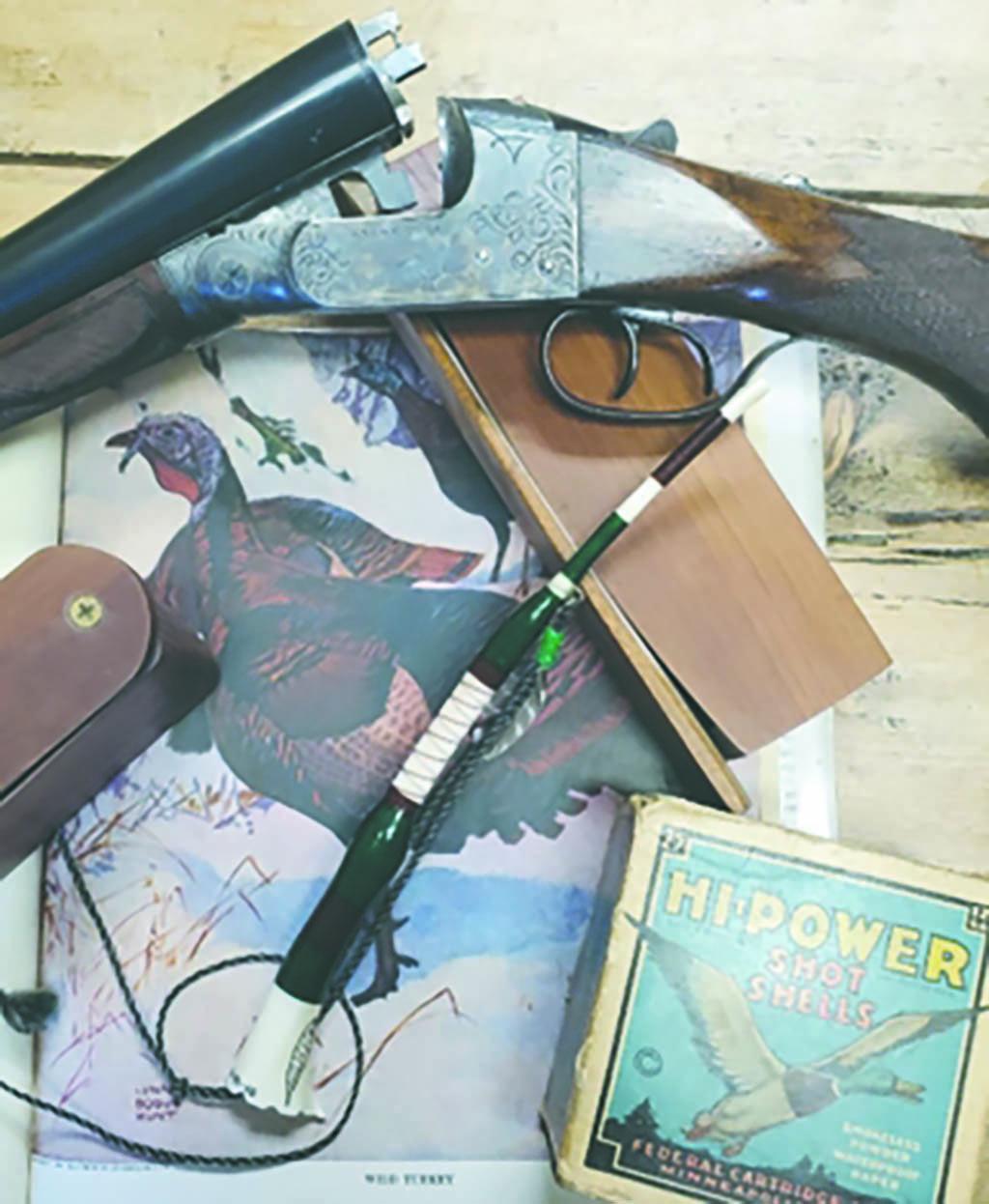
Beginning in the 1930s and into the 1950s, outdoor writers (they have to be correct, right?) have said that there is a shotgun out there that “carries like a 20 and hits like a 12.” They were referring to the 16-gauge shotgun, a chambering that has become one of my favorite upland choices. The trick for a 16 is to find one that was built around the 16 or even a 20-gauge frame. That’s what reduces the overall weight of the gun.
I have two that are as light as any of my 20s, a Merkel 1622 which tips the scale at six-pounds and a Browning Feather Citori that’s really a banty-weight at five and three-quarters. As I’ve gotten older, I especially like the fact that they don’t carry like a sack of bricks, while making it quicker to the shoulder.
I’ve also grown very fond of twin-triggers, allowing for a much quicker barrel selection when I’m in a hurry. The light weight of those 16s does cause them to bounce a bit during recoil. While choosing one built on a true 16 rather than a 20-gauge frame adds a little weight, they tend to be just a bit easier on the shoulder. I suggest that you stay away from 16s on 12-gauge framed guns. If choosing one of those, you might as well stick with the 12.
I reach for the 16 for about half of the upland hunting trips I take. As I mentioned earlier, my other favorite is the 28-gauge. First, I’ll confess that the 28 does have a bit of an emotional connection. My father hunted with an old 28-gauge Iver Johnson Champion single-shot — not a great gun when they were built, but a utilitarian tool. It got stolen years ago while I was working on the east side of the state; someone decided that locked doors were no deterrent and that a barking dog could be beaten into quieting down.
Most 28s are built on very light frames, and the doubles and stack-barrels are a joy to handle. Firing only 3/4-once of shot, it’s about as small as I ever recommend for most upland hunting — no offense to you .410 shotgunners. The lightweight of the 28s can make swinging and follow-through difficult, forcing hunters to think about each shot. On the other hand, for the quick point and shoot necessary during the flurry of feathers of flushing woodcock, grouse and quail, it performs way above its weight class and barely gives your shoulder a nudge.
What makes the 28 and the 16 so effective isn’t only their light weight, the double guns I favor, or their balanced quickness. Their impressive game-taking ability comes from something called a “square load.” The shot in the shells is in balance with the cartridges’ length and volume. If looked at from the side, the stacked shot inside has an almost perfectly square profile.
When fired, that compact square load delivers more shot to the target at the same instant, reducing the length or stringing of the shot column while it’s in flight. The load hits flying targets quickly and decisively. As more shot is added to allow for more shot, the length of that shot column outgrows its “squareness.”
The now exaggeratedly elongated shot strings result in more pellets passing both in front of and behind the target. This is what makes a 3/4-ounce load from a 28 far superior to the same amount of shot from the smaller .410-bore firing its long, skinny shotshells.
Each shotgun gauge was designed to have a sweet spot for load efficiency, striving to come close to that square load. For general use, they tend to deliver the best results under most circumstances. They are:10-gauge: 1 ¼ to 1 3/8-ounces; 12-guage: 1 1/8-ounce; 16 gauge: 1-ounce; 20-gauge: 7/8-ounce; 28-gauge: 3/4-ounce; 410-bore: ½-ounce.
Heavier powder charges and shot volumes are available for all of these shotguns and each have their place. Most upland gunners using lead or bismuth are well served by sticking with the old “square shot” rule. It’s interesting to note that shotgun gauges were named by counting how many spherical lead balls would slide down the barrel to equal one pound. The 410, not being a gauge but a bore size, is named after that measurement.
For waterfowl, turkeys and late-season wild flushing pheasants, heavier loads are recommended except for closely decoying birds, the type of hunting in which the 12-gauge shines.
Nontoxic shot requirements for waterfowl and some other hunting areas pretty much throw the square load idea out the window. Steel lightens the weight while lengthening the load, while TSS (tungsten super shot) brings a whole new set of dynamics to the hunting fields – it’s both incredibly effective and equally expensive.
Now that you know how I analyze choosing a hunting shotgun, bet you’ll never ask me why I like English cockers and Gordons. I warned you I was a bit of an eccentric oddball.
“Do not fear to be eccentric in opinion, for every opinion now accepted was once eccentric.”
— Bertrand Russell
(Jim Abrams was raised in rural Columbiana County, earning a wildlife management degree from Hocking College. He spent nearly 36 years with the Department of Natural Resources, most of which was as a wildlife officer. He enjoys hunting, fly fishing, training his dogs, managing his property for wildlife and spending time with his wife Colleen. He can be reached at P.O. Box 413, Mount Blanchard, OH 45867-0413 or via e-mail at jimsfieldnotes@aol.com.)