
Medina County celebrated its 181st County Fair from Aug. 3 through Aug. 9. Fair week is one of our office’s favorite times of the year because we get to interact and connect with community members from all backgrounds.
Much of our discussion is focused on our involvement in assisting landowners to choose the best practices for preserving the natural resources on their property.
For America 250, our booth was decorated similar to many of the rest of the displays: red, white and blue. We highlighted the past 250 years of land use history in America, starting with western expansion into the frontier all the way to where our land practices have brought us to today. A timeline showing the history of Medina Soil and Water Conservation District, depicting the inception of the Soil Conservation Service and the events that brought the desire to preserve our natural resources into view. We recognized last year’s conservation award winners throughout the county as well as advertised what our office has in store moving ahead.
Hay show
On top of our fair booth, the soil and water office also assists with judging at the Hay Show. These past two years have been outstanding for the Junior and Open Class hay exhibits, with almost 50 hay bales entered into the contest this year.
Hay is judged and scored in separate categories based on a standard for small square hay bales. The first criterion is the stage of maturity at harvest. Hay made at the proper maturity will have minimal seed heads, softer stems, and more leaf surface area.
Leafiness is the second category, and the overall leafiness of a bale depends on the moisture content of the hay when baling. If it’s too dry, the leaves will fall off in the field, reducing the nutritional value of the bale. If the bale is too wet, it may not dry properly and may mold, or in some cases, heat up and start a fire. The color of the bale does not necessarily indicate nutrient quality; it just makes them more appealing. Making sure a bale is free of weeds or foreign material is also important when judging the condition of the bale. The final criterion is the condition of the bale. Are they square, packed tightly with clean edges? Less important for scoring and feeding purposes, but for ease of keeping and storage, it’s an important part of making quality hay.
Rolling river
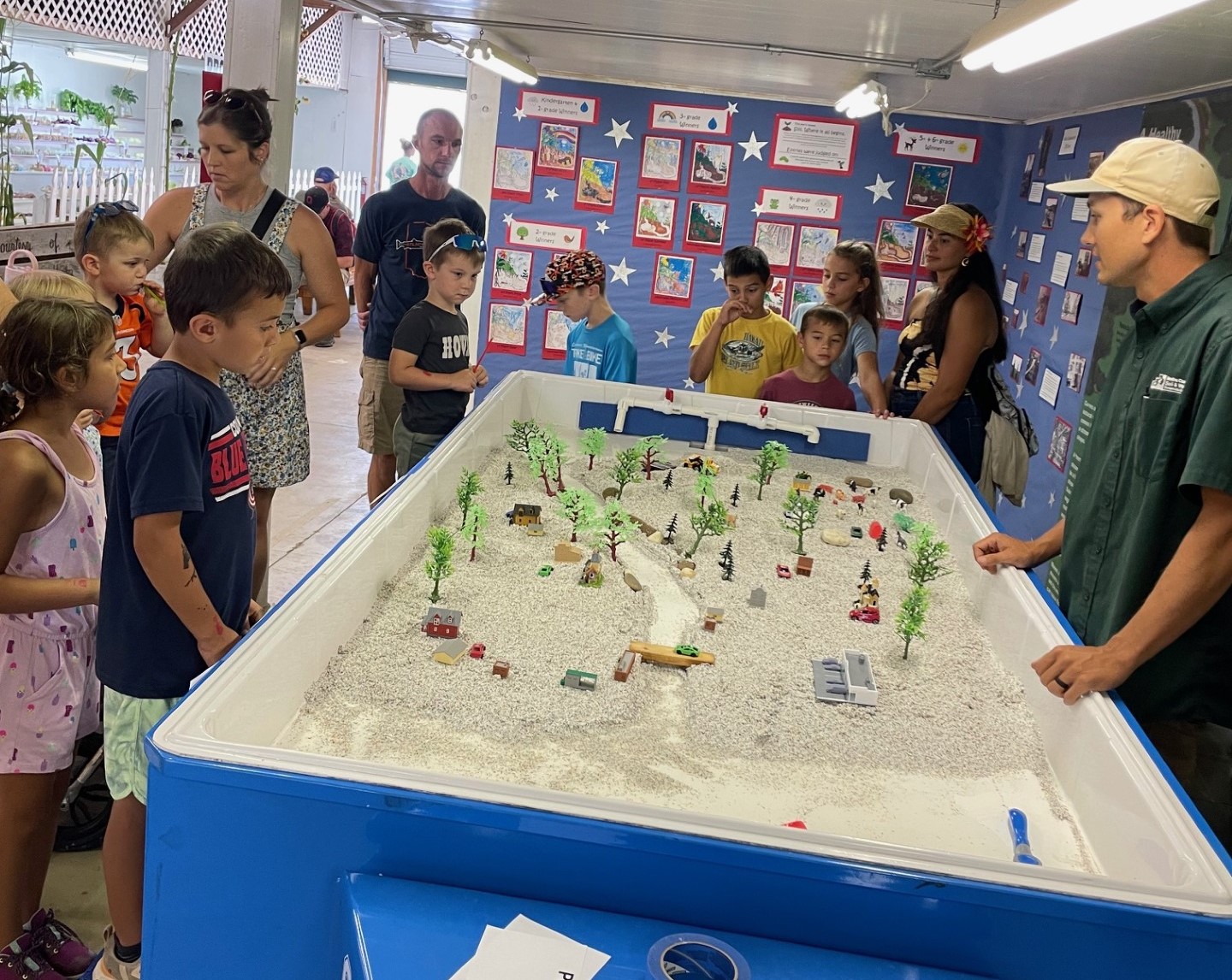
This year we added a new piece of equipment to our inventory: a large blue trailer with a hand-made landscape and what appeared to be a stream throughout the center of it all. This trailer is our Rolling River stream trailer. It’s a grant-funded project that our office acquired this spring, designed to show folks how our streams and watersheds interact with different land uses.
We can build an array of riverine systems — from meandering, heavily vegetated streams with reinforced banks that you might find in natural areas, as well as straight-line, channelized ditches with minimal vegetative cover as we see in commercial and industrial areas. Having the ability to bring a larger-scale model that’s interactive for groups of all ages to educate them on how what we do on our land impacts not only your own ground, but everything downstream as well.
Soon, the Rolling River stream trailer will be available for Medina Soil and Water staff to take to school events and field days to highlight how streams interact with our everyday lives!
The words “bringing the stream to you” written on the side emphasize the push for education on the best ways we can interact with our waterbodies.
If you’d like to know more about Medina County SWCD’s involvement with the fair or would like to check out our new stream trailer, give us a call at 330-722-9322. We’d be happy to connect with you.