




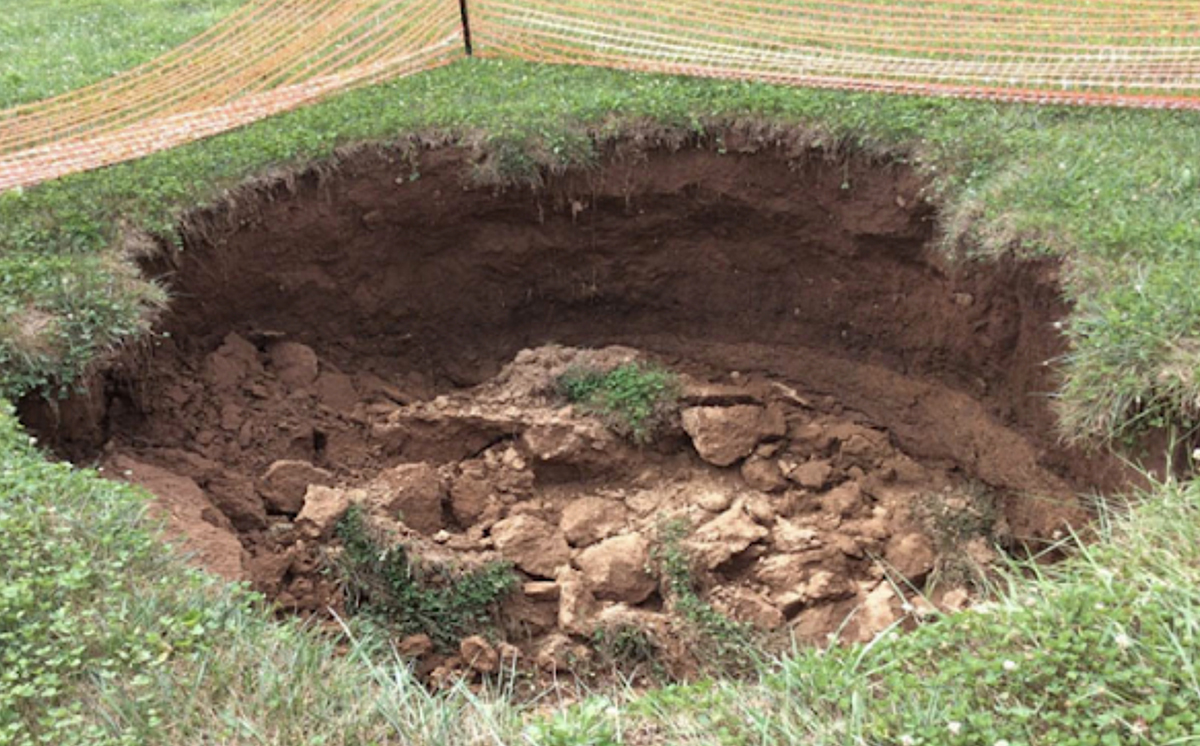
Hey, did you know that soil has a sadness emotion? Yep, after a sinkhole forms, the ground gets a little depressed. OK, shake your head and roll your eyes. Seriously, in more recent times, we’ve seen the emergence of sinkholes in the unlikeliest of places. Folks want to know what a sinkhole is, are they safe and what should they do about it.
Do we know enough about sinkholes to determine if they’re merely a nuisance or something more dangerous? It depends on what type of a sinkhole it is, where it presents itself and also what caused it to develop.
There are many definitions, but in short, a sinkhole is a geological event that forms a depression in the ground which is caused by an underground erosion, or the karst process of dissolution of soluble rocks. Sinkholes are also caused by drought, flooding, loose soil types, hydric-soil locations and man-made influences. That may sound like a lot, and it is, because there are a lot of conditions that contribute to the creation of the thousands of sinkholes in Ohio each year.
Sinkholes: Are they dangerous?
Sinkholes pose the biggest danger to property like building foundations, roadways, downtown streets or agricultural fields. The U.S. Geological Survey reports that they can cost Americans up to $300 million in damages each year. Are they dangerous to people? Not as much as you think. Deaths from sinkholes are very rare. If they’re small enough, they backfill on themselves and that’s the end of the event. If they’re large enough, the crater is big enough to let you know to stay away from it. The sizes range from a few feet to a few hundred feet.
What can cause a sinkhole?
Typically, each season presents its own reasons for a sinkhole. In late summer when everything dries up, the ground waters dry up, leaving voids in the water table where water once was. These voids no longer have the compressive water pressure for support, and the grounds above it tend to collapse. This leaves a hole or depression. Conversely, whenever there’s the torrential deluge of rain, the water tables flood creating the same swelling effect as fracking that expands the ground soils. This loosens the support and again, it collapses. One of the most common causes for sinkholes is the karst process, a chemical and mechanical erosion where the constant movement of waters on the aquifers dissolve the softer rocks like limestone, gypsum, dolomite and the salt beds. When these supportive rocks break down, the same thing happens and the grounds above collapse on the voids.
How can the effects of man-made influences cause any issues?
Well, that depends on your area. If you’re in an area that’s being developed, fracked or otherwise dug up for construction, these actions can change the underground drainage channels. Also, living in an urban area that puts a demand on well water that diminishes water levels, or the need for watering crops in an agriculture area can have the same geological effects. All of which can lower the water tables, and just like before, removing the supporting structures underneath the ground that provides an opportunity for the voids to collapse.
Another man-made influence could be the soils buried around a culvert, or drain pipe has eroded away which allows a sinkhole to develop around a buried pipe. One last possible culprit could be the old mine shafts in the area. As mine shafts fill with ground water the same type of karst process happens. Erosion takes place, and the support structures are dissolved and then the ground collapses.
We’ve been identifying what’s called a cover-subsidence sinkhole; these pose a mild risk, whereas a cover-collapse sinkhole are the ones that can be more destructive. These are characterized by a sudden collapse of the surface ground that rely on softer soils like clay which cannot support the weight of the land above, and it gives way. In both cases whether it’s a slow formation or a quick formation event, the ground will settle itself out.
There are many different reasons a sinkhole will develop and most will have the same end result. So, what do you do if you have one on your property? If it’s small enough and its not near a foundation or building structure, most likely you can just fill it in. However, if it’s near a structure, you should call your local county engineers office, mark it off and keep kids and pets away from it. You can also call the Ohio Department of Natural Resources Department of Minerals. They will guide you on your next steps. The more we know about planet Earth, the better stewards we can be.