


Have you ever been at a party and been accosted by a storyteller? Maybe it was about Aunt Mabel’s back surgery or an ancient high school football player’s Al Bundy-like recitation of his glory days on the gridiron.
As a wildlife officer and occasional outdoor writer, I’ve grown accustomed to being the target of such stories. You might think I’d grow tired of hearing one more “how I got that deer-turkey-fish” yarn, or another account of a hunting dog, a new shotgun or the good old days. But I haven’t.
While the stories themselves are often the same performance with a different cast and location, each storyteller brings something unique to the experience. Like a new recurve bow, that’s the draw.
Each episode is as individual as the person telling it. That’s the beauty of wildlife and the outdoors. We experience it in our own personal way, our recollections painted by the brush of memory. That’s why I feel compelled to listen.
When a story bubbles up, it’s no longer simply something we did. It has evolved into something we are. A good tale has the ability to transport listeners into memories of their own, and before long, they’re adding their stories to the conversation.
White whale
Matt Hoehn had the opportunity to live one of those stories. Matt was an Ohio wildlife officer supervisor and, like most of that particular ilk, enjoyed spending time outdoors. He’d heard his share of hunting anecdotes and could easily relate to the storytellers.
Now he had quite a tale of his own.
Matt bowhunted an 80-acre parcel of private land in Auglaize County, spending considerable time scouting the countryside and learning the habits of the deer that lived there.
While whitetails share certain behaviors, each deer is as much an individual as the property it inhabits.
In 2017, Matt had an opportunity to harvest an unexpectedly large whitetail buck during muzzleloader season. Unfortunately, opportunity doesn’t always translate into success. Buck fever had him shaking like a freshly mixed martini, and he simply missed.
Like Melville’s Moby Dick, the elusive quarry disappeared into its woody lair, only to resurface in occasional teasing glimpses.
Matt had never considered himself a trophy hunter, having taken only one buck in more than 20 years. While certainly not opposed to harvesting a big-antlered deer, he generally enjoyed filling the freezer with a healthy alternative food source.
He loved the process, understood conservation values and appreciated supplying his family with a valuable resource.
“I do admit that I pass up deer and small bucks. The majority of my deer harvests happen in January. I just enjoy being in the woods. I typically only buy one tag, because my 14-year-old son hunts. We get to spend a lot of quality time together, which makes this sport so much better,” Matt explained at the time.
Changing tactics
But now he knew there was a giant roaming his hunting grounds. Not one to use baiting stations, he began carefully reviewing his hunting tactics. Early on, he used two trail cameras, but his scouting gradually evolved into an old-fashioned boots-in-the-mud approach. He simply began paying closer attention to his surroundings and the obscure signs a buck leaves along its travels.
He also stepped up his practice routine with his Mathews Outback bow, three-pin sight and tried-and-true Muzzy Hybrid broadheads.
“I knew he was still around. I missed him in 2017, but had since seen him four times,” Matt remembered.
His work supervising wildlife officers gave him plenty of experience with deer and deer hunters. You might think that would give him an advantage. Or maybe not so much.
“My job actually almost cost me seeing the buck. I was talking on my phone to one of my county officers. There was a problem reported by a landowner who had witnessed a bowhunter shoot two antlerless deer and never tag them. As soon as I put the phone in my pocket, I looked up and the buck was 25 yards away,” Matt recalled with a wistful smile. That encounter was another reminder that the buck was still nearby.
Matt became increasingly selective about the days he hunted. Limited in how he could approach the property, he entered only when the wind was favorable and would help keep his scent from betraying him.
He avoided areas where he believed the buck spent most of its time, instead hunting the edges of its suspected territory. He began finding basswood trees 8 to 12 inches in diameter scraped and stripped of bark. The buck was leaving little doubt about who ruled that kingdom.
“On the morning of Nov. 13, 2018, I used a climbing tree stand because of the northwest wind. I positioned myself in a pinch point along a travel corridor. There wasn’t much action until 9 o’clock when a lone doe walked past at 40 yards. Then a button buck at 10 o’clock. He came in right after that looking for the doe. It happened extremely fast,” Matt recalled.
This time, buck fever didn’t have an opportunity to spoil his aim. The arrow flew true, and the buck was taken cleanly.
“After it happened, I was a mess and called my wife, Nicole. She kept asking me what was wrong, because, I’ll admit it, I was crying. You put so much time and effort into it. It’s rewarding when it all comes together,” Matt said.
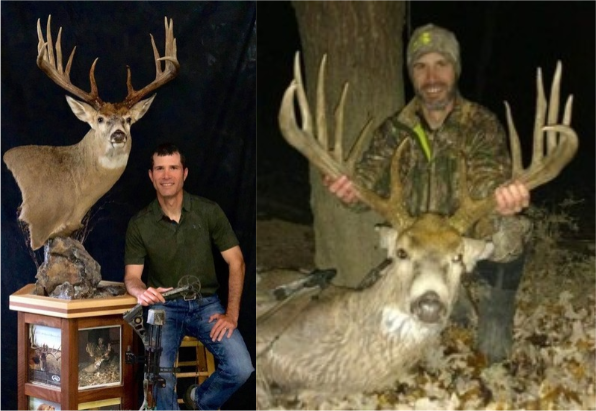
Although the buck’s live weight was only 180 pounds, its antlers were extraordinary. Measured as a typical 12-point buck under the Boone and Crockett scoring system, it grossed exactly 199 inches and netted 186 2/8 inches. The Ohio Big Bucks organization classified an additional point as an abnormal common-base point.
Under Boone and Crockett’s non-typical classification, the rack grossed 206 3/8 inches and netted an even 201 inches.
“I’ve hunted there for the past six years and have never seen anything like that deer before,” Matt said.
And the story didn’t end there. The taxidermist sent photographs of Matt’s buck to North American Whitetail magazine. Editor Gordon Whittington requested permission to feature the hunt in the October 2019 issue, putting Matt and his remarkable deer on the cover.
At the time of its initial scoring in 2019, Matt’s buck ranked as the fourth-largest typical whitetail taken with a bow in Ohio. By 2022, it had slipped to eighth place. Today, it stands at a still-impressive 34th on the state’s all-time list, a tribute to Ohio’s remarkable deer hunting opportunities.
You know, listening to Matt’s story reminded me of my first buck. I missed my alarm that morning and…