



Most anglers have enjoyed the electronic revolution to the point that many don’t recall ever being without simple depth finders. That technology has replaced the “best guess” and depth charts for those trying to keep their propeller attached to their boat or from the worst case of running completely aground.
Those depth finders have come a long way. While many boaters still maintain a simple digital depth reader, dedicated anglers most often choose the more recently developed models, which can show intricate details of what was once hidden deep beneath the surface.
Besides reading the depths and warning of submerged obstacles and reefs, these gizmos identify fish-holding structures, movements of fish swimming singly or in schools and even the approximate size of those fish. This information can help confirm the angler’s target location, how deep the fish are swimming, and, based upon experience, the likelihood of what kind of fish they’re seeing and the methods and lures best suited for the situation. Hot spots can then be stored in the gear’s electronic brain so that the angler can return to the same location at any later point.
To me, this is something I like to call magic. I can’t fathom how they interpret these fathoms or exactly how they work, so I set out to get some basic understanding of how these gadgets operate.
How to find them. Most of us have seen a movie where the submarine is underwater and a loud “pinging” is heard as some overhead ship tries to locate it. This is the basis of sonar, the acronym for Sound Navigation Ranging. It was originally used to help explore and map the depths of a lake or ocean. It also became useful in locating objects such as the hidden submarine. Think of it as underwater radar.
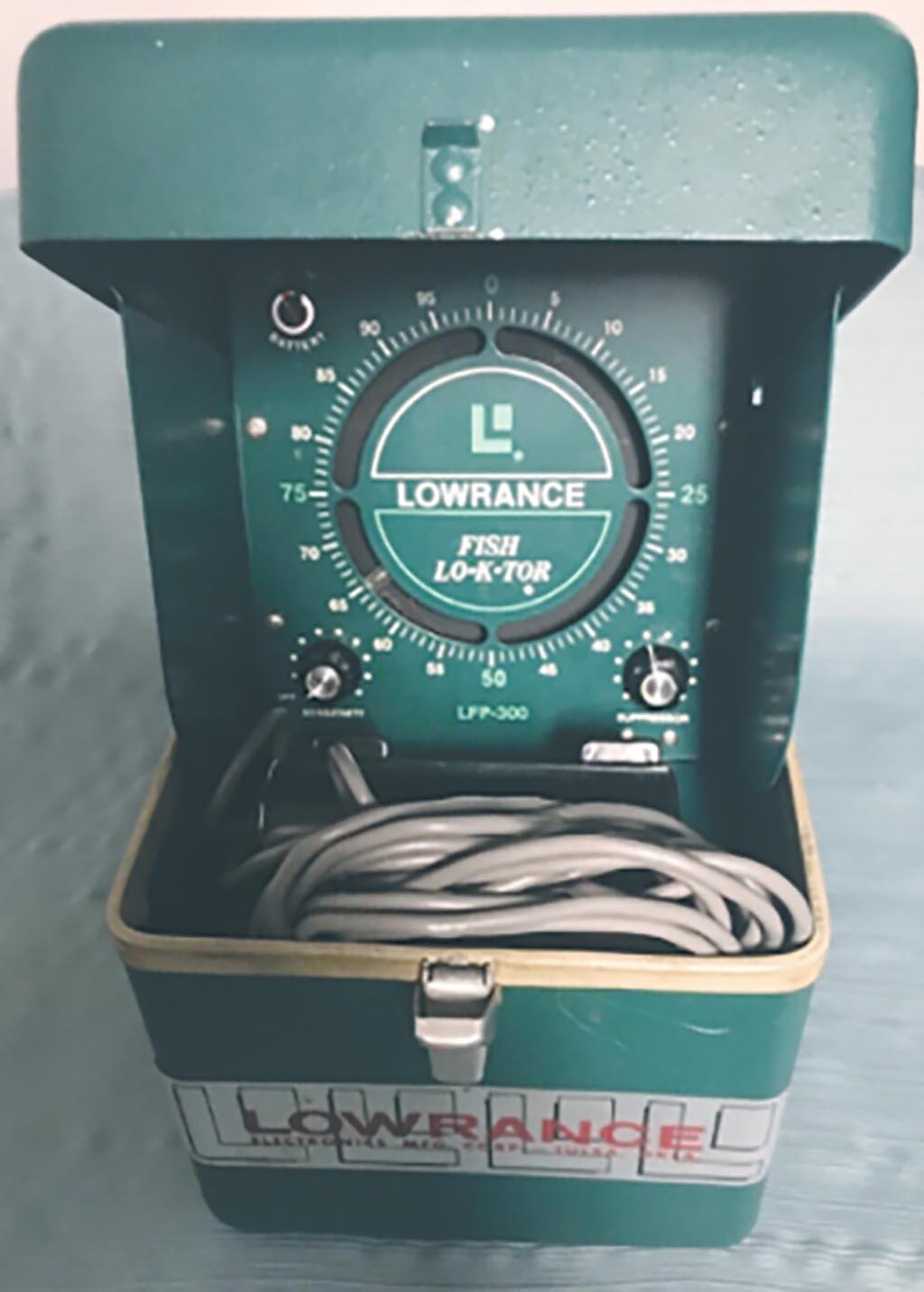
These new fancy fish finders are an extension of that sonar technology, which was adapted into becoming a fishing tool. The earliest “sporting” models were simple depth flashers that could also detect fish swimming through the area. These would show another “flash” on the clock-like face of the unit’s dial. They were effective, and many are still in use, even though that technology has been pretty much swept away since the 1990s. They’re still regularly found at flea markets and garage sales.
Today, LCD screens and advancements in technology have netted a lot of anglers, put the hooks into their wallets, while gaffing them for as much as $4,000 for the very best. Fortunately, there are plenty of options that won’t break the bank. Specialty books and a lot of expert authors often weigh in on selecting the best-suited fish-finding and underwater lake analysis — but this column isn’t one of them.
Where to go
What good is a fish finder if you don’t know where to go or what area offers the best angling opportunities? Once again, we enter the age of technology.
A couple of years ago, during an outdoor event geared for outdoor lovers, then Ohio Lt. Gov. Jon Husted announced, “The best places to fish are usually kept secret, but not in Ohio. Now anglers can find out where the fish are through the DataOhio Portal that provides data-driven guidance on the best fishing opportunities across the state. This tool is designed to take you where the fishing is the best, but figuring out how to catch them is still on you.”
The DataOhio Portal is an information-loaded site and is the centralized location for state of Ohio data for agencies, their partners and citizens, helping to inform programming and policy by combining data from across state government. The portal currently features over 300 datasets.
Within this site, you can now access the Where to Fish, Sport Fish Report, Angler Survey and Waterbody Report tools, which include interactive maps, graphs, and table surveys that allow you to customize your search based on criteria that are most important to you.
The Where to Fish tool equips anglers with a guide on where they’re most likely to find the best fishing opportunity based on their interests and criteria. Users can enter the radius in which they are willing to travel, their sport fish species of interest and other fishing factors.
The Sport Fish Report tool displays relative abundances (catch per effort) based on a user’s selections of species of interest.
The Angler Survey tool combines the outcomes of angler surveys for a waterbody and year of interest. For users interested in where anglers go most often to catch fish and how many are caught per hour, visit: data.ohio.gov/wps/portal/gov/data/view/angler-survey
The Waterbody Report can be used to select favorite locations and review changes in the sport fish abundance, size and structure throughout time. In addition, you can view the average length-based growth data by species. It can be used in identifying the sport fish in favorite reservoirs, streams or pools of the Ohio River.
You shouldn’t forget to also download the free HuntFish OH mobile app for your smartphone. It’s a great mobile path for hunters, anglers and shooters to access licensing, game check, fishing regulations, an interactive fishing map, and much more — all ready to be explored with your fingertips.
Whether you’re a landlubber or a waterdog, you can now use your smartphone or laptop to help preplan that next fishing trip. Then, if you have a fish finder or just a dose of fisherman’s luck, maybe you’ll be having a fish fry during the upcoming holiday or celebrating a new “Fish Ohio” trophy. Regardless of the fish you catch, this might land you another reason to keep casting your rods.
“Most of the world is covered by water. A fisherman’s job is simple: Pick out the best parts.”