




Wandering through a woodland as darkness folds over twilight often frightens people. We’re each preprogrammed to have an instinctual fear of the dark. That anxiety begins while we’re children as we imagine creatures hiding under the bed or waiting in the shadows. Human eyesight is not as keen as many land-roaming creatures, and our sense of smell can’t pick up the slack as darkness descends around us.
Our ancient ancestors knew this fear to be real. When darkness fell, the entire world shifted into something that felt supernatural. They lived among large animals that often became more active at night, hunting for their next meal. The more predatory of our own species also recognized that this was the time when others of their kind were most vulnerable. Folktales of werewolves, goblins and vampires permeated their stories, and highwaymen would often hide along seldom-traveled roads. All of this strengthened their collective apprehension of nightfall.
Fortunately, today we tend to grow out of most of that fear as experience tells us that no vampires are waiting outside of our windows and that stubbed toes are the biggest threat. Even though we have overcome much of that anxiety, many still feel an unease when entering darkening woodlands. While there are still large and potentially dangerous predators in some parts of the world, those places tend to be remote areas where only the woods-wise venture out. Today, getting lost is likely the worst of our fears, yet being unprepared for the elements or an accidental injury can prove a greater risk.
For me, the night’s darkening cloak brings back the magical. Not the superstitious fears of our ancestors, but the thrill of a new world coming to life. Walking quietly down a trail without the use of a flashlight allows my vision to become surprisingly sharper. I am more aware of faint scents and sounds often ignored during the day. The rattle of dry leaves made by a scurrying deer mouse, the baritone booming of distant bullfrogs, a mockingbird’s chattering to the stars, the clatter of spring peepers and the unexpected snort of a doe attempting to identify this intruder become the symphony which fills woodlots and forests with an enlightening new perspective.
There are certain sounds that appeal to me the most. Night flights of geese discussing their migrating travels, the rarely heard Whip-poor-will in Ohio’s unglaciated hills, the mournful trill of a screech owl and the lonely “peent” and chattering flight of woodcock. These sounds grab something deep inside of me, causing me to stop and listen as I hold my breath while taking in every note. When a group of coyotes howls into the night air, ancestral fears tickle the hair on the back of my neck as I stare into the darkness, expecting to see yellow eyes peering back.
Owls
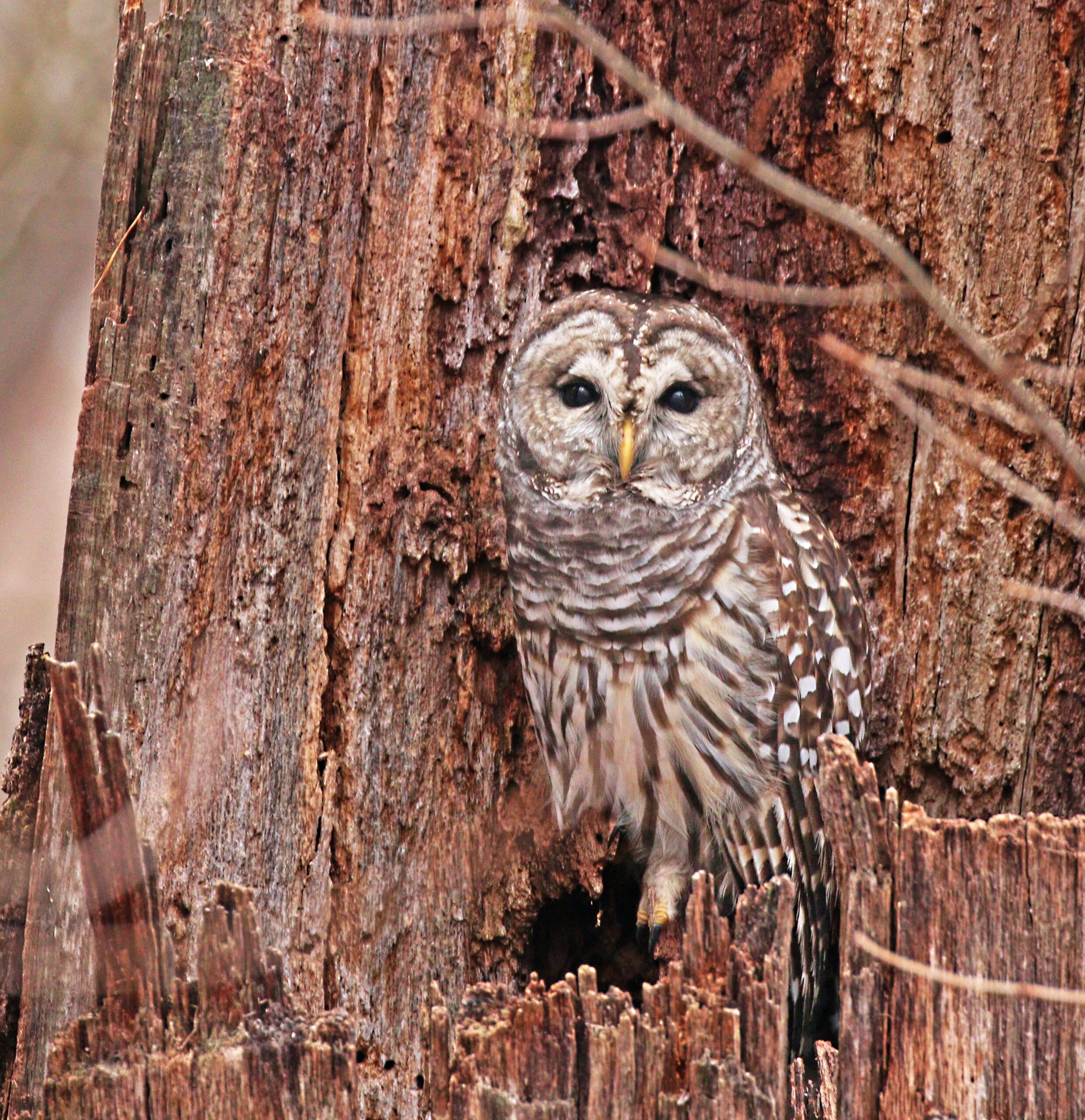
Then there is the unmistakable question that looms from the darkened riparian waterways behind our house. “Who cooks for you? Who cooks for you all?” The barred owl asks as he perches in the trees, his own night vision looking for that scurrying deer mouse to expose itself. If another barred owl should answer the question, a resounding argument may well be the result — the resulting racket dominating the night air.
Barred owls are brown-gray owls, lacking the ear tufts of the great horned owl. They have white spots on their back, white streaks on the belly that run lengthwise, and white bars on the neck and breast running crosswise. It’s these bars that gave the owl its name. It is also a large bird, standing 18 to 24 inches tall with a 3 1/2- to 4-foot wingspan.
They prefer larger tracts of deciduous forests, especially wet areas. They’ll find homes in wooded swamps, poorly drained woodlots and protected hillsides to drier, upland areas. Their preference for wetter sites has nothing to do with water. Barred owls live there because these areas are less likely to have been disturbed by timbering activities, which remove mature, deteriorating trees used by these cavity-nesting birds.
Barred owls hold a significant role in the control of a variety of rodents and, to a lesser extent, insects. Although these are the owls’ preferred food, they’ll feed upon a wide variety of small mammals, reptiles, fish and insects, including snails, slugs, spiders, bats, songbirds, woodpeckers, crows, crayfish and rabbits. Most of their hunting is done at night, although on rare occasions, they may be out during daylight hours.
Barred owls rarely build their own nests. They frequently use hollow tree cavities, old hawk, squirrel and crow nests, and on occasion, man-made nesting structures. Recently, my friend Bob Vargo and I cooked up our own idea for my river bottom owls. Repurposing a tree stand used for deer hunting, it became a platform for a new nesting box in the hopes of providing a secure spot for one of the big owls to make a home. Easy to access and clean, it may serve the purpose quite well. It might just coax their nightly discourse a little closer to my trails. If you’d like to build your own barn owl nesting box, visit: https://dnr.maryland.gov/wildlife/Pages/habitat/wabarrowlplan.aspx. Nesting begins in February, so now’s the time to build and scout areas for an autumn installation.
It’s always a great time to explore the awakening of those serenades of darkness. As the songbirds fall silent until sunrise, explore the world of the night. While there will be no wizards or magic dust, you may still become enchanted by what you discover.
“And into the forest I go, to lose my mind and find my soul.”
— John Muir






Loved this story! I, too, am a big fan of owls and am inspired to build a nesting box!