





Digesting the speed and scope of 2025 would take a book, not an article. Still, after months of conversations with farmers and decision makers across the Midwest, one truth stands out: The year earned its place among agriculture’s fastest-moving, yet most innovative of times.
“The way of getting things done might not look like the traditional route, and agriculture has to adjust to that,” said Brandon Kern, deputy executive director at the Ohio Soybean Council. There was no single road to progress.
Crops
When a federal government shutdown halted the U.S. Department of Agriculture’s crop progress reporting, farm publications (and farmers) lost real-time data. But, for many regions, final harvest numbers ended up on top with record yields.
For corn, one economist called out this year for having a “bin-busting national average yield.” Production nationally topped previous records by more than a billion bushels. Inside Ohio, county yields reflected both extremes. Wood County performance trials by Ohio State reported 106 bu/acre, the state’s low, while Wyandot County averaged 338 bu/acre. Meanwhile, national cash corn prices were down for the fourth year. The 2025 season-average price settled at $4/bu, down 24 cents from 2024, according to the World Agriculture Supply and Demand Estimates.
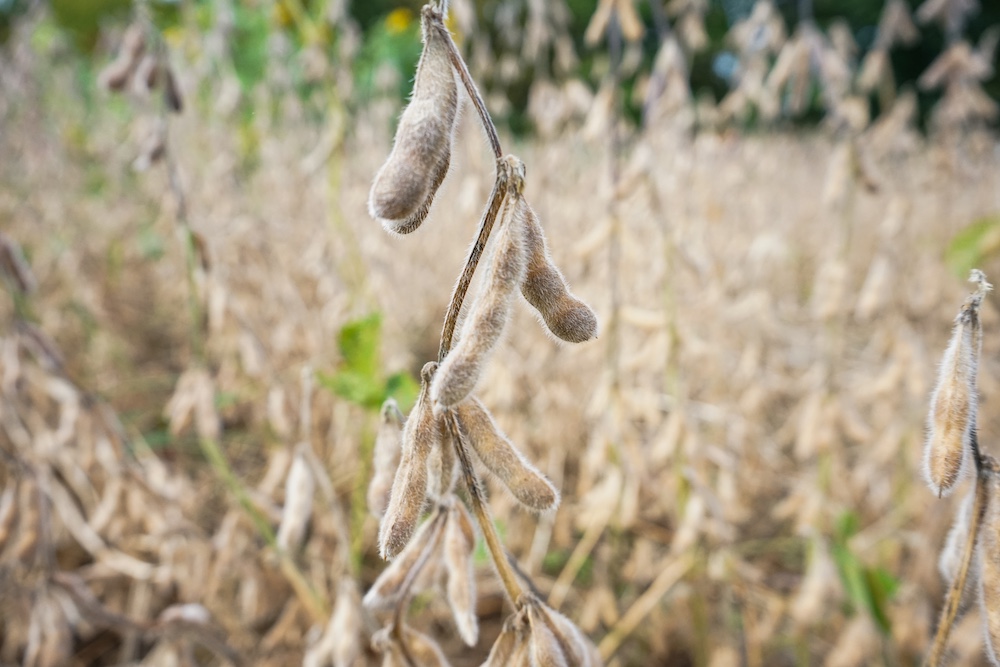
Soybeans also reached national yield highs at 53 bu/acre, although total U.S. production fell to 4.25 billion bushels due to reduced plantings. In Ohio, trial yields ranged from 64 to 79 bu/acre. National price projections hovered near $10.50/bu.
Many Ohio farmers never escaped persistent drought patterns. At the beginning of the year, $10 million in drought relief funding from the Ohio Department of Agriculture became available for losses tied to the 2024 season.
“Because of the dry weather, you couldn’t get the results,” said Darke County farmer Matt Aultman, who typically participates in research with the Agronomic Crop Network at Ohio State.
This winter, the Maumee River corridor still carries the drag of drought, and rainfall remains scarce. Some farmers, like Aultman, focused more on biological inputs as producers chased lower costs and healthier soils.
“We reduced almost all insecticide-treated soybeans to bring back biological life in the soil,” Aultman said. He also began interseeding 16-inch corn rows, reporting early success among neighbors: “There’s more daylight getting to the corn, plus nitrogen cycling between crops. Neighbors and I are seeing real yield benefits.”
Ohio politics
For an off-election year, Ohio remained relatively quiet. The Ohio Farm Bureau advanced its health care plan legislation through the chambers. The state biennial budget opened the door for expanded veterinary tele-health authority, a revised “apiary” definition and a controversial restriction on pesticide applicators. The provision changed the language of who may legally apply federally restricted use pesticides (RUPs). Family and employees supervised under license holders no longer had the legal ability to do the farm job without an applicator’s license. However, legislators worked to reinstall the exemptions and added it into House Bill 10 in December, a catch-all agriculture revisions bill, signed by Gov. Mike Dewine the Friday before Christmas.
Funding tensions also surfaced around H2Ohio. Although DeWine highlighted 2.5 million acres enrolled and strong phosphorus-reduction progress this year, his request for $270 million resulted in about $165 million for 2026–27. Policy groups say farmer cost-share funding remains protected — most cuts came from ODNR and EPA project budgets, including wetland initiatives.
Current Agricultural Use Valuation (CAUV) progress reignited again in December. Five related bills were introduced — not to change farmland assessment rates, but to evaluate school district millage impacts and how local revenue is distributed. The theme of the legislation is changing its “process and transparency.” But the revisions to reduce CAUV taxes are expected to be taken up next year.
Meanwhile, the 2026 gubernatorial race began early. Candidates Amy Acton and Vivek Ramaswamy spent the year traveling the state and attending events like the Ohio Farm Review, though neither offered public, detailed agriculture or energy policy agendas yet. In March, Ohio Corn & Wheat endorsed Ramaswamy — its first gubernatorial endorsement in 30 years.
Solar beyond peak
Even as “farms, not solar” signs remain across rural Ohio, utility-scale solar development slowed sharply. Three projects were approved in 2025, three remain pending and multiple counties enacted bans.
Dale Arnold, director of energy, utility and local government policy at the Ohio Farm Bureau Federation, explains that today’s construction stems largely from projects planned five to six years ago, after developers captured remaining transmission capacity.
“For the past 18 months, no new utility-scale solar project has begun in Ohio from scratch,” he said. “That wave is waning and working toward its finish.”
Yet, one agriculture in solar project that Ohio State University has partnered with is now being challenged in the Ohio Supreme Court. Oak Run Solar Project, a 4,000-acre agrivoltaic utility solar site will become the nation’s largest “agrivoltaics” project. Appealing the approval by the Ohio Power Siting Board, Madison County township trustees argue the board failed to meet statutory environmental and procedural requirements.
Outside court, the kitchen-table conversations still continue, just with different development pressure. The largest land use conversion continues to be housing development.
Over the past 20 years, Ohio has lost 270,000 acres of farmland — 48% to development. Delaware and Butler Counties saw the steepest declines, losing 9,547 and 6,975 acres, respectively, according to agriculture land loss data from Ohio State University.
But instead of renewables now, the lease request letters to farmers are from horizontal drilling in the Ohio River corridor, industrial development, transmission build-out and data-center growth.
“Electricity is becoming the fuel of choice,” Arnold said. Ohio now hosts an estimated 1,800 data centers, with consolidation accelerating. Farm families, he said, are “seriously looking at this” — weighing the benefits and risks of leasing land for a range of projects.
Trade strategy with a soybean deficit
During the 2024 campaign, President Donald Trump promised tariffs to reshape global trade. On Feb. 1, 2025, he signed an executive order imposing 25% tariffs on Canada and Mexico and 10% on China — only to delay implementation days later. Subsequent negotiations focused on smaller markets, leaving deficits in major destinations untouched for months.
Hit the hardest were soybean farmers. “In the short term, the trade strategy being pursued creates market disruptions,” said Kern, from Ohio Soybean Council. “It creates higher input costs, inflation and export losses for farmers.”
Tariff revenue later funded $12 billion in producer relief, announced in December, though Kern noted it covers only a fraction of losses. Even if China imports 12 million metric tons, that remains roughly half of last year’s volume, he explained.
Ohio, compared to other states, was able to weather the storm. “In Ohio, there’s been some regionality to basis,” he said. Some farms locked in prices early; others are still sitting on full bins and unsold grain. Kern warned that export access can erode permanently if agriculture isn’t vocal about trade priorities.
Federal policy
In Washington, the traditional farm bill framework did not survive intact. Major components were split and folded into multiple spending and tax packages. Just as farms diversify to stay profitable, federal policy is diversifying to find political will and funding for expanded crop-loss coverage, stronger price supports and evolving market protections.
Passed this summer, the One Big Beautiful Bill directed $65.6 billion toward ARC, PLC and DMC safety-net programs, amongst other pieces of the farm bill. It also included tax-relief measures that continued the Qualified Business Income Deduction, made Estate Tax Relief for family farms permanent and extended the Clean Fuel Production Credit.
Meanwhile, the rollback of DEI programs, paired with shifting budget priorities, saw the largest cut and freeze of $6 billion in cuts to U.S. science agencies. Land-grant universities are among the most affected, raising concerns about agricultural research capacity. Roughly 15,000 USDA employees accepted deferred resignation buyouts in 2025. And nearly 3,000 are expected to relocate to new regional working hubs by next year to better serve the USDA “customers” in rural America. Public comments on the reorganization plan revealed 82% discontent for this proposed change. The agency acknowledged it would continue with its plans regardless of public comment.
For Ohio, Highly Pathogenic Avian Influenza (HPAI) struck the poultry industry hard, again. At the beginning of the year, Ohio ranked third in the nation for outbreak cases. By March, the USDA reported 15.5 million birds depopulated, with smaller cases continuing into year’s end. The agency issued a five-point response plan, easing egg prices somewhat. Poultry farmers tell Farm and Dairy they remain on high alert this winter for avian influenza, as continued virus circulation among wild birds and migratory movement sustain disease risk to flocks.
This is Part 1 of a two-part series, beginning with a look back at 2025 before turning toward the outlook for 2026.




