




Across Ohio, landowners are receiving offers to lease their property for the development of oil and natural gas wells, pipelines or utility-scale solar projects.
While the state is regionally divided between the two, with shale development primarily occurring on the eastern side of the state and solar development being concentrated in southwestern Ohio (with some exceptions), the questions about legal agreements, construction and the oversight of both are similar.
It is important to note that the land after this level of disturbance will require mitigation, potentially renovation, and this often happens at the most inopportune times.
The bottleneck in the oil and gas industry has been and continues to be pipeline infrastructure. It really does not matter what side of the state you reside in, that pipeline easement/right-of-way can impact your farm any time of the year.
Get your priorities in line
It is important to realize that you and the pipeline company have different concerns when it comes to that easement. The pipeline company is worried about their timeline and erosion — as long as the ground is covered, they are covered!
You, on the other hand, have a much more complex system. Of course, you care about the timeline and erosion, but you also care about your crops, weeds, compaction, soil health and the time of the season this happens. That pipeline company will likely seed only once; what happens later is on you.
There are communication barriers that farmers need to be aware of. I have seen farmers state they desire cool-season forages, and that is what they got from the pipeline company, but it was seeded in July. Annual grass weeds came up, the foxtail prevented erosion and that was the end of that conversation.
Using cover crops just to mitigate damages and hold the land over for an optimal seeding could be an option for the landowner. Sometimes, you get what you wish for. But seeding something that your livestock does not typically graze can have consequences.
A ROW can easily be 100-feet-plus in width and stretch for miles. This can significantly impact pastures, and altering the species can have consequences for livestock diet and health. A lush growth of legumes coming out of a low-quality hay winter can cause livestock to bloat and cost you more than you anticipated.
Timing matters
When thinking about seed mixtures, consider what your livestock is used to and what machinery you have available. The “best” is not always the most beneficial.
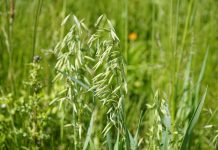
If we are talking about a July reseeding, we do not recommend warm-season perennials like switchgrass and big bluestem, due to the multi-year establishment protocol. Summer annuals, on the other hand, work very well in a July reseeding easement situation. Some options include sudangrass, sorghum-sudangrass, pearlmillet and teff grass. If we are getting into August and September, oats, triticale and annual rye grass would work well to graze or harvest in the spring.
There are some differences in what legumes and grasses provide for livestock. In general, grasses are highly adaptive to many seasonal fluctuations; they reduce erosion due to their interconnected fibrous roots, they hold in plants that have heaving potential, and are great at smothering out weeds when not overgrazed. The legumes will again provide nitrogen to the pasture, are typically higher quality than grasses, can increase the carrying capacity of the pasture based on the root system and plant structure and will reduce grass tetany.
As livestock owners, certain disorders such as grass tetany or bloat can cause sudden and serious issues. Either one can result in multiple animal losses. Without going into too much detail, grass tetany can be caused by a potassium and magnesium imbalance. Bloat can be caused by forge quality that is very high in energy and very low in fiber.
A well-balanced grass and legume pasture will mitigate these harmful disorders.
In most pasture settings, the most common legumes are alfalfa, red and white clover and birdsfoot trefoil. Each will offer different advantages and disadvantages.
Alfalfa advantages: excellent quality, very productive, good summer growth, good drought tolerance, excellent option for dual-purpose hay-n-graze (graze in summer).
Alfalfa disadvantages: requires high pH and fertility (potassium and phosphorus); requires good drainage; prone to insect damage; sensitive to trampling damage; bloat hazard.
White clover advantages: excellent quality, palatable, grows rapidly, spreads by stolons and fills gaps, tolerates poor drainage, can be no-till or frost-seeded. White clover disadvantages: low yield, lacks heat and drought tolerance, bloat hazard.
Red clover advantages: vigorous establisher, high yields, tolerates wet soil and low pH better than alfalfa, excellent for renovation by no-till or frost seeding, fairly heat and drought-tolerant.
Red clover disadvantages: generally short-lived, difficult to dry for hay, bloat hazard.
Birdsfoot trefoil advantages: can grow in adverse soil conditions like hard clay soils, salt-tolerant (close to roads), does well in wet and acidic soils (best at pH 6.5), prevents bloating in livestock.
Birdsfoot trefoil disadvantages: poor seedling vigor, requires reduction in competition for good establishment.
Prep work
Before any seeding work is done, the prep is extremely important. Try to include the steps below in your contract, as they follow the Ohio Department of Natural Resources’ Best Management Practices. Instead of adding fertilizer to the standard you have, add to the recommendation of the soil test for optimal results.
1. Prepare the soil (lime, fertilizer)
2. Control problem weeds the year before seeding.
3. Purchase high-quality seed of adapted varieties.
4. Inoculate legume seed with the correct and viable inoculant.
5. Suppress existing vegetation prior to seeding.
6. Calibrate and check all equipment settings prior to planting.
7. Use appropriate planting equipment and techniques that ensure good seed-soil contact.
8. Plant the best crop for the window you are given.
A farmer’s life can be tough, and life can dump work on you at the worst times. Remember your resources and reach out to agencies, friends and family and have those conversations about what you want or how best to mitigate unscheduled problems.
Dealing with pipeline easements can be a headache that persists if it is not undertaken with a thorough plan.