


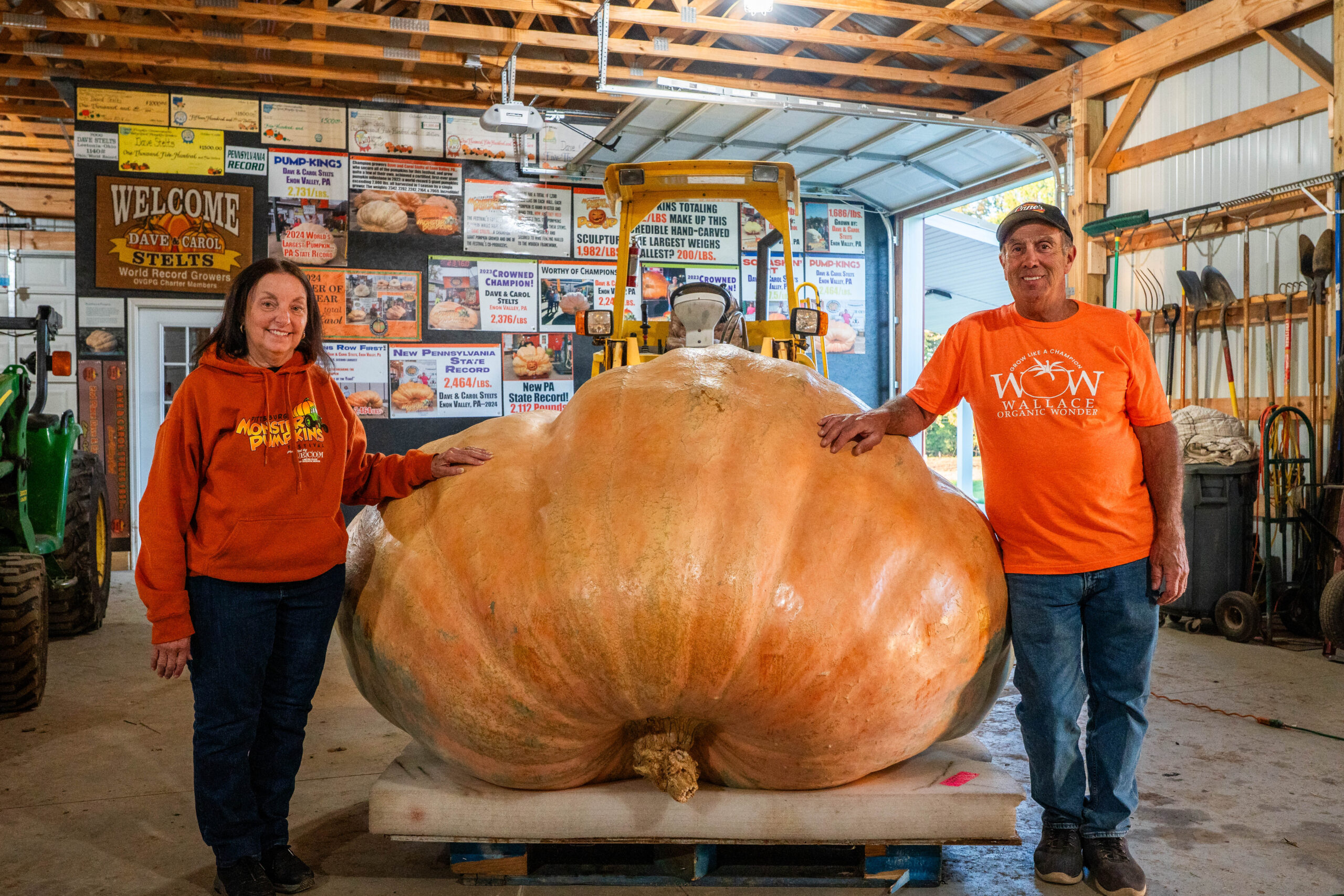
ENON VALLEY, Pa. — Dave and Carol Stelts took the crown for the largest pumpkin at the Ohio Valley Giant Pumpkins Growers competition on Oct. 11: a title the couple is becoming quite used to.
Out of 41 growers, the Stelts took first with 2,565.5 pounds — the largest pumpkin the couple has ever grown. The couple most recently broke the world record in 2024 and finished eighth in the world this year.
But growing a pumpkin is more than an October festivity. The Stelts spend most of the growing season planning and caring for the pumpkins, so when the leaves start to change, their giant pumpkins will be ready to rake in some new awards.
“Above all the winning and all the other stuff, and yes, we’re competitive, but boy, when you get moments (with the kids), it’s really nice,” Dave said. “It makes you feel good when you see the kids smile and the parents are happy.”
Where it begins
Dave first got into growing pumpkins with his dad, Jim Stelts, in the ‘70s. “My dad said the best part of growing back then that I did was talking to him,” Dave said, followed by a chuckle.
Dave grew up in Leetonia, Ohio, on a 55-acre property where his dad gardened before taking an interest in giant pumpkins. Together, the two regularly attended the Columbiana Street Fair and the Canfield Fair, participating in the biggest pumpkin contest.
“I remember our biggest we ever had was 131 pounds. I was so happy,” Dave said. “And then we had a guy come in with the 200-pounder and beat us.”
After a 12-year hiatus, Dave returned to growing giant pumpkins with his father in 1994, and joined the Ohio Valley Giant Pumpkin Growers.
Dave took notes at the meetings and adapted the information he learned to his own operation. The following year, Dave and Jim earned their first ribbon at the Ohio Valley Giant Pumpkin Growers’ first international competition.
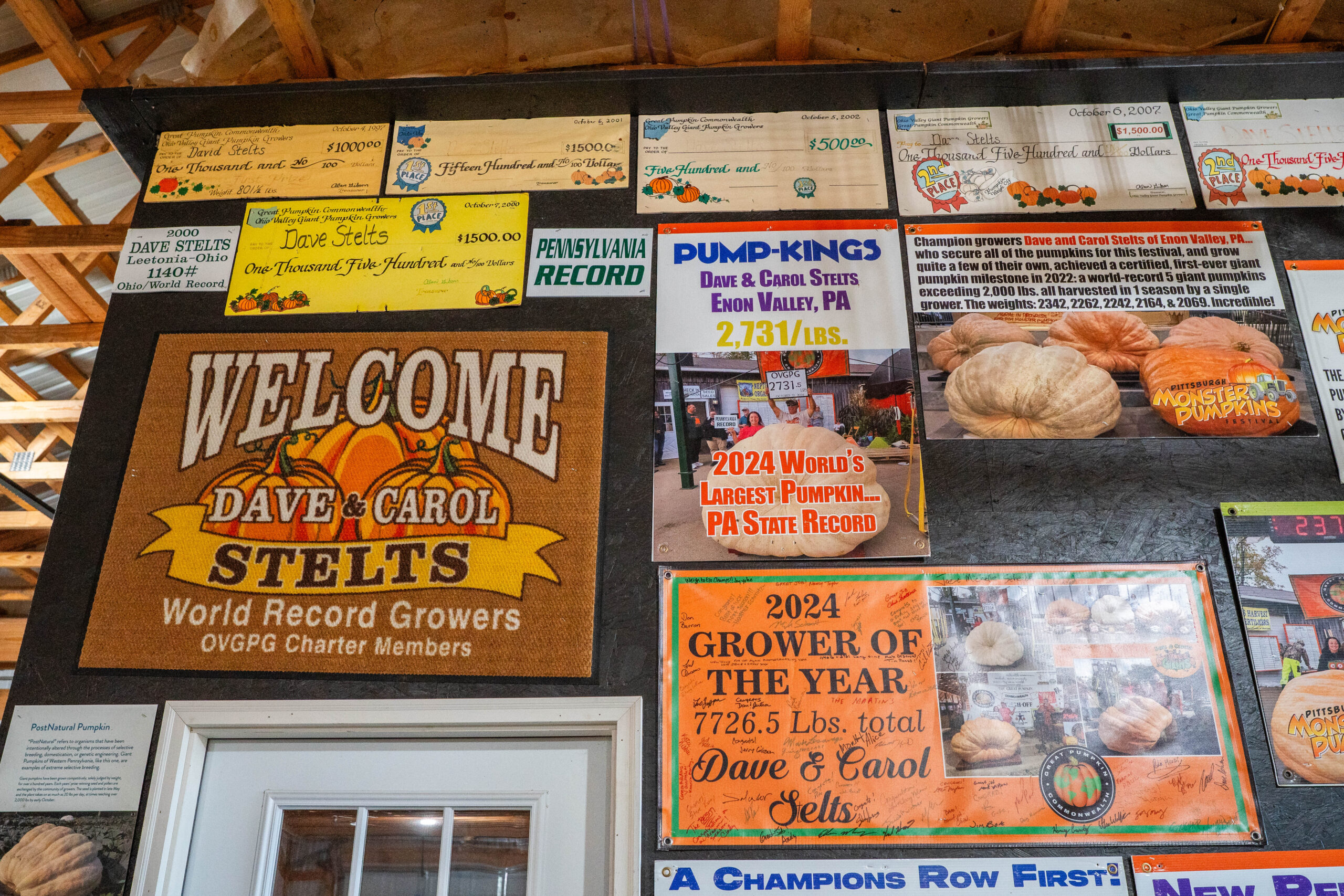
This success only grew: in 1997, they grew their first 800-pounder, winning the Ohio Valley Giant Pumpkin Growers weigh-off. Three years later, they broke the world record at 1,140 pounds.
In 2003, Dave got a new pumpkin-growing partner: his wife Carol. “That’s really when the success happened; she’s the lucky charm here,” Dave said.
The two grew pumpkins on their property in Edinburg, Pennsylvania. But, according to Dave, “It was terrible.”
“It was just two acres along the side of a hill. We terraced it out, but we couldn’t rotate, and so we knew that we had to do something,” he said. That’s why they moved to their current property 12 years ago, and the change made a significant difference for their pumpkins.
A science
The Stelts bought their current property in September 2013, which had a home with no electricity, heat or plumbing.
“What’s the first thing (Dave) does? He puts those telephone poles out there (to make the growing plots). He’s all focused out there on the pumpkins. I’m like, what about heat and air and plumbing and all that electric something?” Carol said.
To make the perfect pumpkin field, Dave tilled the ground, then crowned the ground — to allow adequate runoff — and added telephone poles to section out four different plots and hold up a shade cloth that covers the plants.
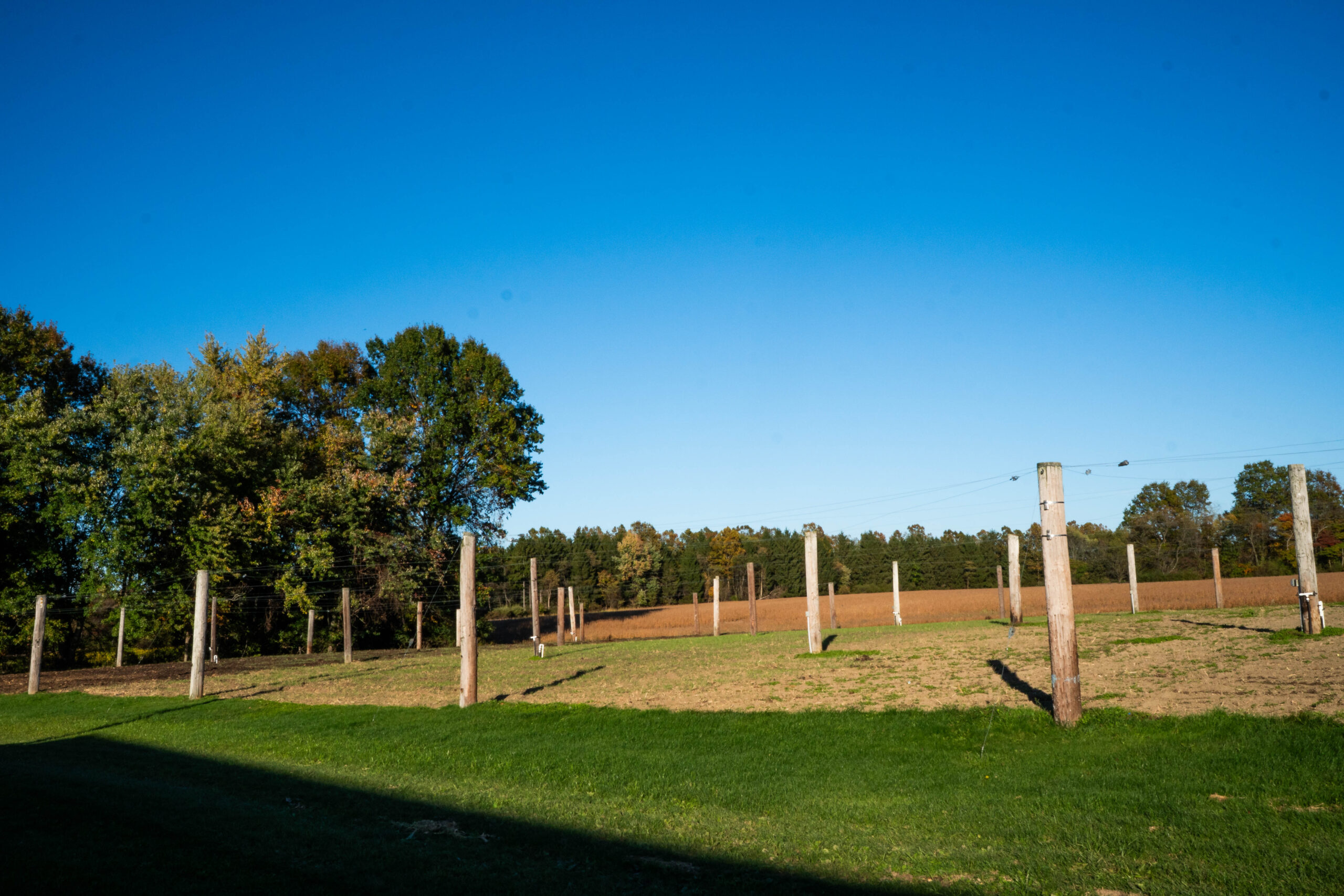
According to Dave, adequate water management is one of the most important aspects of growing a giant pumpkin outside.
“You can always add it. You can’t always get rid of it,” Dave said. By crowning and tilling the field, water is allowed to drain outward toward the perimeter. “We want to tilt it just slightly, so it has runoff because you don’t want it to be flat and hold water and then be a swamp,” he said.
The Stelts begin their season in April, starting their seeds — saved over from the pumpkins the year before — inside. Ten days later, they plant the seedlings in the ground.
Once outside, the Stelts put plastic down around the plants to keep the soil dry, cover them with a polytunnel and mini-greenhouse and install soil heating cables to keep the pumpkins warm.
The couple pulls off this equipment by the end of May, when the pumpkins start to outgrow the confines of the greenhouse. Next, they till the ground around the plants and add soil amendments before laying down wooden walking boards and a drip irrigation system.
“We never walk on the ground so we don’t compress the soil,” Dave said, adding, “We use a lot of biology.” Throughout the growing season, the Stelts will feed the pumpkins necessary nutrients, including nitrate and potassium.
After the ground is ready, the Stelts shift their focus to the vines, staking the leaves with bamboo sticks to ensure they are not damaged by high winds. In June, the pumpkin blossoms are close-pollinated after they reach a certain length.
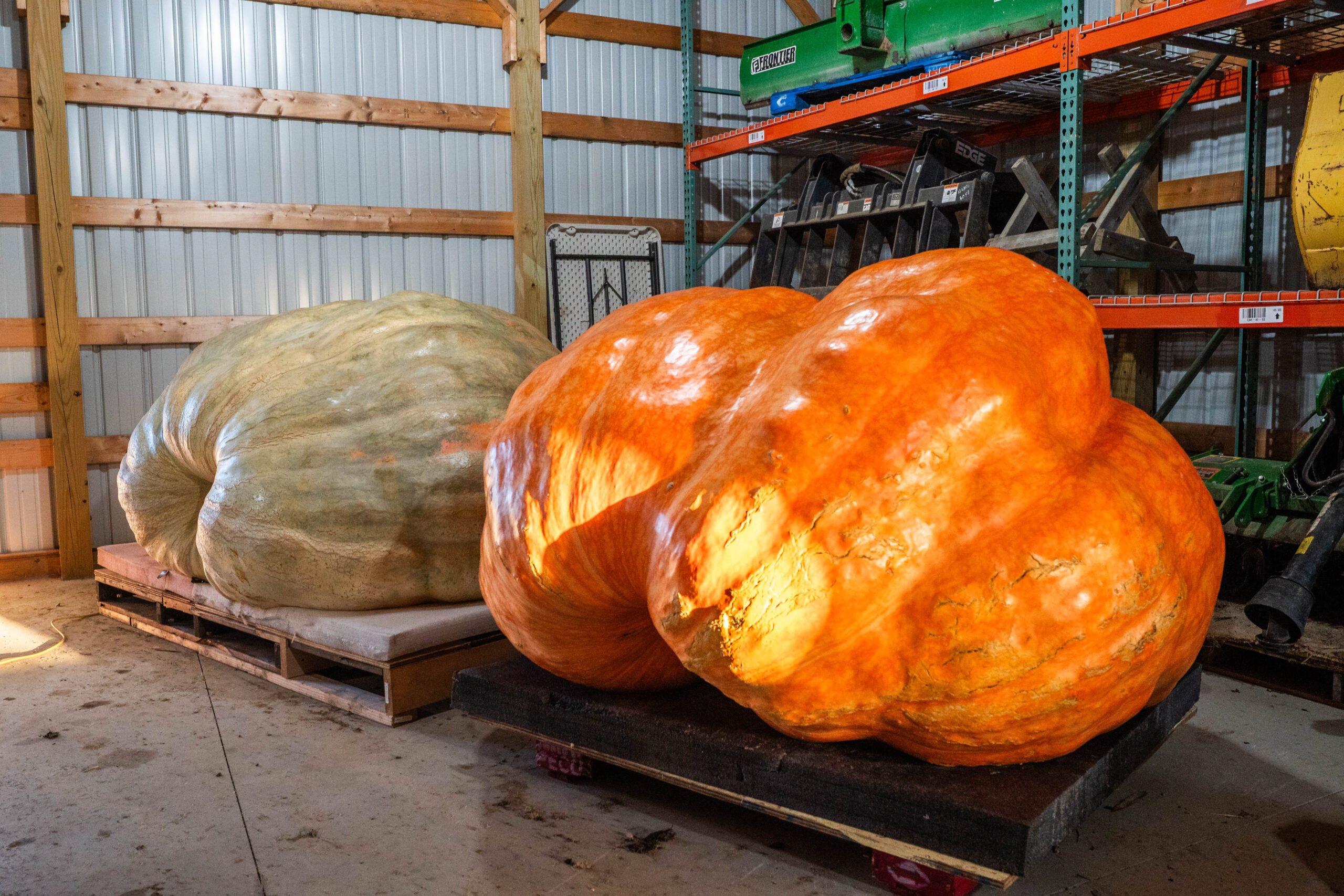
Every year, the Stelts grow eight pumpkins covering 10,000 square feet. “Our big ones will grow 50 to 60 pounds a day for a couple of weeks, and that’s when it’s fun,” Dave said.
Healthy soil is also important for growing giant pumpkins; the Stelts regularly test their soil to determine what nutrients they need to give their plants.
They prep their soil four years in advance, rotating which section they grow their pumpkins, planting cover crops like mustard and winter rye and adding compost to the ground.
By early September, the pumpkins are ready to harvest just in time for competitions.
Success and joy
Every year, the Stelts try to attend eight competitions for their eight pumpkins; unfortunately, they lost three pumpkins this year, attending five contests.
They attended the Michigan State Fair in September and took first place with a 1,998-pound pumpkin. Other contests they participated in include the Central Great Lakes Weigh-Off in Michigan; the National Pumpkin Weigh-Off at Oakland Nursery in Dublin, Ohio; the Ohio Valley Giant Pumpkin Growers competition in Canfield; and the Pittsburgh Monster Pumpkin Festival in the Strip District.
After the season is over, the pumpkins are harvested for seeds and then sold to community groups and businesses for entertainment like the Pittsburgh Zoo.
Over the years, they have taken 25 pumpkins down to late singer Dolly Parton’s Dollywood Amusement Park in Tennessee, and delivered the 2026 world record pumpkin to Salem, Massachusetts.
While life is good, the Stelts admit they’ve considered installing a greenhouse to grow the pumpkins, as Mother Nature continues to be a challenge.
“Every year, it seems like it gets a little worse with the weather,” Carol said. Dave adds that the presence of greenhouse gases is contributing to worse weather.
“Having to adapt to what’s getting thrown your way outside is a big challenge,” he said. According to Dave, the couple experienced six tornadoes this year and strong winds throughout the season; the wind can rip the vines of the pumpkins when on the ground.
That’s why the Stelts started holding up the leaves of the pumpkins with bamboo stakes to stabilize the leaves. “That’s the lifeblood for the plant,” said Dave about the leaves.
But sometimes, no matter the management, excessive water can also become an issue, like late summer this year, when the region got a record-breaking amount of rain.
Combined with heat and humidity, wet conditions send diseases into “hyperdrive,” Dave said, and spraying may not be a viable option
Despite the challenges, the Stelts continue growing pumpkins every year to spread autumn joy.
“We (enjoy going to the competitions) and seeing those little kids, seeing the sheer joy in their faces,” Dave said. “You like to pass that on to the next generation.”
(Liz Partsch can be reached at epartsch@farmanddairy.com or 330-337-3419.)