



In this article, we will discuss a fungal disease that can affect our oak tree species here in Ohio and in the wider Southeast Ohio/Appalachian foothills region.
The disease is called oak wilt, and it is a fungal vascular disease that often kills the affected tree. The affected tree has a defensive reaction to the fungus in its system and essentially plugs its own vessels in the xylem, which prohibits water uptake, causing the tree to wilt and lose its leaves.
Trees in the red oak family (northern red, scarlet oak, pin oak and black oak) are highly susceptible to the disease and can often die very quickly, even as fast as a few weeks. Trees in the white oak family are also able to contract the disease but take much more time to die, often a few years later.
How it spreads
The disease is spread in two different ways. The first form is from sap-feeding beetles called Nitidulids that carry the fungal disease to other trees. When a tree dies from the disease, fungal spore mats form under the bark of the tree.
These mats give off an odor that attracts the beetles to it. The beetles feed on these spore mats and then sometimes travel to a healthy tree, causing the disease to spread to it. The beetles are highly attracted to fresh wounds, and this is where the disease is able to infect the new tree.
This is why pruning oak species and most tree species in general should be done in the dormant season. November through February is considered a generally safe pruning window.
Obviously, storms and wind damage are natural events that cause wounds on trees, but being smart about pruning and avoiding the growing season months is crucial, especially for large red oaks in urban settings or yard trees.
The second way that oak wilt spreads is through the root systems of oak trees. Oak species can have roots that graft together and create a large network of interconnected roots. This can be detrimental when oak wilt is established in a tree that is connected to others. If root spread does occur, then often you will find a pocket of dead oaks in a circular shape as the disease is spreading outward from the initial tree.
How to identify it
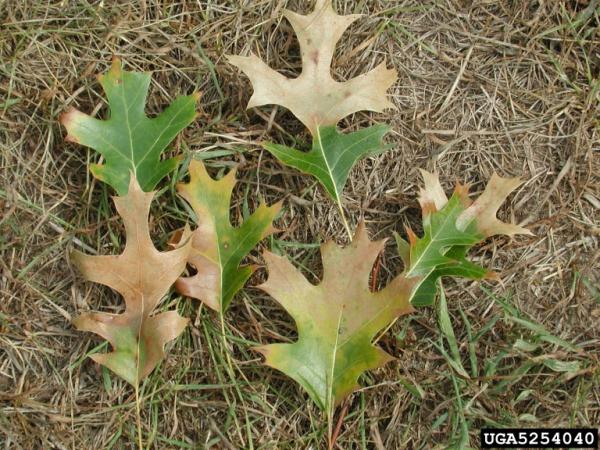
When trying to identify trees with possible oak wilt, there are several things to be on the lookout for. Red oaks will show the quickest, most obvious signs with brown coloration of the leaves. Branches will die starting at the top and working downward toward the trunk. White oak family species will be much harder to tell, as the same symptoms take longer to show themselves. Any rapid defoliation during the growing season could be a sign of the disease.
Look for clusters of dead or dying red oaks. Recently we discovered an oak wilt site here in Monroe County. It was obvious very quickly that the red oaks were either completely defoliated or in the process of defoliation. No other species in that area were affected, so it made a stark contrast. Samples were taken by the Ohio Division of Forestry, and the samples came back positive for oak wilt.
How to stop the spread
There are some treatment methods to help prevent the spread of the disease, but not much can be done for trees with advanced symptoms. The hope is to stop the spread using a few different methods; the first would be using approved fungicides, and the second would be “trenching” or digging a line around the affected trees to sever the root connection and, in theory, stop the root transfer of the fungus.
Identifying the disease early is crucial if either of these methods is going to be used.
If you feel that you may have trees infected with oak wilt or you have any questions about the disease, then please contact the Ohio Division of Forestry or your local soil and water office. A site visit can be conducted and if oak wilt is suspected, then samples can be sent for testing to determine if the disease is present.