



When you’re perusing magazines or newspapers and come across an outdoor how-to column, a good yarn worth repeating or tips on where to go and what fish are biting, do you ever wonder who’s behind the computer screen?
Chances are, you’ve read their bylines often enough that some names are familiar. What you might not realize is that many of these writers are linked through an organization that has been part of Ohio’s conservation history for more than eight decades.
As part of my work chronicling the history of Ohio’s Division of Wildlife, I asked well-known, award-winning outdoor writer Steve Pollick to explain that connection.
Steve is a past president and life member of Outdoor Writers of Ohio (OWO), retired editor of The Blade in Toledo’s outdoors section, and author of the monthly “Open Season” column in Ohio Outdoor News. He joined OWO in 1969, so he’s had a front-row seat to much of its history.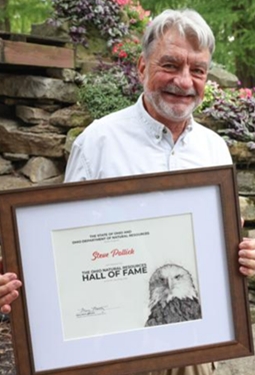
Here is his story:
The Outdoor Writers of Ohio was founded by a handful of outdoor writers in 1939, a full decade before the Ohio Department of Natural Resources and its seven divisions were established.
But the histories of OWO and the Division of Wildlife are deeply intertwined. Technically, the division is older, tracing its beginnings to the Ohio Fish Commission, established in 1873.
Over the years, many Division of Wildlife employees, particularly those working in communications and education, have joined OWO. Others have served as officers and board members, as have employees from other ODNR divisions.
Annual OWO conferences have traditionally included Division of Wildlife programs and administrative presentations. And since at least 1957, OWO has maintained Ohio’s official list of state-record fish, working with Division fisheries biologists to verify potential records.
From its original handful of members, OWO has grown into an organization that, in recent decades, has numbered between 60 and 80 writers, photographers, artists, broadcasters, filmmakers, educators and other outdoor communicators.
Its membership has included some true giants of the profession: filmmaker and photographer Karl Maslowski, internationally known wildlife artist John Ruthven, author George Laycock, writer-photographer Erwin “Joe” Bauer, writer-videographer Lou Klewer, and outdoor showman and writer Bob Hart Jr., among others.
Breaking barriers
OWO also has an interesting history of breaking barriers. In 1941, just two years after its founding, the organization accepted its first woman member, identified in surviving records only as “Mrs. George Hinds” of Marion. Her first name went unrecorded, reflecting the customs of the time. In 1981, Jane Barr of Hudson became OWO’s first woman president.
The connections between OWO and ODNR have been especially strong. Former Division of Natural Areas and Preserves chiefs Ralph Ramey and Guy Denny were active in the organization, with Denny serving as its longtime secretary. Another OWO past president, Tim Snyder, was an assistant chief of that division.
Vicki Mountz, former acting chief of the Division of Wildlife, also served as OWO president. So did Chip Gross, a retired wildlife officer, educator, and former editor of Wild Ohio and Wild Ohio for Kids. Melissa Hathaway, who succeeded Gross as editor of Wild Ohio, also served as president. Mike Mainhart, a popular seasonal naturalist with the Division of Parks and Recreation, was another past president.
Contributions
Such close relationships have occasionally created tension. After all, an independent press and a government agency do not always see issues through the same lens.
But those differences generally have been resolved amicably, with both organizations recognizing the importance of informed public discussion about conservation.
One of OWO’s most enduring contributions has been its state-record fish program.
The first known reference to its Record Fish Committee appeared during a 1957 outing at Rocky Fork Lake in Highland County. Members learned that the organization’s published list of record fish was receiving statewide attention.
The program continues today. Division fisheries biologists help examine and certify prospective records before the OWO committee considers them for official recognition.
The program differs from the division’s popular Fish Ohio Awards. Fish Ohio recognizes catches meeting minimum length requirements, while state records are determined by weight.
OWO’s involvement in conservation, however, reaches far beyond fishing records.
History
In 1944, during World War II, the organization petitioned the federal government for “a small amount of ammunition to perpetuate hunting,” provided it did not interfere with the war effort.
Small allotments were forthcoming.
By 1945, OWO members were petitioning Ohio legislators to create a unified department of natural resources, replacing the smaller and more limited Department of Conservation.
The proposal failed in 1945 and again in 1947. Finally, in 1949, legislation established the Ohio Department of Natural Resources and seven divisions, including the Division of Wildlife.
OWO had helped champion an important step in Ohio’s conservation history.
The organization was originally closely associated with the League of Ohio Sportsmen, holding its annual business meetings during the League’s conventions in Columbus. OWO did not hold its own independent annual conference until 1956, when members gathered under the theme “Keep Ohio Green and Clean.”
Unfortunately, many early OWO records, including its original constitution, were lost after 1958. Reconstructing the organization’s history has required considerable detective work.
In 1988, past president Bob Light and others undertook that challenge, piecing together OWO’s first 50 years. Light had become the first third-generation member of his family to serve as OWO president in 1982.
Throughout its history, individual OWO members have tackled controversial conservation issues, including commercial fishing in Sandusky Bay, gillnetting for Lake Erie walleye, trapping and dove hunting. But the organization itself does not endorse political positions, leaving members free to express their own opinions.
OWO also ventured into book publishing during Gov. Michael DiSalle’s administration. Its 113-page pocketbook, Outdoor Ohio, contained 30 articles and 60 photographs contributed by members. It sold for $1, “tax included.”
In his summary of OWO’s first 50 years, Bob Light quoted an old-timer who captured something of the organization’s spirit:
“We are an organization of hunters and fishermen in the field, not Democrats or Republicans.”
Today, members’ interests reach well beyond hunting and fishing. They include camping, hiking, boating, paddlesports, wildlife viewing, nature study, backpacking, skiing, snowmobiling and nearly every other outdoor pursuit imaginable.
The tools of outdoor communication have changed dramatically since 1939. Typewriters have given way to computers, film to digital photography, and newspapers to an ever-expanding world of electronic media.
But the purpose remains much the same: sharing knowledge, encouraging appreciation of the outdoors and helping people understand the importance of conserving the natural resources around them.
For more than eight decades, Outdoor Writers of Ohio has worked to live up to a simple motto that remains as relevant today as it was at the organization’s founding: Conservation and Truth.
“Outside is the only place we can truly be inside the world.”
― Daniel J. Rice