




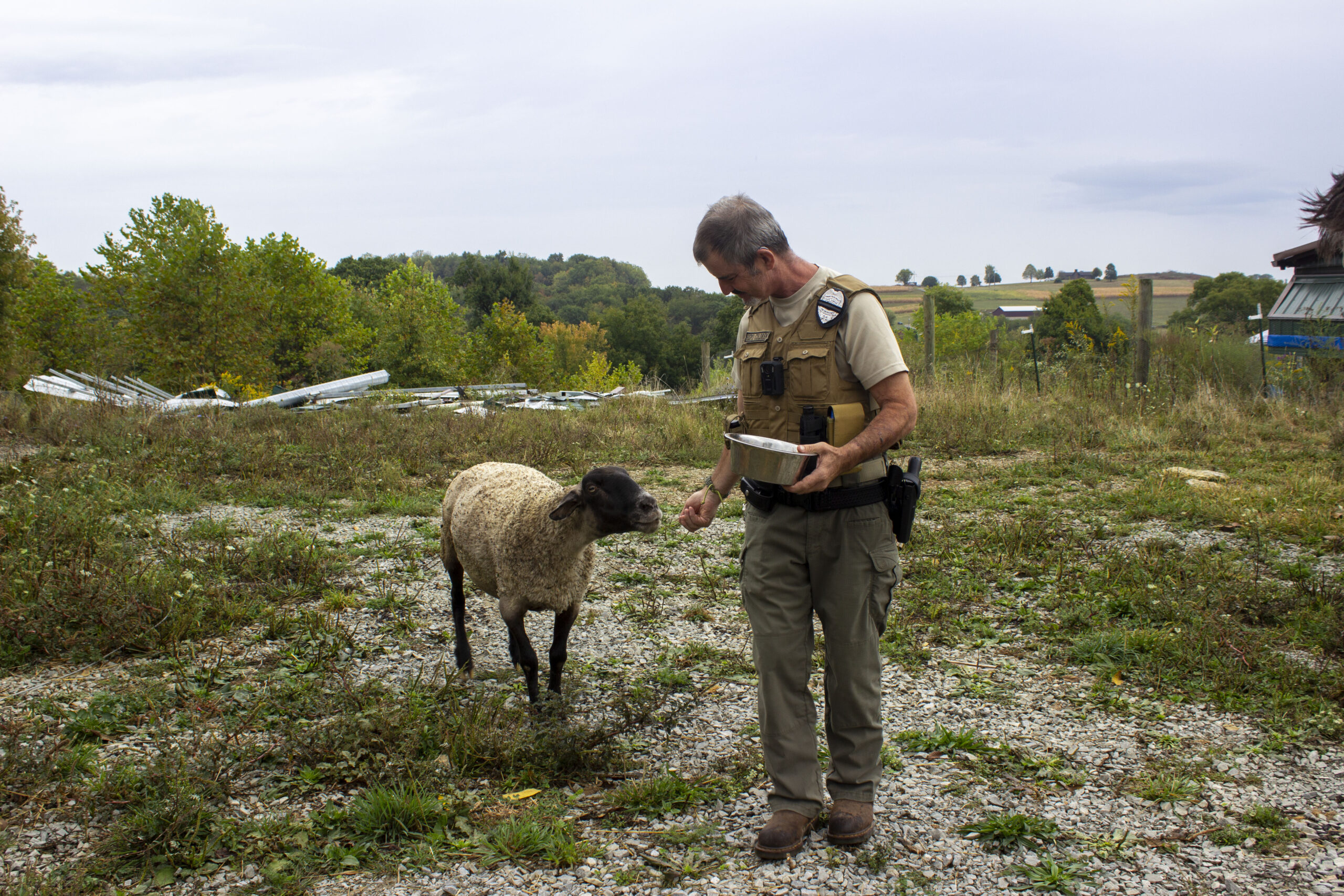
VANDERBILT, Pa. — Rodney Coldren never forgot the day he met Gloria. The sheep was limping badly, her hooves painfully overgrown from untreated laminitis. In sweltering 90-degree heat, she carried nearly nine pounds of extra wool that hadn’t been shorn in years. Coldren, a humane society police officer for Fayette and Greene counties in western Pennsylvania, seized the sheep under a search warrant and got her the help she needed, paying for veterinary care out of his own pocket.
“She was not a happy sheep,” said Coldren’s wife, Trish Prosser. The neglect case against her owner ended in a misdemeanor charge, which was later dropped when the owner agreed to surrender Gloria to live permanently on Coldren’s farm. Gloria’s situation is just one of many examples of the complicated, exhausting work rural humane society police officers like Coldren face every day.
Despite being relied on to defend animal welfare, humane society police officers in rural western Pennsylvania face dangerous work, heavy caseloads and strict legal requirements while covering large areas with little to no funding to sustain their operations, forcing them to shoulder thousands of dollars in costs for training, kennels and animal care.
‘No idea.’
In Pennsylvania, when it comes to criminal allegations of animal cruelty, such cases are referred to the local or state police, who have jurisdiction over criminal law. But there’s an additional force that helps bridge the gap in expertise and resources: humane society police officers like Coldren. The training, he explained, is rigorous, including two weeks of mandatory courses — one in legal proceedings, the other in animal husbandry — followed by sponsorship from a nonprofit humane society that petitions the court to have the officer sworn in.
“Humane officers are fully sworn police officers. We have on-view arrest powers. We can charge felony aggravated cruelty,” Coldren said. “We have very limited jurisdiction to just animal cruelty and neglect, and only to counties that we’re sworn in, but within those parameters, we operate with the same authority as state policemen or a municipal officer.”
For Coldren, a United States Army veteran, the path into this work began just a couple of years ago.
“When I got into it, I had no idea the scope of the duties and the responsibilities and what we would be doing. I thought, ‘Oh, OK, I’ll go, I’ll talk to people. I’ll get them to comply, I’ll write some citations.’ But I didn’t think I’d be taking animals, holding them,” Coldren said.
Last year, along with his wife and a group of disabled veteran farmers and military families, Coldren formally incorporated the nonprofit Southwestern Pennsylvania Humane Law Enforcement (SWPA) to focus exclusively on humane law enforcement to fill what they saw as a gap in services in their corner of the state.
“There is nobody else who does animal humane police work in Greene County,” Coldren said. “I am the only officer. And I am one of two officers here in Fayette, and the only one who actually lives in Fayette County.”
In western Pennsylvania, Beaver and Lawrence counties also share one humane officer. Crawford and Butler counties do not even have a dedicated humane officer, leaving animal law enforcement to local and state police.
Coldren and Prosser say one of their biggest challenges is simply helping people understand what humane society police officers do — and what they don’t. They don’t pick up strays. Humane officers are granted authority to investigate complaints of animal cruelty, which includes intentional abuse and neglect, gather evidence and refer cases for prosecution. They receive specialized training with help from state veterinarians to recognize the difference between illness, malnutrition and outright cruelty.
“All of this, by the way, is self-funded. The commonwealth provides nothing. They mandate very particular things, but they will do nothing to help you get there,” Prosser said.
‘Someone’s got to do it.’
It doesn’t have to be this way. Earlier this year, state Sen. John Kane introduced SB 661 with bipartisan support, which among other things, would train and equip humane society police officers and provide grants to animal shelters to help cover the costs of cruelty investigations. But the legislation is stuck in committee. Kane could not be reached for comment.
Coldren and Prosser reached out to their local state senator, Pat Stefano, who represents Fayette County, as part of their broader effort to lobby for government support and funding for their work. In a statement to Farm and Dairy, Stefano agreed the state needs a steady source of funding for their work, though he suggested local options should be part of the discussion to avoid burdening taxpayers.
Others, like state Sen. Elder Vogel, a Beaver County farmer who also chairs the Senate Agriculture & Rural Affairs Committee, said in a statement that the state’s tight budget makes new funding for humane officers unrealistic for now, though he acknowledged the importance of their work.
Jane Gapen, director of the Humane Society of Greene County, said that kind of attitude has left the individuals and organizations defending animal welfare stretched thin for decades. When she moved back to Greene County after college, Gapen realized there was no one who investigated animal cruelty there.
“And so I thought, ‘Someone’s got to do it, and I want to be the one,’” she said.
Gapen spent 25 years investigating cruelty cases before becoming director, often paying for vet bills and transportation out of her own pocket. Now her days are spent writing grants, managing staff and raising money to keep her shelter afloat.
Gapen said humane officers face not just financial strain, but physical danger. Over the years, she’s had her life threatened, been confronted by people with guns and even had a man try to stab her. Judges sometimes assigned her bodyguards just to make it to and from the courtroom.
“It’s dangerous. It’s dirty. Animals can be dangerous, but more importantly, people are real dangerous,” she said. “It’s got to be in your DNA to put up with all (this), knowing that you’re only doing it, you know, for the good. And altruistically, because you certainly don’t get paid. And certainly the state doesn’t care.”
Her biggest frustration is that while Pennsylvania provides for dog wardens, who handle strays and rabies checks, it does not support humane police officers, who carry out criminal investigations.
“The state needs to hire humane police officers and care for them like they do their dog wardens,” she said.
Gapen also hopes the state will make training more accessible and affordable. Right now, humane officers must cover the cost of mandatory courses themselves, traveling across the state to attend. The basic humane society police officer certification course, offered by the Pennsylvania Academy for Animal Care and Control, which currently holds approval for certification and continuing education for humane society police officers, costs $1,550.
Until that changes, humane societies like hers, along with SWPA, will continue to rely on grants, donations and what she calls “angels in the community” to keep going. She insists the work is too important to walk away from.
Tough position.
Cases involving livestock and poultry can be particularly trying, as there are fewer resources available for these animals.
At Kindred Spirits Rescue Ranch in Beaver County, founder Lisa Marie Sopko manages care for roughly 200 animals, including horses, donkeys, sheep, pigs and countless roosters and ducks, all while knowing the sanctuary rarely has more than six months of funding at a time.
“We’re always just in like a hamster wheel of trying to figure out how are we going to feed everybody, how are we going to continue to take care of everybody?” Sopko said.
She takes in owner surrenders, as well as humane cases. Despite the relentless tasks and financial pressure, she finds profound reward in seeing the animals recover from some of the most horrific circumstances. Many arrive sick, aggressive or malnourished; yet with consistent care, they gradually learn to trust again.
There are unique challenges of caring for farm animals as humane cases vary, Sopko said. Often, humane societies and officers may not be equipped to handle larger farm animals, lacking trailers to move them or experience rounding them up. Her farm is ineligible for most grants, she said, which are often earmarked for domestic animals like dogs, cats and sometimes horses, and because Kindred Spirits is not a production farm, Sopko doesn’t receive funding from the state department of agriculture. They rely on donations to get by.
Beyond the daily operations, however, Sopko has a deep understanding of the strain on the broader animal welfare system. When humane officers arrive seeking placement for rescued animals, finding adequate space is often a challenge.
“Unfortunately, humane officers are in a very tough position because if they can’t find space for the animals, then they cannot remove the animals, and then that means that there can’t be justice served for the animals and hope for the animals,” Sopko said.
Sopko said more support, education and funding for both sanctuaries and humane officers could alleviate some of the pressure, allowing them to focus on the animals rather than the logistics and finances.
“We would love to see our townships and counties and states supporting us more,” she said. “I would love for people to really have an understanding of what we do, what kinds of situations these animals are in.”
‘The right thing to do.’
The workload is relentless. In July, SWPA opened 32 cases, seeing Coldren execute a search warrant, seize animals, handle transfers from state police and file multiple felony and misdemeanor charges.
The work itself can be grim. Coldren recalled cases of finding dogs dead in trash bags, animals tethered without shelter in freezing weather and malnourished pets left behind by tenants who moved out.
“By far the most common reason we execute a search warrant and seize animals is abandonment,” he said.
Penalties are steep: A citation carries a fine of up to $750 per infraction per animal, Coldren explained, meaning fines can quickly multiply into the thousands. Still, half the time, he said, defendants don’t show up in court, and restitution meant to be paid to SWPA for medical or boarding costs almost never materializes. The financial toll often falls back on officers themselves.
In July, Coldren and Prosser’s expenses were nearly $2,500, with almost $900 coming directly out of their own pockets to make ends meet, while only $250 came in through donations. That’s in addition to the hundreds of miles they drive across rural counties, all while paying for their own fuel.
When possible, Coldren tries to educate owners and bring them into compliance with Pennsylvania’s animal welfare laws, but the situation is compounded by a shortage of other officers in the field. Still, Coldren carries on because “it’s the right thing to do,” he said.
“You simply can’t unknow what you know (after) what you’ve seen. And to turn my back on this work after knowing the scope of the problem and seeing the conditions of these animals is unthinkable.”




