


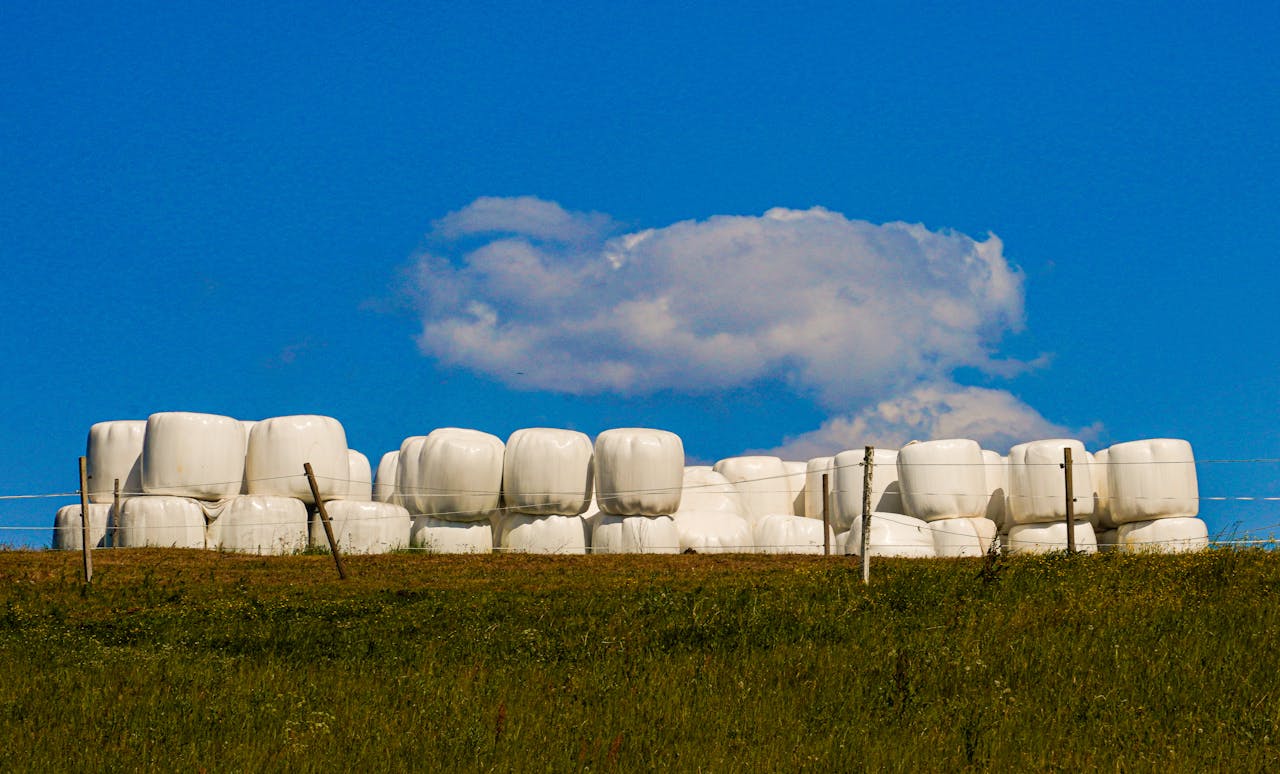
Mother Nature has been providing crazy weather again this year. Many areas receive rain every few days, keeping moisture levels at field capacity with only a day or two for forage drying between rains. Cool-season grass quality is rapidly declining as seed heads emerge, and alfalfa is at peak quality.
Baleage can be an excellent tool for managing challenging harvest weather windows or for storage when barn space is not available. The ideal condition for baleage is to bale the hay between 45 to 55% moisture and wrap it within two hours of baling. Delaying bale wrapping for 24 hours increases internal bale temperature by 20 degrees Fahrenheit, decreases forage energy values, and raises NDF levels.
Baleage preservation uses anaerobic conditions and the acids produced in fermentation to preserve hay. The higher the bale moisture, the more lactic acid production to support fermentation. Baleage fermentation is slower than in haylage, often taking 6 weeks.
When forage is baled between 25 to 40% moisture, it will not ferment properly, and baleage at these moisture levels should be considered as temporary storage. In such situations, preservation primarily involves maintaining anaerobic, oxygen-limiting conditions. Mold is more likely at this moisture; higher bale densities and more wraps of plastic is required to better seal out oxygen. If using a tube wrapper, bale uniformity is critical to prevent an oxygen pocket from forming between bales.
Forage study
A recent study conducted at the U.S. Dairy Forage Research Center investigated the benefits of wrapping 25% moisture hay. This moisture has often been considered no man’s land as it is too wet to safely bale with preservatives as dry hay and too dry to bale as baleage. This hay is sometimes known as sweet hay.
The study investigated the heating of the wrapped hay versus the unwrapped hay with preservatives. Wrapping hay significantly reduced heating with no protein degradation compared to unwrapped hay. When Propionic acid was added at baling to the wrapped bales not only was heating reduced but after 84 days in wrapped storage the bales exhibited improved aerobic stability for the following 33 days it was monitored. This means that the hay would have improved bunk life.
Quality starts with mowing. While KEEPING OXYGEN OUT is the most important part of making high-quality baleage, it starts with mowing. When baleage is the planned storage method, your harvest capacity-limiting factor will be how many bales you can wrap an hour, with the ideal goal of wrapping the bales within four hours. Based on research done at the University of Wisconsin-Madison, we recommend laying swaths as wide as your mower will allow, helping preserve forage quality and speeding up drying to 65% moisture by 10.8 hours.
High-density bales
When baling, your goal should be to make the highest-density bales possible. Increasing density from 6 lbs. DM/ft3 to 8 lbs. DM/ft3, you gain an extra 12 hours of bunk life in the haylage due mostly to better bale fermentation. Your goal should be to achieve a minimum of 10 lbs. DM/ft3, with higher densities easily achievable. One study achieved dry matter densities over 18 lbs. DM/ft3.
Increasing bale density, however, often slows harvest down. Instead of making windrows as large as the baler can handle, smaller windrows and slower ground speeds increase bale density. The more revolutions of the bale within the bale chamber, the denser the bale becomes. The dry matter density of bales decreases as forage moisture content exceeds 60%, with higher-density bales having a moisture content of 45-50%. Pre-cutting systems on the baler that size the theoretical particle length to 3 inches or less also increase bale density, especially in crops with a high stem to leaf ratio.
Wrapping tips
Most bale wrap is one mil low-density polyethylene, and bales need a minimum of 4 mils of plastic to seal out oxygen, requiring a minimum of six wraps to accomplish this over the entire bale. Types of plastic vary greatly in their stretchiness, which can reduce thickness by up to 25%. Some stretch is necessary so that the plastic stays sticky and seals well between the layers of plastic.
Be cautious when wrapping in the rain as this will reduce the stickiness and allow more oxygen to penetrate, causing spoilage. Also, be cautious when wrapping forages that poke through the plastic, which will require more layers. When oxygen enters the bale, they start to heat and quality declines when temperatures are over 120 F. The amount of time until bales are wrapped and the number of mils of wrap significantly affect internal bale temperature.