

My father-in-law called me at the end of April, asking if we’ve made any hay yet. In southern Ohio, where he farms, the weather was dry, and they finished planting before the first of May.
All I could do was laugh as I told him about our growing season so far here in northeast Ohio. Weather conditions this spring have not cooperated with timely planting, leaving many wondering about the best strategy for getting crops in the ground.
April was one of the warmest on record in Ohio, yet parts of the state received more than 8 inches of rainfall during the month. Even under ideal drying conditions, several consecutive dry days will be needed before soils are fit to support fieldwork.
The advantages of planting in late April through early May are well established. Crops planted within this window benefit from a longer growing season and typically achieve the highest yield potential. However, as planting is delayed beyond this period, yield potential begins to decline. With June approaching, and many acres still unplanted, some farmers may feel pressure to push the limits of acceptable field conditions.
A few considerations below may help you weigh the tradeoffs between waiting for drier soils and planting into marginal soil conditions.
Challenge of planting in wet soil
Working wet soils can be extremely frustrating. The risk of equipment getting stuck is always present, and in certain soil types, tillage can create clods that become nearly impossible to break apart once they dry. These clods can harden to the consistency of concrete and prevent proper closure behind the planter, reducing seed-to-soil contact. Adequate seed-to-soil contact is critical for moisture absorption, uniform germination and consistent stand establishment. Without it, stand counts may suffer, ultimately reducing yield potential.
Wet soils are also significantly more susceptible to compaction. Equipment traffic in these conditions can cause compaction several feet below the soil surface, even when soils appear only moderately damp. Compacted soils have reduced pore space, limiting the movement of air and water and restricting root development. As a result, plants may struggle to access available nutrients, potentially leading to visible deficiency symptoms despite adequate nutrient levels in the soil.
Planting under wet conditions can also lead to smearing of the seed furrow. Similar to how a float smooths wet concrete, planter components can smear the sidewalls of the furrow, creating a dense barrier that roots struggle to penetrate.
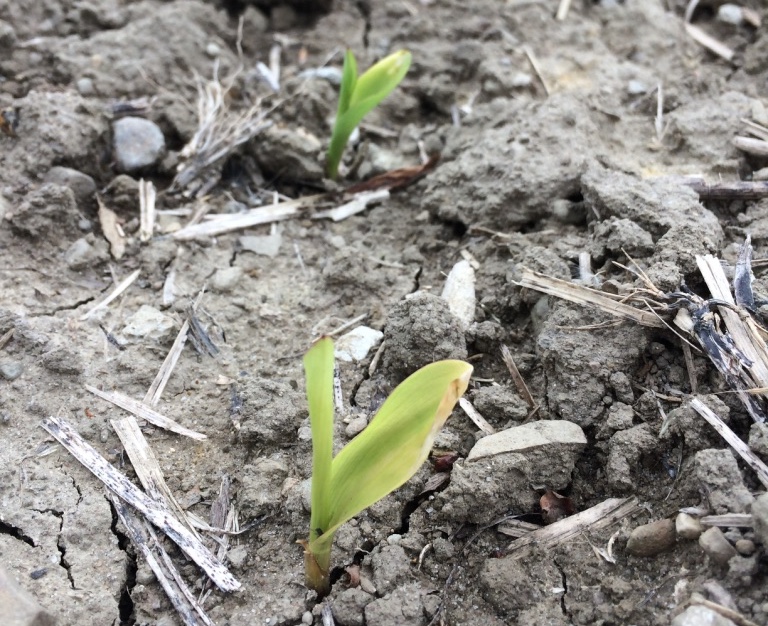
As corn plants develop, roots often follow the path of least resistance, growing parallel to the furrow rather than outward. This restricted root system can make plants more susceptible to lodging early in the season. “Floppy corn,” commonly observed between the V2 and V4 growth stages, is often associated with these compacted or smeared seed furrows.
If you wait
Late planting also poses other challenges with herbicides and nitrogen application. Residual herbicides applied at burndown near the end of April will likely run out of protection earlier in the season. If this occurs, a timely post emergence herbicide application will be needed to control problematic weeds. If you have a history of waterhemp, including a second residual with your post application may be warranted.
If wet conditions persist into June, you may need to adjust your nitrogen strategy to compensate for poor growing conditions. Hopefully that doesn’t happen, but your local extension office can help you decide on those changes if needed. Stay safe out there, and good luck planting!
(Lee Beers is an assistant professor and extension educator with Ohio State University Extension in Trumbull County. He can be reached at 330-638-6783 or beers.66@osu.edu.)