


Already this May, there have been several inquiries coming through the Extension office about hemp dogbane concerns and requests for help with keeping it under control in agricultural systems. If you are not familiar with hemp dogbane, you will be by the conclusion of this article.
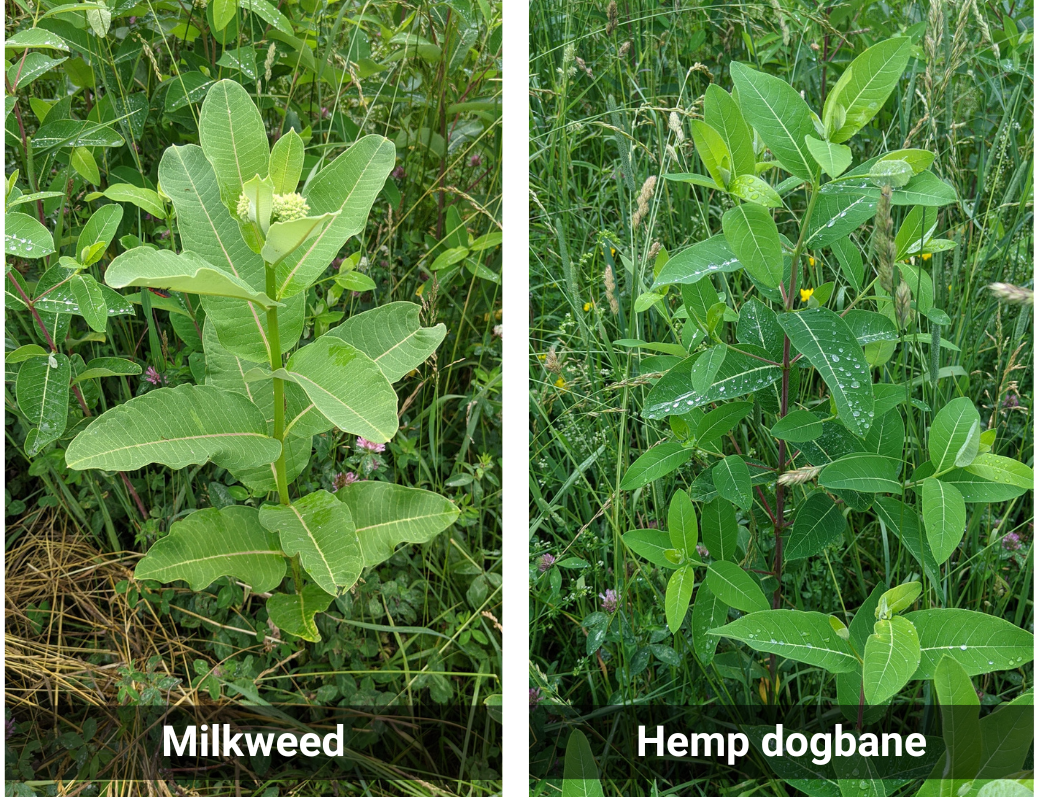
Hemp dogbane has creeping roots, leaves that appear on opposite sides of the stem, and it produces a milky sap. It is often confused with milkweed, which is very similar in appearance before blooming and often found growing side by side.
How to ID
Differences include that young milkweed leaves have fine hairs and hemp dogbane leaves are nearly hairless; milkweed stems are generally thick and green, but hemp dogbane stems are usually red to purple and thinner in comparison; hemp dogbane frequently branches in the top canopy, while milkweed will typically not branch unless mowed; and seed pod shape is distinctly different after flowering with milkweed producing an upright teardrop-shaped pod and hemp dogbane producing a long bean-like pod that hangs from the plant.
Both hemp dogbane and milkweed are easy to find this time of year and are often growing in the same habitat, which can range from roadsides to creek edges, open fields, forest edges and flower beds. You can learn more about milkweed and hemp dogbane by comparing the photos provided with this article (milkweed on the left hemp dogbane on the right) or by watching this video comparing the two plants side by side at youtu.be/OLb1wM7z0AY.
Benefits?
The usefulness of milkweed in the landscape is often justified for monarch butterfly populations, and hemp dogbane is also frequented by various pollinator species. Historically, hemp dogbane has been used by Native Americans to make rope, clothing and baskets. Both milkweed and hemp dogbane have the capability of spreading rapidly by their creeping roots and seed production. Because of these survival characteristics, it takes time and patience to remove them from a system where their disadvantages outweigh their benefits.
Poisonous
Both milkweed and hemp dogbane are considered poisonous to livestock. Toxicities can occur from fresh or dried leaves, stems and roots. While death from poisoning is rare, reduced production efficiency is common if consumed. Symptoms range from mild to severe and include vomiting, diarrhea, coordination loss, tremors, heart problems, respiratory distress and death.
Some animals may consume hemp dogbane or milkweed, regardless of the risk. Some animals may refuse feed contaminated with small amounts. Horses tend to be most sensitive to hay containing hemp dogbane and milkweed. Regardless of livestock species, the greatest risk for poisoning occurs when animals lack access to more appropriate food sources and in cases where contaminated feed has been chopped into a mixed ration.
The concern with these plants tends to be lower in grazing systems where animals have the choice to graze around the problems and forage for healthy food. However, in hay systems where populations are high, it may be impractical to avoid making hay that has some levels of hemp dogbane and or milkweed in it.
How to avoid it
If you can graze the hay field, that may be a step in the right direction for providing high-quality forage and better weed control following grazing. If the hayfield cannot be grazed and must be baled, avoid using balers with silage knives and avoid including contaminated hay in a mixed ration. Do what you can to keep the hay long-stemmed. The larger the pieces of hemp dogbane or milkweed are in the hay, the easier it will be for the animals to sort it out while eating.
Do not force the animals to “clean up” the bale if hemp dogbane and milkweed are known contaminants in the hay. This could lead to consumption at dangerous levels that could lead to illness.
Prevention
While eliminating milkweed and hemp dogbane from all ecosystems would be unwise and unrealistic, treatment of some kind is advised in situations where livestock are consuming forage from areas with high populations. Both are best controlled in agricultural settings by a combination of strategic mowing and systemic herbicide application.
For mowing to be an effective control strategy, it needs to be employed early and often. This will inevitably reduce forage yields in the process, but it may be worth the sacrifice. To reduce the population of plants, the impacted area needs to be mowed strategically twice or more during the growing season to prevent the plants from flowering and producing viable seed. The goal of mowing is to stop the problem from getting worse by preventing seed deposition and weakening the root system over time.
Treatment
Herbicide applications can provide quicker responses than mowing if done well. The best timing to apply systemic herbicide to hemp dogbane and milkweed is before seedlings reach 8 inches tall. The next best timeframe is while they are in the early bud stage (just about to flower). It is important to use a surfactant with the herbicide to bond the herbicide to the leaf tissue and penetrate the waxy leaf cuticle. Without a surfactant, the herbicide will run off the leaves and not be absorbed into the vascular system. As with any herbicide, fully read the label and follow the instructions for application. The label is the law.
Herbicides that are most effective on hemp dogbane are Remedy Ultra (90% or better control), 2,4-D (80% or better control), glyphosate (80% or better control), Cimmaron Max (80% or better control) and Curtail (80% or better control). Milkweed is less susceptible to herbicide application. The most effective herbicide on milkweed is glyphosate (80% or better control), followed by Remedy Ultra (70% or better control), Dicamba (70% or better control) and Crossbow (70% or better control). In scenarios where both plants need to be targeted, Remedy Ultra will provide the most complete control using a single product.
No control strategy will provide 100% control in one growing season. Patience and persistence are key in keeping hemp dogbane at bay. For personalized assistance related to forage crops, reach out to your local extension office or explore the resources available at forages.osu.edu.