




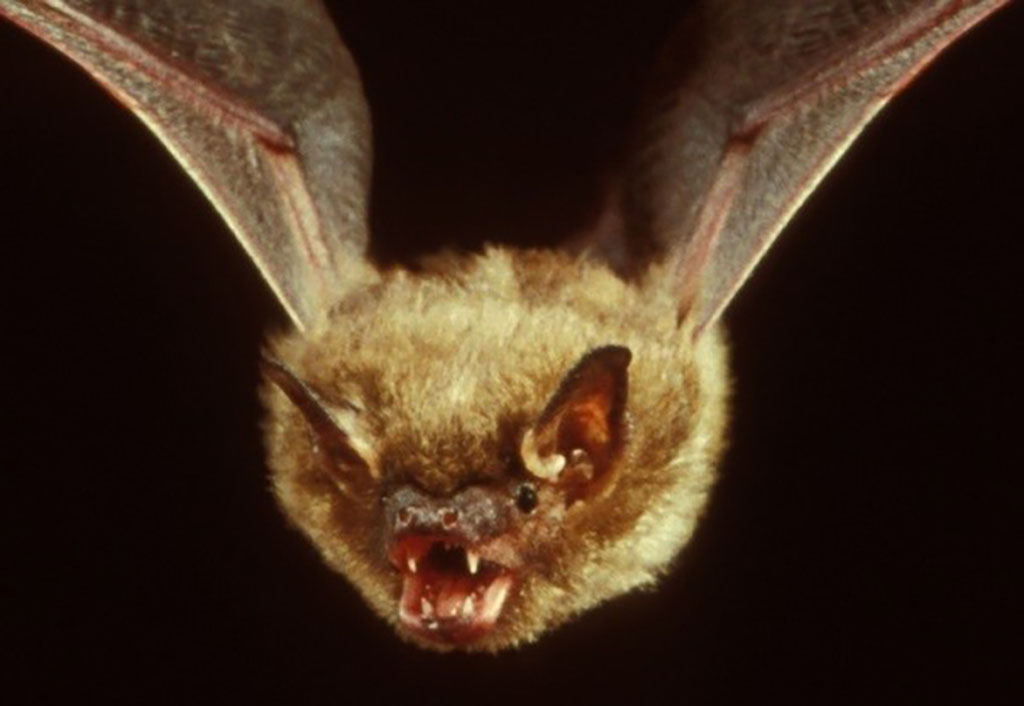
While venturing into the kitchen one morning for that important blast of caffeine, I noticed something clinging to the screen of one of the windows. I walked over and was somewhat surprised to see a bat napping in its strangely inverted posture. This gave me the perfect opportunity for a close inspection, but with its head tucked, a positive identification was tough. In the end, my best guess was that it was a little brown bat, since it’s considered Ohio’s most common.
The bats’ reputation has always gotten a bad rap. Yes, they swoop through the night with a haunting grace that causes some people to begin ducking, and they’re forever linked to author Bram Stoker’s Dracula, Nosferatu and other legends of blood sucking night stalkers. While the stories and movies are great around Halloween and campfires, we don’t have much to worry about when it comes to the real deal — at least as bats go.
Vampire bats
OK, before we get any further, I know someone is thinking, “But there really is a vampire bat.” So, let’s take a little closer look at the elephant — or bat — in the corner of the room.
The vampire bat does indeed exist and feeds on blood, a trait called hematophagy. Think of them as ordering their steak rare, but hold the steak. There are just three species of blood-sucking bats, the Common Vampire Bat, the Hairy-legged Vampire Bat and the White-winged Vampire Bat. All three of the little guys range from Mexico to Brazil, Chile and Argentina and are mostly connected to the rainforest regions. All three rarely will bite a human, but the common vampire does feed on mammal blood, livestock being the closest they’re likely to come to interacting with people. Its two relatives prefer the blood from birds. Like most bats, they’re also small — only weighing between one and two ounces.
How do these bats get away with this bite-and-fly tactic? Their tiny front teeth are used to make minuscule cuts into the skin of their sleeping prey. The bats’ saliva contains an anti-clotting agent as well as a chemical that numbs the area so as to not wake the victim. They aren’t the type to suck blood like their legendary counterparts. They just lap up the blood oozing from the incision, sort of like the family dog laps water. There’s usually little harm or evidence of the bats having grabbed their after-hours drink, though the risk of an infectious disease does exist.
Bats of concern
Now, getting back to all bats — contrary to what many believe, bats aren’t mice or rats that have miraculously grown wings. Neither do they have the penchant for terrifying people sporting big hair — even though some old tales claim otherwise. Bats belong to their own special scientific group called Chiroptera, which encompasses nearly 1,150 bat species inhabiting every continent except Antarctica.
Chiroptera is derived from two Greek words, “cheiro,” meaning “hand” and “pteron,” which infers “wing.” This aptly describes the skin that stretches between elongated arm and finger bones to form the bat’s avionics. I know that you may be thinking that animals have legs and not arms, but I think arms and fingers offer a better description of this little flying mammal’s anatomy.
According to Bat Conservation International, 13 bat species have been identified in Ohio: big brown, Eastern red, Eastern small-footed myotis, evening, gray myotis, Indiana myotis, little brown, Mexican free-tailed, Northern long-eared, Rafinesque’s big eared, silver-haired, Townsend’s big eared and tri-colored. All are listed as “Species of Concern” except for the Northern long-eared bat, which is “threatened” and the Indiana bat, which is classified “Endangered.” It is important to understand what these listings mean. There are six levels of classification for animals facing biological population reductions.
Special Interest: This category includes any animal that occurs periodically and is capable of breeding in Ohio. It’s at the edge of its range and has low breeding densities. It hasn’t been released as part of enhancing Ohio’s wildlife diversity. Except for conserving already occupied areas, little management is dedicated to it since it’s unlikely to influence population trends.
Species of Concern: This category includes such animals as the bat I found resting on my window screen. They’re in danger of becoming “threatened” if their population remains under continued stress. This category also includes animals for which there is some concern, but for which information is insufficient to permit an adequate status evaluation. This group can contain furbearer and game species whose population is dependent upon high-quality or quantity of habitat and is not adversely impacted by regulated harvest.
Threatened: This category of wildlife includes species whose survival in Ohio is not in immediate jeopardy, but that threat exists. Continued or increased stress will result in it becoming endangered.
Endangered: These species are threatened with extirpation from the state. The danger may result from one or more causes, such as habitat loss, pollution, predation, interspecific competition or disease.
Extirpated: A designation for wildlife that occurred in Ohio at the time of European settlement and that has since disappeared from the state.
Extinct: Defunct, vanished, inexistent, wiped out, finished, gone, disappeared – forever dead.
Despite the ecological importance of bats, they remain one of the most understudied mammals. Understudied and misunderstood. According to the International Union for Conservation of Nature, 17% are categorized as “data deficient” and 21% are categorized as “threatened” or “near threatened” on a worldwide scale. Population declines in bats can be attributed to a variety of factors, including changing landscapes, human persecution, disease and wind energy development. Declines are often not detected early because population size and density are difficult to estimate. Recovery from serious population declines is also a slow process since females typically only give birth to one or two pups a year.
All bat species in Ohio are protected by law, especially those that are endangered, such as the Indiana bat and the northern long-eared bat. The Ohio Department of Natural Resources enforces regulations to protect these species, particularly during critical periods like maternity season and hibernation.
After the devastating White-nose Syndrome (a fatal fungus-related disease) was discovered in the state, the Ohio Division of Wildlife established a mobile acoustic monitoring program to survey bat populations and travel. The goal is to observe changes in bat abundance over time in Ohio. This study will also provide an opportunity to join the continent-wide monitoring effort called NABat, which encompasses all of North America. Learn more about the division’s research and the status of Ohio’s bat populations by searching Ohio Mobile Bat Acoustic Survey online.
Finally, people worry about rabies in bats. While it can occur, it’s been estimated that less than 4% of bats turned in for testing are diagnosed as positive. The key is to not handle any bat (or raccoon or other fur bearing animals) to avoid a bite. If you must remove a bat from a location, leather gloves should be used.
Before you ask, the world’s largest bat is the golden-crowned flying fox. They can have a wingspan of up to five feet and weigh 2.5 pounds. Don’t worry, they’re fruit eaters and are only found in the tropical rainforests of the Philippines and East Asia — no need to duck that flying football.
How to help
Explore Bat Conservation International at www.batcon.org and you can also visit Ohio State University’s “Bat Working Group” at u.osu.edu/obwg/ and review Ohio Bat Conservation Plan.
You can help our shrinking bat populations by placing bat houses in strategic areas. For information and a great variety of plans, visit: morningchores.com/bat-house-plans/. Commercially built bat boxes can also be found at many farm stores and online.
“The baby bat Screamed out in fright, Turn on the dark, I’m afraid of the light.”
— Shel Silverstein