


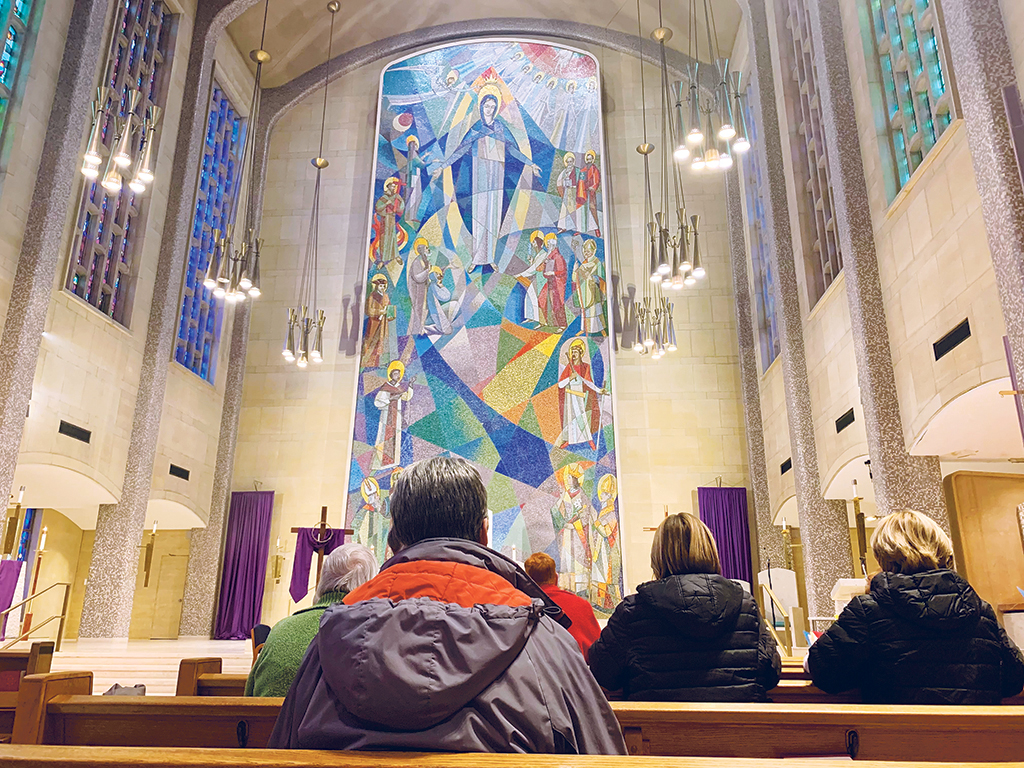
YOUNGSTOWN — On a recent evening in the midst of Lent, among a sparse congregation, the Polish devotion of Gorzkie Żale — literally, “Bitter Lamentations” — unfolded solemnly. You’d wonder how this beautiful music might have sounded a generation ago, when the power of the chorus filling the pews would complement the organ’s thundering notes. Yet even with an attendance of only about a dozen or so seated in a few rows, the voices from this fellowship still managed to convey how deeply tender these texts are.
Through a collaboration between PolishYoungstown and St. Columba Cathedral, the centuries-old devotion has been revived, offered at 6 p.m. on Wednesdays during the months of February and March. The cathedral acts as the North Star of the Youngstown Diocese and is situated between downtown and the campus of Youngstown State University. The 45-minute service includes scripture-based reflections, traditional hymns and Benediction of the Blessed Sacrament; the final one this season was planned for March 25.
For the Polish Catholic community and their friends, this tradition has become a way not only to meditate on the Passion of Christ, but to hold fast to a disappearing world of language, customs and parish life that once defined family identity for scores of Ohioans before dwindling attendance led to numerous church consolidations and closures over the years.
“You can take the building, but you can’t take our faith. Our faith stays with us, and our means of celebrating — that is unique to us — stays with us,” said Aundrea Cika Heschmeyer, who initiated the return of the service.
“A home for our hearts.”
Heschmeyer is the director of PolishYoungstown, an organization dedicated to educating and inspiring Mahoning Valley residents on all things Polish. She said the group approached the cathedral with an offer to raise money for a new spiritual home for Polish Catholics — “a home for our hearts” — where they could feel they still belonged. Cathedral leaders quickly embraced the idea, offering space and pledging to give the group a visible, permanent place in the life of the church, making clear they were not just visitors but part of the parish family.
The text and reflections of Gorzkie Żale invite worshipers to move beyond routine and into an encounter with Christ’s suffering, seen through the eyes of Mary and the faithful. Because Lent is a reflective season, the lamentations are meant to help worshippers fully enter into Mary’s grief as she watches her son die, making the experience both spiritually contemplative and emotionally raw. Heschmeyer compares it to meditation.
“A lot of times, people will repeat a word over and over, like a mantra, yeah? And the reason they do that is to get into a different headspace. That’s what the lamentations do, because in our busy weeks, we don’t necessarily focus on Lent every minute or anything like that, right? So this is a time that you step away,” she said. “It is a meditation on the Passion of Jesus Christ.”
Changing times
For one longtime participant, the devotion is a way of preparing the heart for Easter.
“It kind of gets you into the feeling of, you know, this is what Jesus went through. And it’s your way of preparing for His resurrection,” said Ursula Gerchak.
She notes the emotional power of Mary’s voice in the text.
“With Mary’s dialogue, you feel what this mother is actually going through, seeing her child go through all this. It gets emotional.”
For many, including Gerchak, this time of year is inseparable from the story of St. Stanislaus, once a busy Polish parish in Youngstown whose closure marked the end of an era.
Gerchak, 70, attended grade school there and recalled how thoroughly faith and heritage were woven together in that church.
For years, the early Sunday service at 8 a.m. was conducted entirely in Polish, she recalled — “the mass, the songs, everything was in Polish.” By the 1990s, much of the liturgy had shifted into English, but many of the musical elements stayed in the old language: the entrance hymn, offertory, communion and recessional were all kept Polish. And the community fought to keep it that way, to preserve the language and music as they had always been woven through the Mass, holding out until, over time, Gerchak said, they seemed to lose it all. She reflected on how generational shifts have affected participation and tradition.
“Like with every place else, if you go nowadays, there’s hardly anybody in churches, like in the big cities or whatever,” she said. “You figure it was the older generation that has passed on.” With many younger people uninvolved, she’s doing her part to keep some of the culture alive.
The shuttering of ethnic parishes has been felt across the diocese, said Monsignor Robert Siffrin.
“One of the things that’s happened in the last 20 years as many of our nationality parishes have grown old and some of them are closed (is) we’re trying to keep the heritage and the tradition of our people alive and not only understood but treasured,” he said.
Some of the examples of that heritage, thankfully, haven’t gone far. After St. Stanislaus closed, its cherished icon — the valley’s only shrine to Our Lady of Częstochowa — was brought to St. Columba and now rests in the cathedral tower, part of an effort, Siffrin said, to signal that Polish Catholics are welcome there. At the same time, the cathedral’s gorgeous floor‑to‑ceiling mosaic of the saints, first installed along with the building’s construction in 1958 and recently cleaned and cast in the glow of new lights, depicts the national patrons of different countries, from St. Boniface and St. Louis to St. Casimir, St. Patrick, Martin de Porres and Thomas More. That mosaic, depicting the saints of so many nations side by side, reflects how the valley was founded by Catholic immigrants from across Europe. It also continues to affirm St. Columba as a place where the diverse customs of the faithful may find refuge even in changing times.
“The tradition of focusing on the sufferings of Jesus during Lent is a strong Polish tradition. In fact, Eastern Europe and southern Europe tend to have an emotional focus to the sufferings of Jesus, and the Polish tradition is one of those. So when there was an interest in reviving and bringing it here, I thought, well, this is a natural place to bring people.” Siffrin said.
Continuity
During the homily, Deacon Mark Izzo preached about the weight of words, enough to make any reporter in the room sit up.
“The Word of God is so powerful, the word of Jesus — that’s why we listen,” he said. “Our words also have power.”
He was describing how language can either complement the life-giving work of God or undermine it when it’s used to put down others spiritually, emotionally or socially.
That sense of responsibility in expression carries into the music for the service, too. Musician and accompanist Luke Politsky, who played the organ, said that recomposing the melodies and carefully choosing and shaping each musical phrase connects him and the wider congregation to those who came before.
“The music that I played … was not written down anywhere. It’s more of an oral or auditory tradition, and you basically can’t find sheet music to it. So, as somebody who just wants to get it right and try to help preserve the tradition, I had the couple folks who know it sing it for me.”
He recorded them in sessions; sometimes they left him voicemails.
“And then I would go back and listen to it and plot it out in sheet music. So that was really interesting, and it’s a way for me to connect with my heritage and my faith too,” he said.
His family history runs straight through the old parish, as well.
“I’m Polish and my family attended St. Stan’s. My grandparents were married at St. Stan’s. My parents were married at St. Stan’s,” he said. “Certainly, my great-grandparents would have attended. They lived in the same neighborhood as Saint Stan’s. So, you know, I’ve got stories from my grandmother about her walking to church. And so it was their neighborhood hub. So when it closed, it was very unfortunate, but we’re happy that St. Columba allows us to carry on the tradition.”
That sense of continuity is spiritual as much as cultural.
“Knowing that in some way, my family has participated in this, and that I’m still helping to carry that on in a different way, in a different location, that means a lot to me,” he said.
Heschmeyer hears the same theme in the stories that resurface each year.
“Those grandma stories. ‘Oh my gosh, I remember going to this with my grandma.’” She said. “That’s all part of this. Every time we tell a story like this, the person is not forgotten.”
For first‑timers, the organizers have worked hard to make Gorzkie Żale accessible. Heschmeyer said they created a bilingual booklet so the prayers are printed in both English and Polish, allowing people who don’t know the native language to follow the entire service.
She offers this invitation to anyone seeking a deeper faith practice:
“There is no more contemplative Lenten experience in the middle of the week for one hour than this. Take a moment, one hour of your time, to be immersed in the experience of the Passion.”





“dziękuję!” Paul. [“Thank you!]
Polish heritage now 80 years strong!
Born, bred and will die Catholic!
Dad worked the Mills.