



Get caught up: How flax became the forgotten cash crop of 19th-century Ohio
The grueling history of growing flax in early America
In the previous column, the discussion had turned to Major Gen. David Sloane Stanley and his pioneer-era recollections of the laborious process of harvesting and preparing flax for use.
Stanley wrote about spreading the bundles of harvested flax in a newly mown meadow to begin the process of rotting the stems which contained the sought-after fibers.
Next, Stanley wrote, “After six weeks the stem, as straw, becomes brittle from the dew and rain, and when perfectly dry it is broken up and again bound in bundles and laid away for the next process. After laying in the barn all winter, in the spring the flax is hauled to the brake.”
Another means of rotting — or retting — the flax straw was to lay it in a creek bed where the slow-moving water could decay the woody stem.
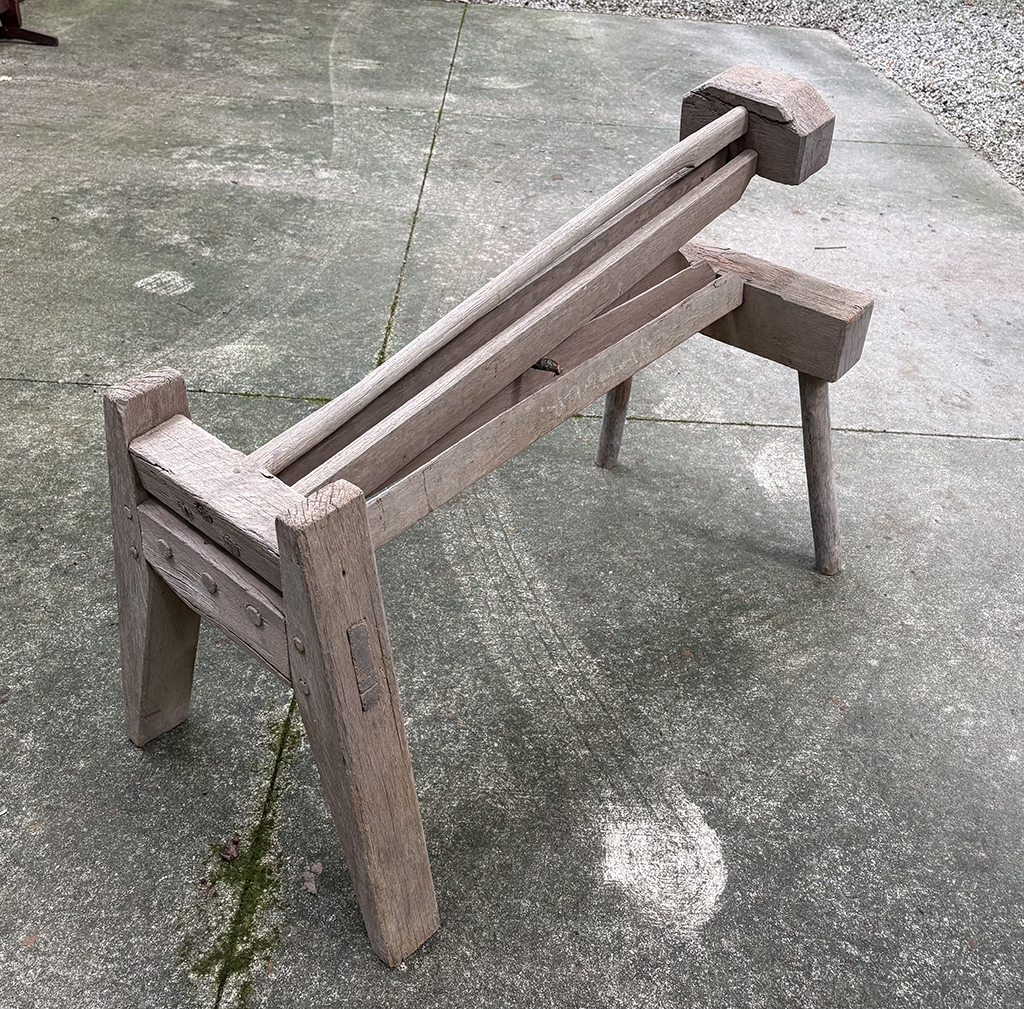
When Stanley wrote about a brake, he is referring to an archaic machine used to break up the fibrous stems of the plant. Brakes were large cumbersome contraptions having two sets of wooden blades positioned parallel to one another but set to intermesh with each other so that they didn’t collide. Typically, the bottom set, which was stationary within a raised wooden framework, had more blades than the top set, which was hinged in order to be moved up and down.
Generally, there were two distinct styles of flax brakes — Pennsylvania German and New England ones The Pennsylvania German version was the heavier of the two, usually raised on four legs so that it stood about two feet off the ground. It usually had four blades on the bottom and three on top. The New England type was lighter, often having three blades on the bottom assembly and two on top. It sat on shoe feet rather than on legs. Both versions utilized mortise- and-tenon and wood-pinned construction.
Of the process Stanley wrote: “First it (the flax) is placed over a big wood fire, above any danger of being burnt, and heated to increase the brittleness of the flax straw. It is then taken by large sheaves and put into the brake where it is pounded and broken between fixed and perpendicularly moving blades of wood until the stem of the flax is completely beaten out, leaving only the fiber.”
“It is then,” Stanley recalled, “passed to the stretchers who take skeins of fiber and throw it over an upright and smooth board and beat the handful of fiber.”
Stanley was referring to a process known as scutching, in which handfuls of flax stems which have been crushed on the brake are laid over a scutching board. Then a wooden scutching knife is used to beat the heck out of the fibers to remove as much of the outer bark from them as possible.
The scutching knife, however, did have a secondary use, which was as the family board of discipline. If a youngster misbehaved, he or she was invariably threated with being the recipient of “a good scutching” on the rear end.
Scutching knives ranged in size, shape and style, some being beautifully crafted out of fine hardwoods like walnut, cherry or curly maple, while others were quite crude. There are also rare examples of double scutching knives which have two blades protruding from the same integral handle.
The scutching removed the short fibers, known as tow, which was used for making grain bags or coarse clothing. (Have you ever heard of a youngster being called tow-headed? This refers to the color of flax tow.)
Like many laborious chores in early America, they were made easier if performed within the setting of a social occasion. Thus, rural communities would hold large scutching parties — or bees — at which residents would haul in their flax to be broken and scutched. Usually, several brakes and numerous scutching boards would be present, and everyone brought their own scutching knives, as well as a dish for a pot-luck lunch. Thus supplied with the necessary food and equipment — and likely a few jugs of liquor to quench the thirst — many hands made light work and significant headway on an onerous job was often made by the end of the day.
Stanley recalled that after the tow was beaten out, “only the true flax remains. The remaining fiber makes pure linen. The fine linen made from pure flax was for tablecloths, women’s wear, ornamental tidies and even fine stockings.”
With the tow now eliminated from the developing linen, it was time for even more steps. Stay tuned for the next column.