




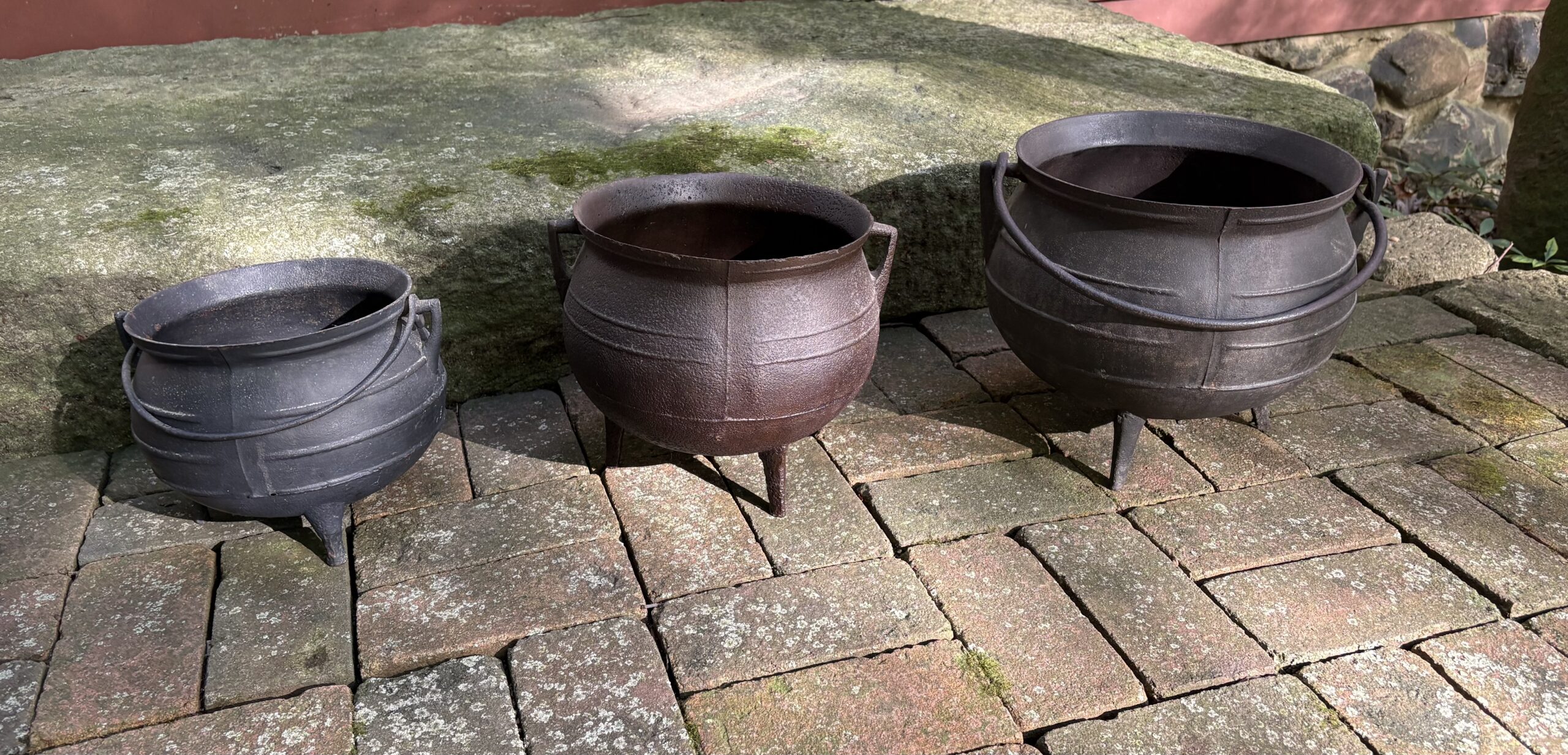
In the opening paragraphs of Conrad Richter’s novel The Awakening Land (which should be a mandatory read during the nation’s 250th birthday celebration for all residents of what was historically the Ohio country), the main character struggles through the trackless wilderness west of the Ohio River carrying “the big kettle and little kettle packed with small fixings.” She has lugged them all the way from somewhere in southeast Pennsylvania to where she and her family will homestead in the darkness of the vast virgin forest.
The kettle
Of all the items brought by the early settlers, arguably none was more important than the iron cooking pot — or kettle or cauldron. The pot was the vessel in which not only cooking chores were performed, but where water was heated for bathing, where clothing was washed, hides soaked and much more. Without a good iron cooking pot or two, a family’s odds of survival in the hostile forest environment were markedly diminished.
Most of the early iron pots that found their way into the Ohio country were cast in Pennsylvania at foundries in Philadelphia, Lancaster, and later Pittsburgh. While earlier forms of pots existed in the eastern U.S., the style that most commonly crossed the Appalachians and Alleghanies was the so-called flare-top kettle.
The walls of this style of kettle were thinner than its earlier counterparts, substituting exterior ribbing for strength rather than simply having very thick sides, which added weight.
Flare-top kettles were in the shape of a compressed ball. They were manufactured in graduated sizes, which ranged from very small pots for sauces to monster-sized vessels in which a grown man could comfortably sit. They typically had a wide, outward-flaring lip and three triangular-shaped feet on the bottom. These feet were arranged in a triangular configuration and were two or three inches in length, thus allowing them to stand over a bed of hot coals on the hearth.
Handles
Just beneath the lip on opposite sides of the vessel were two “ears” where a handle could be attached. Pots could be purchased with a blacksmith-made handle already permanently attached, although the customer would have had to pay an extra penny or two for that. The cheaper option was to purchase a universal pot handle or pot spreader — also at a cost of a few cents. The universal pot handle resembled a pair of iron tongs, hinged at the center and having hooks at both ends. This handle could be opened or closed so as to hook through the ears of any size kettle a family had or might acquire in the future. Some pot spreaders also had an integrated hook, which would allow them to hang from a crane. This negated the necessity of having to buy an “S” hook from the blacksmith.
Lids
Iron lids were available with kettles, but it seems like few settlers must have bought them, as remarkably few show up today in the antiques marketplace. One possibility is that the lids became brittle over time with the repeated heating and cooling. Because of this, dropping a lid onto the stone or brick hearth would certainly have resulted in its breaking, chipping or cracking. Also, having a lid on a pot would require having a tool to lift the hot lid in a time when potholders and oven mitts were unknown. What was known, however, were lid lifters made by the local blacksmiths. These devices were about a foot in length, having a hook at one end to snare the handle of the pot lid, and a hand grasp at the other end. Using this, the cook could easily lift the hot cast-iron lid and gently set it down on the hearth. Lid lifters were an item that allowed blacksmiths to find artistic expression, and many examples are known in which the smiths incorporated such aesthetic touches as chamfering, bevelling or twisting the metal. Many families, however, would have saved the cost of lids and lid lifters by simply using a piece of board to cover the kettle.
Early iron pots can be identified by a particular hallmark that relates to the method by which they were cast. Such pots were cast upside down in a two-part sand mold. The founder would pour the molten iron into the mold through a small vertical opening, or gate. The mold would be filled to the top, or until the molten iron ran out of the gate. After the pot cooled, the excess iron that remained from the gate was simply knocked off with a hammer. This left a shallow, jagged edge on the bottom of the pot known as a gate mark or sprue mark. Early pots can be identified by the presence of this small ridge, which in later pot manufacturing was ground off.
While early cooking pots do survive today in some numbers, the majority were lost during the great metal drives of World War II, when citizens donated massive tonnages of old metal items to be melted down to support the war effort. Among the plethora of items lost were early iron stoves, street benches, hitching posts, lamp posts, outmoded manufacturing machinery, architectural accoutrements of all types, as well as countless numbers of iron fireplace tools and furnishings. Sadly, many of the kettles that survived the metal drives wound up becoming planters on people’s front porches, a role in which the bottoms ended up rotting out of them.