

After the construction of the fireplace and its chimney were completed, along with some sort of appliance for hanging the cooking pots, it was time to start assembling the myriad other furnishings that would come into play for both heating and food preparation. These will be examined over the next several columns.
Andirons
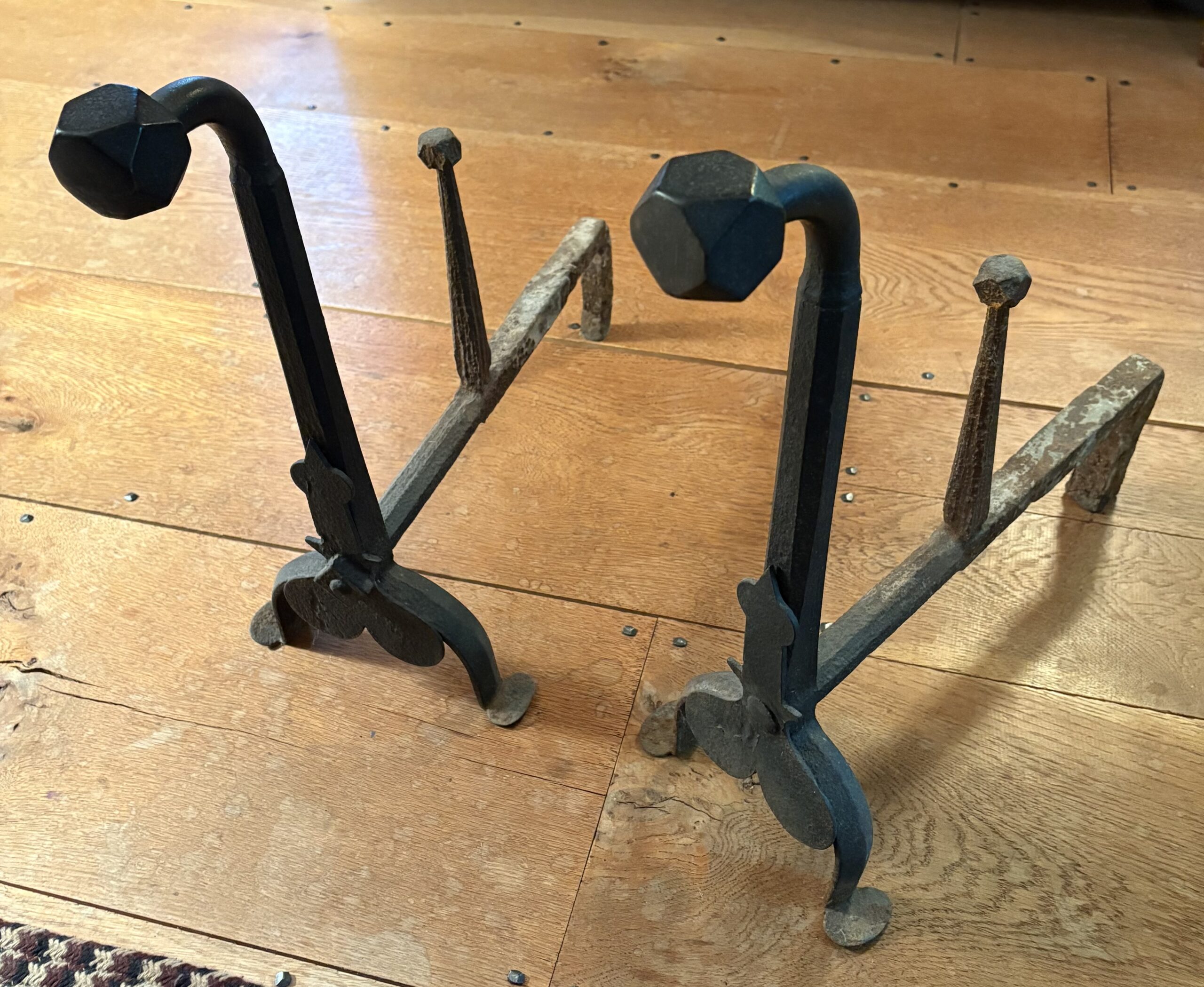
First and foremost, however, the settler had to procure a set of andirons, or firedogs as they were commonly called. In their most basic form, andirons were simply a set of wrought or cast iron risers designed to keep the logs in the fireplace positioned slightly above the floor of the hearth. Why? In order to burn efficiently, a fire needs to have a good draft. In other words, it needs to constantly be taking in air from below, which is heated by the flames before rising into and through the chimney to the outside. The better the draft, the hotter the fire will burn.
In more modern wood-burning fireplaces, the amount of draft is regulated by metal dampers located at the top of the firebox, which can be opened or closed to allow as much heat to exit as the user desires. In early fireplaces, however, there were no dampers. Look up the chimney of an early fireplace, and all you are going to see is the sky. OK, there may be some chimney swift nests or a few little brown bats, but that’s it for obstructions. Because there were no controls of any type, fires in early fireplaces burned very hot — and very inefficiently. It was not really a problem, though, because wood was plentiful. Thus, the fact that vast quantities of it were consumed was not particularly troubling. And utilizing andirons was preferable to having a stack of firewood smoldering on the hearth because air couldn’t get under it.
For the pioneers, therefore, andirons were a must-have item — every bit as necessary as a cooking pot or a crane from which to hang it.
In developing rural communities, the crafting of andirons was the bailiwick of the blacksmith. And the blacksmiths must have taken extreme pleasure in making these because it gave them an unequaled opportunity to demonstrate their imagination and artistic skill. No other purely utilitarian item for the early home incorporates as great a sense of folk art as do andirons. Other than making the log rests the correct depth for the firebox they would be used in and making the uprights proportional to its height, the blacksmiths were unrestrained in their designs. It would be impossible to list the almost endless motifs which evolved from the blacksmith’s forge, but the uprights were adorned with scrollwork of all types, their tops crafted into the shape of various animals, or with hearts, faceted balls, elongated or compressed balls, swans’ necks, pigtails, sunflowers, snakes, diamonds, fleur de lys, knife blades and much more.
The uprights often had twist work, punched decoration, and sometimes a series of hooks on the front so that a rotisserie bar for roasting meat could be suspended between them. Occasionally, at the rear of the log rests there were small secondary uprights used to prevent logs from rolling off the back.
As trade increased with the eastern part of the country, settlers had access to cast iron andirons, often manufactured at foundries in Pennsylvania and New England. Such foundries cranked out molded andirons having a vast array of motifs. Among the most popular patterns were those having uprights in the likeness of George Washington, Hessian soldiers, Indians, owls, cats, black figures, ships, political symbols, classical motifs such as Grecian columns, floral and religious motifs and more.
Pokers
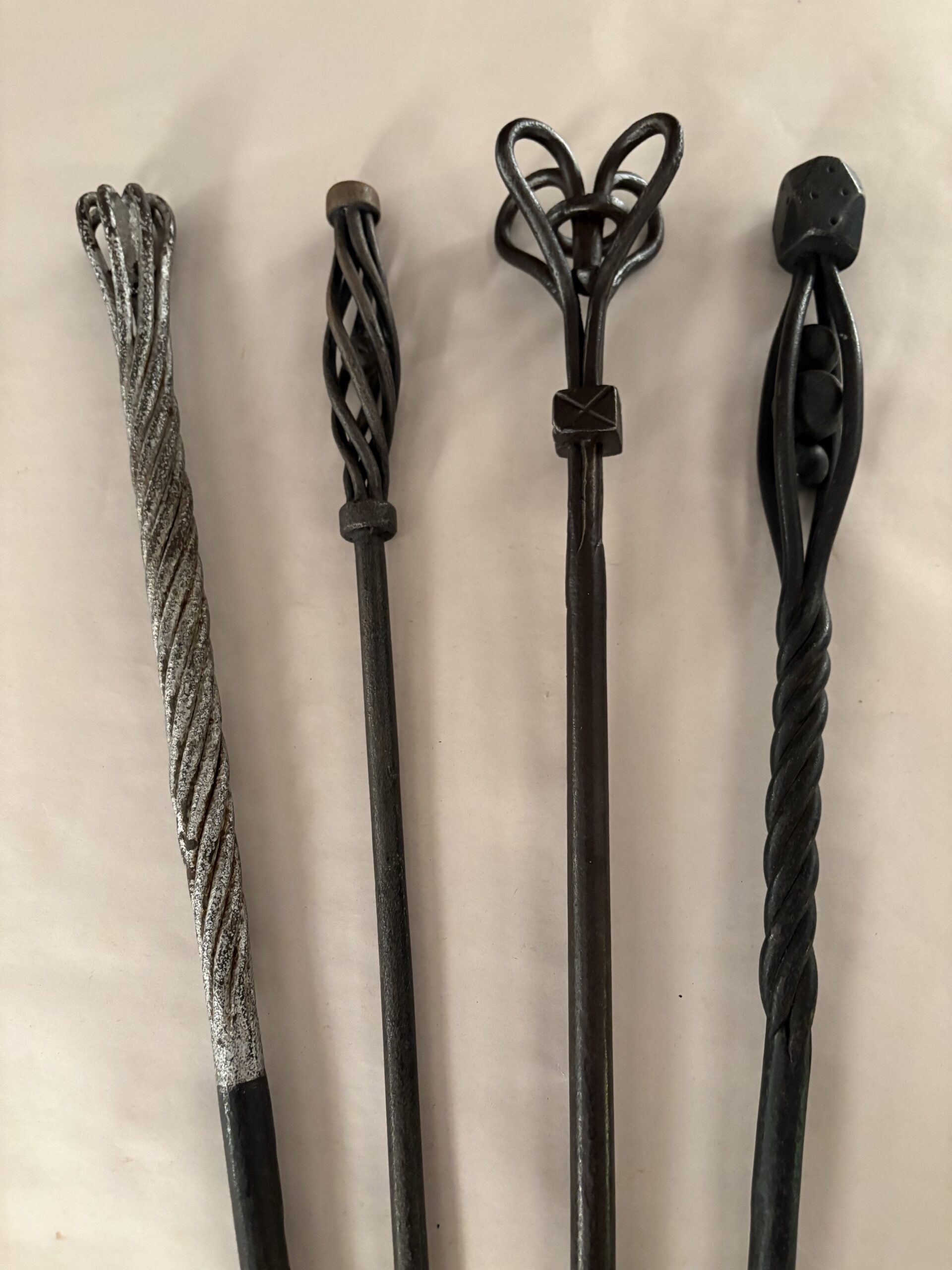
Along with andirons, the next most needed fireplace implement was a sturdy poker. Pokers, also the product of the blacksmiths, were essentially straight wrought iron rods that were tapered to a dull point on the business end. Pokers were used — as the name implies — to poke and maneuver the burning logs. The idea was to keep the logs from compressing atop one another on the andirons, thereby preventing air from circulating between them and resulting in inefficient burning.
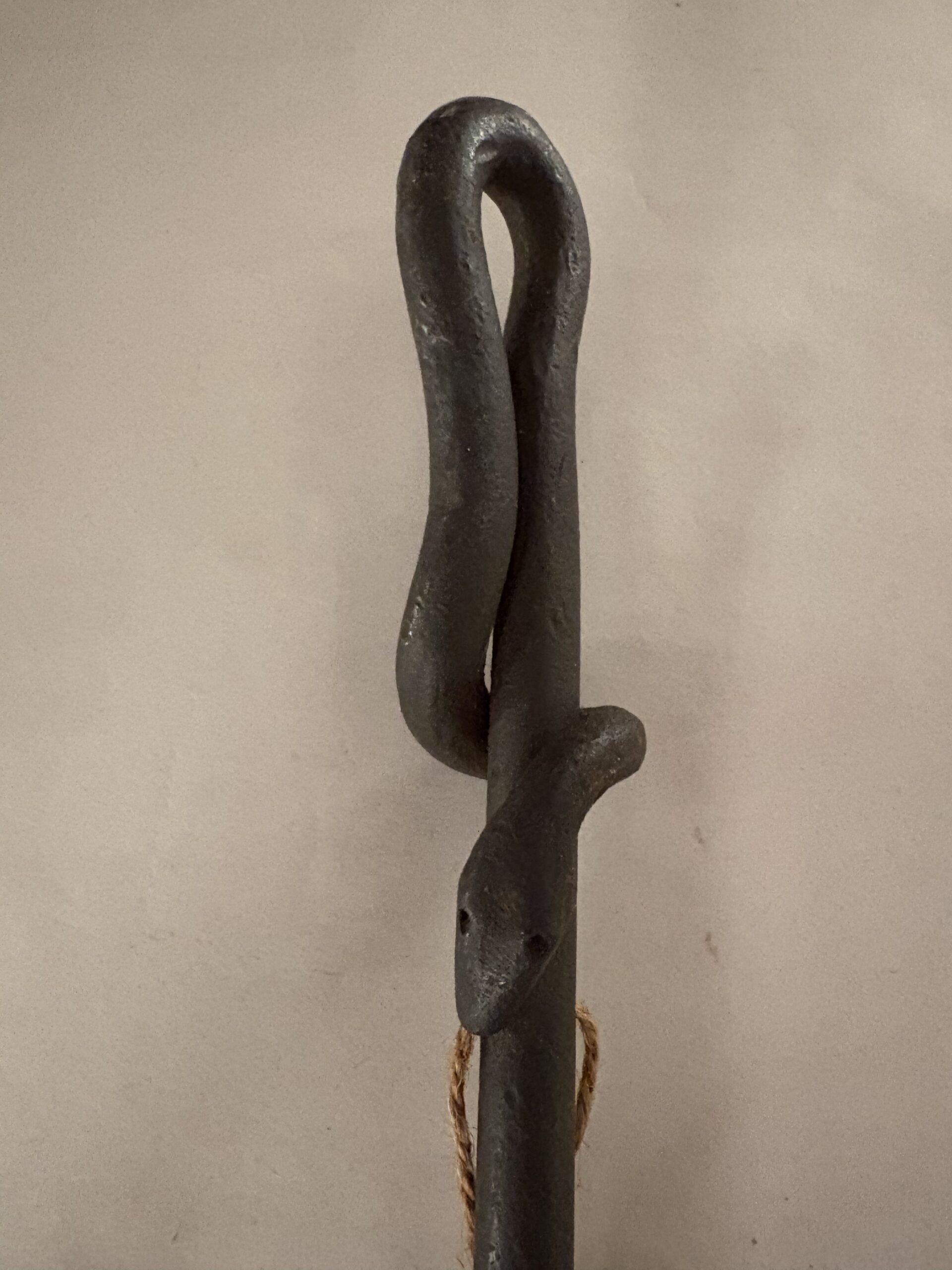
Like the andirons they were used in conjunction with, pokers were another utilitarian item that blacksmiths put a great deal of creativity into crafting. Most of the artistry in pokers is found at the top, or handle, though it is not uncommon to find a serpent snaking its way up the entire length of the rod to the handle. Many poker handles were made as cages that contained multiple marble-sized iron balls. Some terminated in faceted or compressed balls, hearts, dice, openwork designs formed from decorative twists in the iron, and even in designs that resemble flames.
Often, blacksmiths would split the iron rod into multiple strands halfway up and decoratively twist them before connecting them into the handle.
Today’s wood-burning fireplaces still require the use of andirons and pokers, but their now homogenized designs do not in any way resemble the artistry of those hammered out by the blacksmiths of pioneer times.