

The recent state budget bill, House Bill 96, enacted new changes for Ohio beekeepers effective next year.
The $5 registration fee has been eliminated! This fee was collected for each apiary registered by location when you submitted the paperwork registering your hives. Beekeepers will still be required to register their hives and apiary locations with the Ohio Department of Agriculture.
Other changes apply to queen rearing and package bee sales. Beekeepers intending to raise queens or nucs for sale must submit a certification request accompanied by a $50 annual fee, which covers all queen rearing and or nuc production locations. Before this law, each location would have had to be registered for $5 each and inspected for a separate certificate. These changes shift the financial burden from the hobbyist to the sellers of nucs and queens.
The Ohio Department of Agriculture will continue to maintain oversight of the apiary inspection program, registrations and queen certifications in collaboration with county inspectors to enforce registration requirements.
The ODA will transition to an online licensing program with provisions for individuals lacking internet access. The new system will identify hive locations as sensitive areas to safeguard against specific pesticide locations.
Winter mite treatments
In the next few weeks, you will need to start your preparations to treat your bees for mites before they start raising their last round of brood for winter. These bees that emerge in late September and early October will be the majority of bees that have to survive the winter. It is vitally important that these bees are free from the viruses that the varroa mites spread, which will help the healthy colony to survive the winter. Preparations, including treating for mites and additional feeding if necessary, will largely determine your colony’s survival rate.
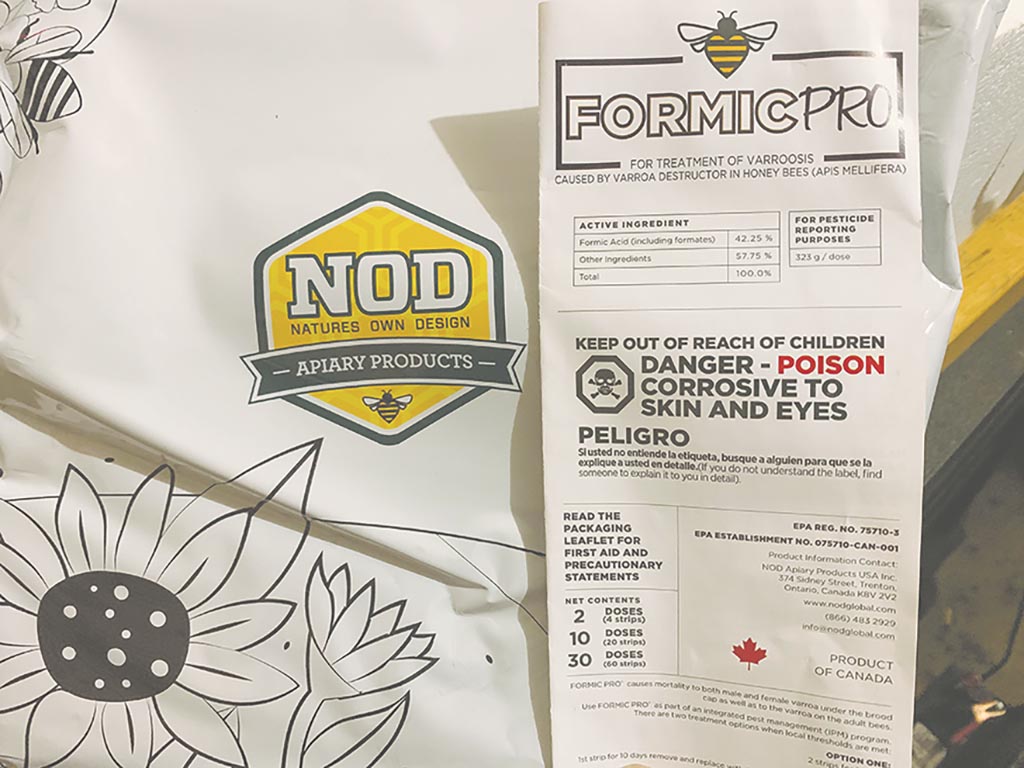
One of the most preferred fall mite treatments is the use of Formic Pro, a gel strip wrapped in eco-paper that acts as a wick to control the release of the formic acid vapors. Mites are not expected to develop resistance to Formic Pro, and the product should not be used at the same time as other miticides or treatments.
There are two options or treatment methods, according to the directions supplied by the manufacturer. The first is a 14-day treatment that consists of laying two strips across the full width of the brood chamber in the middle. Add a super or deep with frames to provide space for strong colonies to expand and to allow air flow within the colony. Option two is just splitting the application by placing one strip, then placing the second strip 20 days later. Formic Pro instructions show treatments should not be done when daytime temperatures are 85 degrees and above and low temperatures are below 50 degrees. There is a window in the fall that usually occurs mid-to-late August when you should use this treatment for best results.
Formic Pro is available locally at BlueSky Bee Supply in Ravenna, Ohio, for a carton of 60 pads that will treat 30 hives for $170 or a carton of 20 pads that will treat 10 hives for $69. Complete instructions on usage are available from the manufacturer at nodglobal.com.