

Last year, we shared insights on managing heat stress in our article “Cool tips for managing heat stress in dairy cows.” Since then, our team has been on the ground visiting local dairies to bridge the gap between general advice and the real-world challenges of our specific climate.
Today, we are sharing what we’ve found so far on a limited number of dairies and inviting you to join this ongoing study. By expanding our reach to more dairies, we can identify the most probable outcomes and pinpoint the specific management patterns that drive superior heat abatement. This approach ensures our recommendations aren’t just based on theory but on the proven performance of dairies just like yours.
On-farm assessment: What to expect
We provide a comprehensive heat stress assessment of your high-producing cows and pre-weaned calves at no cost to the producer. This project is funded internally by The Ohio State University, ensuring an independent, science-based evaluation of your facility. We know your time is valuable, so our five-day visit is designed to be as non-intrusive as possible.
We begin with a brief manager interview and an assessment of housing and management practices. We then install sensors to capture the local microclimate and equip a sample of animals with trackers to measure their lying patterns.
For the next three days, we monitor animals’ respiration rates and activity (e.g., feeding) to see exactly how your herd responds to heat. On the final day, we remove all equipment.
Following our visit, every participating dairy receives a detailed report that identifies specific challenges and opportunities within your current heat abatement strategy.
What our 2025 data reveals
Our visits to seven Ohio dairies (averaging 82.4 F) highlight why these “deep dives” are so valuable. While all dairies were equipped with fans, those that also utilized soakers over the feed bunk saw a distinct advantage:
• As temperatures rose, dairies using fans alone saw a significant decline in cows at the bunk. In contrast, dairies with soakers plus fans maintained higher feeding activity. For a producer, keeping cows at the bunk is the key to preventing the “summer slump” in milk production.
• While respiration rates averaged 70 breaths/minute across all dairies, the rate of increase was much steeper on farms using only fans. Soakers provided a critical buffer, slowing the physiological spike and allowing cows to spend less energy dissipating heat.
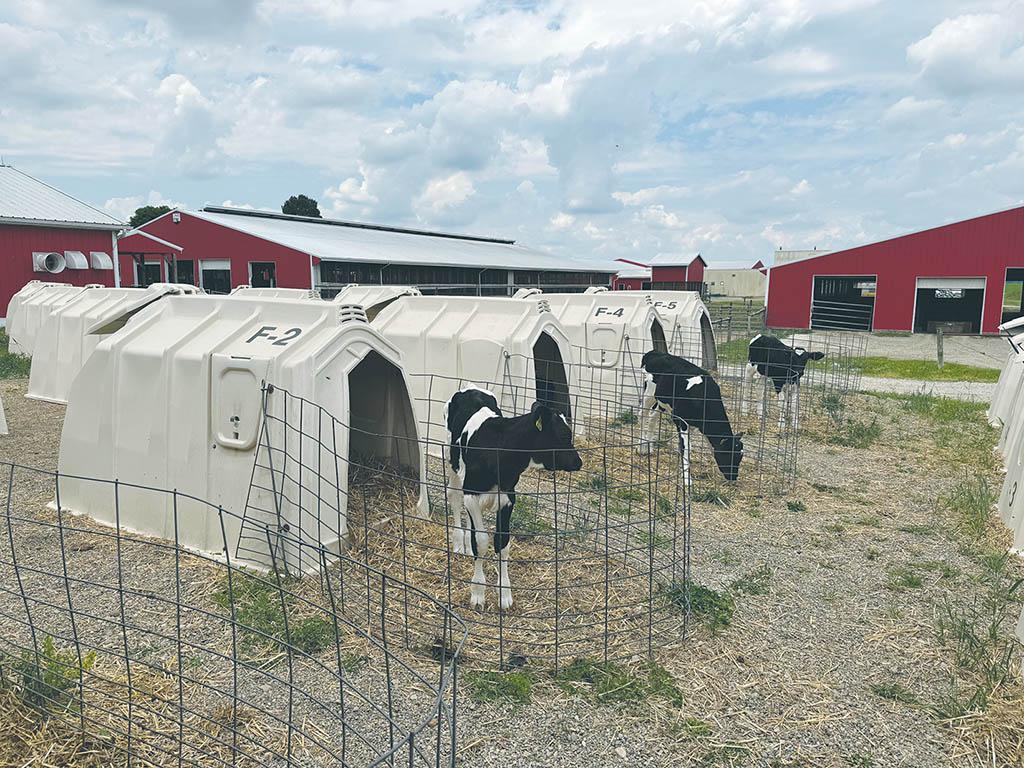
Calves in hutches experienced a much sharper increase in respiration rates compared to those in pens, specifically, an increase of 4 versus 1 breaths/minute for every 1 degree Fahrenheit rise in temperature. Even with vents open and water refills, calves averaged 89 breaths/minute across dairies. This indicates they were working hard to dissipate heat, likely diverting energy away from growth and development.
Why your participation matters
These initial results are compelling, but to move from general observations to reliable, localized recommendations, we need more dairies to come on board.
By participating in this project, you aren’t just helping university research; you are helping us build a roadmap for cow comfort and productivity that is tailored specifically to our region’s climate.
Ohio dairies: Join our 2026 study
If you operate a free-stall system in Ohio with 200 lactating cows and are interested in participating, visit https://go.osu.edu/awer_dairy or email us at awer@osu.edu.
(Israel Obadare and Teresa Carlson are graduate students in animal sciences. Dr. Grazyne Tresoldi is an assistant professor of animal welfare at OSU’s Department of Animal Sciences and can be reached at Tresoldi.3@osu.edu.)