


SALEM, Ohio — Small but mighty describes the Moser Woods Tree Farm, where hundreds of newly planted oak trees are growing in a 12-acre woodlot.
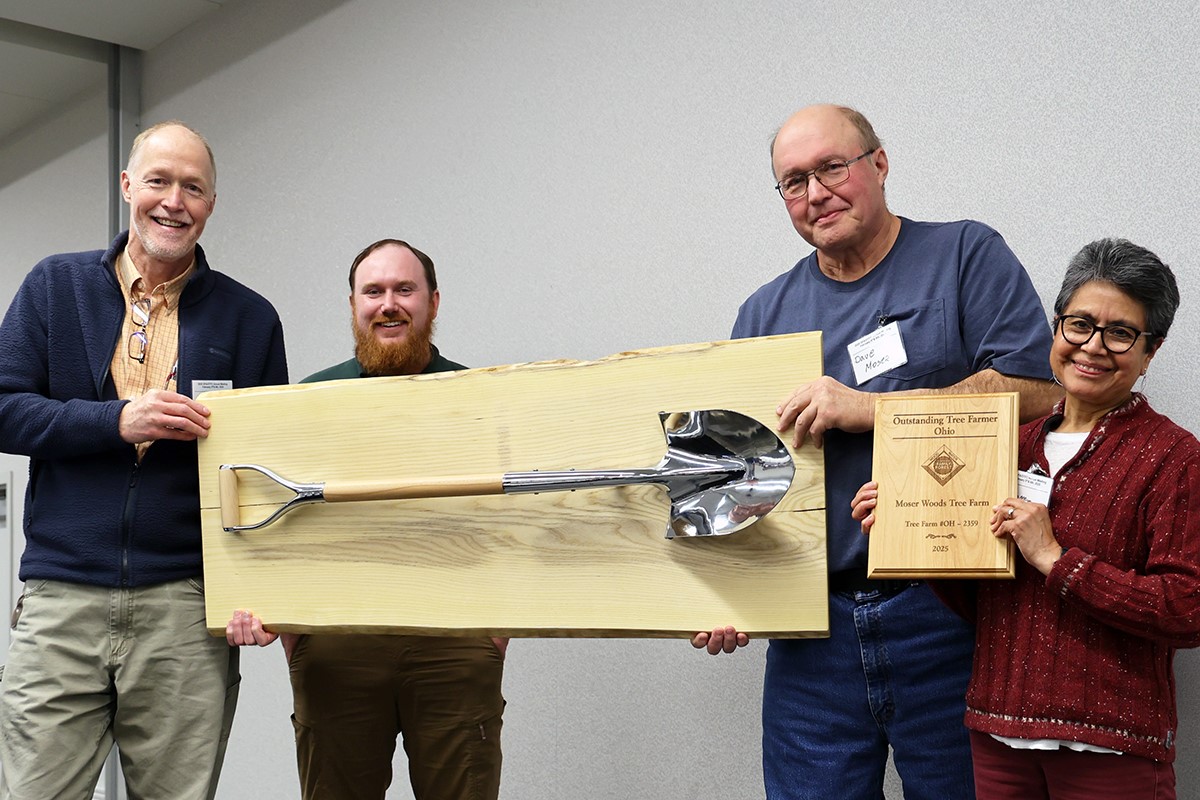
These trees were planted by Chris Moser, the recipient of the 2025 Ohio Tree Farm of the Year award. What started as a goal to manage invasive species turned into a full-fledged effort to give back to the woods he was raised in.
As part of the Ohio Tree Farm of the Year award, Chris will host a tour on Sept. 6 from 10 a.m. to 3 p.m. at his farm, 12300 Bentley Road, Bluffton, Ohio.
“Chris’s woods is only 12 acres. It’s not very large, but, boy, he’s done a lot of stuff in those woods over the years,” said Tom Mills, member of the Ohio Tree Farm Committee.
Where it all started
The Moser family has a long history of forestry management that dates back to Chris’s grandfather, Ezra Moser, a dairy and grain farmer. Ezra first reached out to the Ohio Department of Natural Resources Division of Forestry in 1951, asking them to conduct woodland inspections for timber harvests on the woodlot — part of the Moser farm, which has been in the family since 1842.
This emphasis on forest management only heightened with Chris’s dad, John Moser, who eventually transitioned the farm to raise Holstein replacement heifers. The family farm is now run by Dave Moser, Chris’s brother, who continues to grow soybeans and corn.
John got the woodlot certified through the Ohio Tree Farm Program in 1987. Then he implemented woodland management practices like timber harvests and invasive species control.
Chris started working on forest management when he moved back to the area from El Salvador — where he worked as a volunteer for the Mennonite church and did humanitarian work — with his family in 2000. Chris and his dad removed invasive species in the woods like honeysuckle, wild grape and multiflora rose.
They also harvested small sections of the woods for firewood. His dad, who died in 2013, played a big role in Chris’s eventual involvement with the Ohio Tree Farm Committee and ODNR’s Division of Forestry.
“He always worked with a forester,” Chris said. “That’s one of the things that I took away from conversations with him. Never let a logger come into your woods without going through your local forester and working with them.”
Efforts ramped up
Chris’s efforts to plant trees in the wood lot started to ramp up in 2018 when Mills visited his farm for an inspection to recertify the woodlot through the Ohio Tree Farm program.
His goals as an Ohio Tree Farm were focused on habitat improvement for trees and wildlife, specifically planting oak trees.
Mills encouraged Chris to apply for the U.S. Department of Agriculture’s Environmental Quality Incentives Program, EQIP, to receive funding to conduct this work. But before he could start planting, he had to remove some trees.
“If you don’t open up the canopy again, nothing’s going to grow anyway,” Chris said.
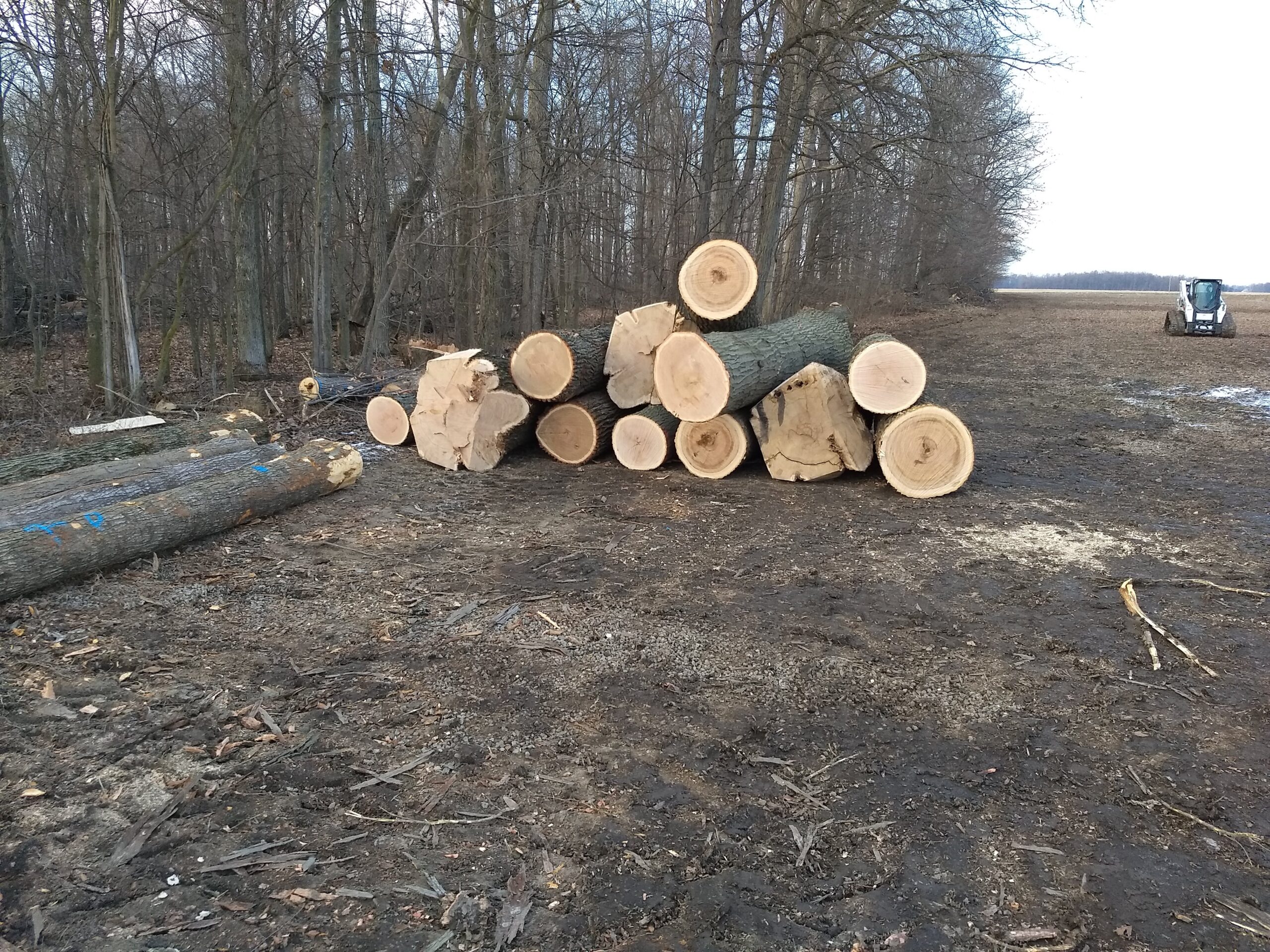
So, in 2019 and 2020, he worked with a local logger, John Schulte of Schulte’s Logging in Pandora, Ohio, to conduct a timber harvest.
Timber harvests should be conducted on a “sustainable yield basis,” says Daniel Barlett, a service forester for the Ohio Department of Natural Resources Division of Forestry who started working with Chris in 2018.
Meaning, “If you take out about around 20% of the timber every 15 years, it gives you a 75-year rotation, and that’s usually the time frame where a tree (grows) from a seedling up to a full-size tree,” Bartlett said.
Oak reestablishment
In 2020, Chris began implementing conservation practices through the EQIP program, including building wildlife structures, removing more invasive species — an annual event, Chris says — and planting oak trees.
“White oak is one of our most valuable and beneficial species to wildlife, to economics, to people. They provide tremendous benefits,” Bartlett said. This includes being a prime food source for wildlife (acorns), a large carbon sink and one of the highest valued trees for timber.
But there’s a huge problem: In the last 40 to 50 years, fewer and fewer white oaks are growing in forests. That’s because they’re being outcompeted by shade-tolerant sugar maple trees, Bartlett said, and sunlight isn’t reaching the forest floor. Oak seedlings need lots of sunlight to grow.
“(This outcompeting nature is) a natural process,” he said, explaining how in pre-settlement America, wildfires would come through the woods, killing the thin-barked maple and beech trees, allowing the oak trees to reproduce.
“When we took fire out of the ecosystem, it had that unintended consequence of now the white oaks were at a disadvantage and the maples were at the advantage,” Bartlett said.
In order to balance this out, Chris and Bartlett began removing sugar maples and beech trees and planting a variety of oak trees, including red, chinkapin, white, burr and swamp oak trees, and walnut trees.
Through the EQIP program, Chris was able to plant 300 trees. But he didn’t stop there. He continued this work through the USDA’s Conservation Stewardship Program, or CSP, starting in 2021.
Through the program, he has planted 730 more trees so far. Today, Chris has planted 1,100 trees on his woodlot, planting 130 swamp and white oak trees just this spring.
Ohio Tree Farm of the Year award and tour
Mills nominated Moser for the Ohio Tree Farm of the Year award last summer. “I was surprised that they wanted to highlight the work that we had done here, because it’s a small woodland lot,” Chris said.
“But I thought what an honor to represent other tree farmers in northwest Ohio, and what an opportunity to encourage others that have a woodland lot that’s between 10 and 20 acres do something similar,” Chris said.
The Moser Woods Tree Farm was honored with the Ohio Tree Farm of the Year award earlier this year, not only for all the work Chris did, but all the work his family conducted before him, Bartlett said.
“Chris put a ton of work into this woods, and we kind of want to showcase that and get more people inspired to take oak facilitation seriously, to work on their woods, see what’s what’s possible” Bartlett said.
As part of the Ohio Tree Farm of the Year award, the winning tree farm is expected to host a tour. This year, the tour will feature a timber harvest and information on tree and shrub identification, vernal pools, USDA cost-share programs, maple syrup production, how to become an Ohio tree farmer and the importance of oak regeneration.
Mills is specifically encouraging farmers with small woodlots to join the tour.
“There are a lot of corn, soybean and grain farmers (in Ohio) that have small patches of woodlands,” Mills said. “There’s no reason why they can’t manage that patch of woods as an overall part of their cash flow.”
For more information, call 419-721-1465.
(Liz Partsch can be reached at epartsch@farmanddairy.com or 330-337-3419.)




