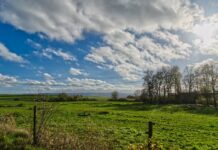

As the growing season is coming to an end, did you get what you wanted out of your pastures and hay fields? Each year presents us with new and different challenges, and this year the overall consensus would probably be the rain. But the rain has just been a big focus here the past couple of months, with some parts of the state seeing around a full year’s amount of rain in just a couple of months.
I know that evaluating is not everyone’s favorite topic, but it is what helps us learn, improve and hopefully make better decisions in the future. As you look back, it may be good to write things down so you have records, and if you ever want or need to compare years, you can.
Now let’s focus back on the growing season. There are areas that we can focus on to help see how your pastures and hay fields did this year. Like, how did your grazing plan hold up? How did your forage species perform? What is the quality and quantity of your hay? Conduct a feed inventory review. How did your infrastructure hold up? Perform a financial evaluation. And looking ahead to next year. This can be a good list to get you started, and I won’t touch on all of these in this article, but these are some things to get you thinking.
Did you follow your grazing plan?
As you get towards the end of the growing season, it is good to look back on your grazing plan and see how it went. As you are looking back, some questions to ask yourself are: Were you able to stay on your planned rotation? If you did not, what were the reasons why? On my family’s farm, we have a field that we skip because when there is a big chance of rain, the creek runs through it and can come up fast. This year, towards the end of July, I saw that field was more underwater than I have ever seen in my life.
How flexible are you?
Do you have enough flexibility built into your system to handle weather extremes like what I just shared? When you get to looking and thinking about your paddocks, did the recovery times fit in with your grazing rotation? Now think of those areas that may have been overgrazed or areas that became too mature. Could there be a reason as to why that is, like shade, where the water is located, or where their mineral is located? If all three of those are in one area of the paddock, I bet that area was overgrazed and the rest of the field not so much and over-matured. Always remember that the animal’s goal is to eat the best-tasting, most desirable plant available and if that plant regrows, eat it again. The plant’s goal is to reproduce and produce a seed head.
How have your forage species been performing?
We have had some tough past couple of years, with drought and rain. Looking at the past three years of where I am at in southeast Ohio, we had severe drought in late summer and fall of 2024, a wet spring and early summer, then drought conditions again in the fall of 2025, and then in 2026 we started dry in the spring, then got some rain, and then in the summer the rain started. Why did I just review the weather from the past three years? The reason is to think about what forage species thrived in those conditions and what did not. Did you notice one that dominated more than it did in years past or were there areas where grass thrived and no legumes or vice versa? This year on the farm, we noticed that there was a lot more red clover.
Do you need to do a seeding next year?
I bet there are spots in some fields that got drowned out with the saturated soil or just standing water. Are there spots that did not recover from the drought conditions from the years before? A seeding does not always have to be a complete do over for the entire field, it could be as simple as doing a frost seeding to add some legumes to a majority grass stand.
Start thinking back.
There is still a lot that we could talk about on this topic of evaluation, but this was to get you thinking on this topic. When it comes to making management decisions for the next year, they are made ahead of time and not the day of. So, take some time and walk or drive through your fields and recall how they did, and just maybe you can find a thing or two to improve on for next year. These past couple of years have provided some stress tests for your pasture; will you be ready for the next one?