


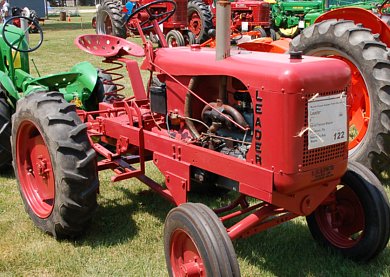
ABOVE: A 1946 Leader tractor owned by Bob and Frances Weaver of Stoneboro, Pa., at the Mercer County Antique Power Association show in 2010. This tractor has “Made in Auburn Ohio” on the front. (Sam Moore photo)
A few weeks ago I received the following note:
My name is Ben Zajicek, I am 14 years old and was wondering if you might do a piece on the Leader tractor company of Chagrin Falls. After all, it is a tractor that was made close to home. My grandfather bought a 1948D model tractor new, my uncle now owns it. My dad bought another that was used and has given it to me. It needs work but it did run. Any information you can give me would be a help. I’ve researched it at school, but couldn’t find much on it. Thanks, Ben.
First, Leader tractors were actually made in Auburn, Ohio, not Chagrin Falls, but I’ll get to that later.
During the 1930s, a father and son, Lewis and Walter Brockway, farmed and tinkered in the tiny community of Auburn, a few miles southeast of Chagrin Falls, Ohio. It seems likely that they ran a repair shop, as one source says Lewis was a sub-dealer for a Chagrin Falls Chevrolet dealer.
American Garden Tractor
About 1937, the two put together a small, 4-wheeled garden tractor using a Chevy 4-cylinder engine and transmission. The little tractor caught on locally, and the American Garden Tractor Co. was formed to build 20 or so tractors per year.
It seems some of the machines were called American and some Brockway, and they were probably painted red.
Early Leaders
The Brockways formed the Leader Tractor Company in 1940 and designed a new machine that was larger and heavier, although still with a Chevy four engine.
The first Leaders resembled the later versions, although they had round steel plates for rear wheel centers instead of square, and a fabricated tin grill instead of cast iron. Instead of red, the early Leaders were dark green with black wheels and a single bottom hand lift mounted plow was available.
About 1944, a dozen or so larger tricycle-type Leader tractors were built. Painted yellow with red wheels, these machines were designated as the Model A and were powered by a 6-cylinder Chrysler engine. At least one of these survives and I saw it at Portland, Ind., (I think) some years ago, but can’t find a photo.
Engine change
By 1945, the supply of 4-cylinder engines from Chevrolet had dried up and the new Leader Model B that came out that year used a Hercules IXB 4-cylinder flat-head engine.
Nothing much else was changed, except for the all red paint job, square rear wheel centers and a rounded sheet metal nose with a perforated grill, although some may have had an expanded metal grill.
‘Made in Auburn, Ohio’
In 1946, the lower part of the nose was cast with “Made in Auburn Ohio” on it. As Leader tractors began to spread around the country, many farmers who saw them liked them and wanted more information. They wrote to the factory, addressing their letters to just Auburn, Ohio. These letters went astray or were returned because tiny Auburn had no post office.
The Model B was replaced by the popular Model D, which is the one most often seen at tractor shows, in 1947. The D was almost identical to the B except for a cast iron grill with the Leader name cast vertically in the center divider and, to eliminate the mail problem, “Made in Chagrin Falls Ohio,” under that. Chagrin Falls had a post office and, in those far off days before zip codes and strict post office rules, that the mail got through.
Auto dealer marketed
The Schott Brothers, who owned a string of automobile dealerships in Ohio, handled the marketing for all Leader tractors, which were selling well during those tractor-starved days. They wanted more production and loaned the Brockways a large sum to finance expansion of the factory facilities.
Unfortunately, the loan carried a pay-on-demand clause and, in 1949, the Schotts called in the loan, forcing the Brockways to sell the company to the Schotts, who closed the plant and scrapped the remaining inventory.
Enter the Brockway
Lewis and Walter Brockway started again. They bought a foundry in Bedford, Ohio, and began to build a much better tractor they called the Brockway. Apparently the Brockway Truck Company of Cortland, N.Y., which had been in business since 1912, raised no objection as long as the Ohio firm was strictly a farm tractor manufacturer.
The new Brockway tractor bore a resemblance to the erstwhile Leader, although it was somewhat larger at 3,100 pounds, was painted dark yellow with red wheels, and was available with either a gasoline or a diesel engine.
Never tested at Nebraska, the Brockway 49G had a Continental F-162 gas engine rated at 42.8 HP, while the Continental GD-157 diesel engine of the Model 49G was rated at 30.6 HP.
While not a true 3-point hitch, the Pesco hydraulic lift allowed an attached implement to be raised and lowered.
Not quite 500 Brockway tractors were built from 1949 until production ceased in 1959.
Got to drive one
During the summer of 1949, I was working for a neighbor who did custom farming. My job was to drive a tired Farmall F-14 pulling a Case pickup baler.
We were baling on a quite steep hillside field and the F-14 was having trouble. The farmer for whom we were baling was planning to become a Brockway dealer and had a brand new one in stock. He suggested we hook the Brockway to the baler to see what it would do and let me drive it.
What a joy that Brockway was over the F-14 — electric start, padded seat, hydraulic drawbar, four speed transmission, foot brakes, and plenty of power — I was in heaven.
I went home that evening and tried to convince my father to replace our Ford-Ferguson with a Brockway, but no sale.
So, Ben, that’s about all I know about Leader tractors. You might want to contact Henry E. Hahn at the Leader Tractor Club, 7606 Hwy. J, Perryville, MO 63775; 573-547-8693. Good luck.
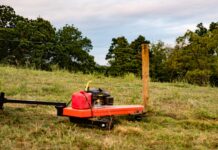




I have a Leader tractor that according to this article is somewhere around a 1947 or older. it has the leader going verticle on the nose and says Made in Chagrin Falls, Ohio. it is in need of some tlc and it was running when we parked it we just have not tried to start it up anymore. prior to receiving it someone has done some alterations to the seat and tried to do some very minor welding. i am interested to know what the value of this tractor and where i might go to notify interested buyers of my intent to sell. any answers will help thanks
Dawn
If you still have the leader let me know I might be interested if you are not too far away.
Has anyone ever compared a Leader tractor to a Bombardier tractor?
I bought a 1946 Leader last week in reasonable condition. I want to restore 100 % to it’s original look and operation but battle to find any technical information, wiring information, original paint codes and tyre sizes. I live in South Africa. Can anybody help me with information or contact detail to source information. On the front grillit specify Made in Auburn Ohio and on the engine manifold HERCULES.
I have recently purchase a tractor likes were you able to get the information you requested? If so would you please pass it on to me?
Thanks
Dave Baxter
PRESENTLY; I HAVE TWO IN MY POSSESION. I BELIVE THEY ARE ( D ) MODELS. THEY HAVE THE VERTICAL LEADER ON THE GRILL HOUSING. I GOT THE PAIR TO COMPLETE ONE. IF INTERESTED, LET ME KNOW.
Also looking for the – Leader tractor grill !!! Please message me if still available !!!
I have a leader 48d for parts it has a good grill you can see it on craigslist under Mansfield Ohio farm and garden
What kind of price
I have an old leader tractor that has a homemade front end loader made by my brother inlaw when he was 16.
He is now 67. The tractor was parked about 15 yrs ago. Unfortunately I will not be restoring this tractor. I don’t want to see it go for scrap. It is quite a relic a bit hard on the eyes but too good to throw away.
I would like to hear from people with Ideas as to what I could do with this tractor
were are you located I have a 46 B that I show but also use to plow snow and use as needed if you are interested in selling let me know or I could possibly restore for you I do restore tractors mostly international but I have restore my leader and have got many ribbons and trophys
I JUST GOT ONE AND WOULD LIKE SELL IT. THE TRACKER HAS SQUARE CENTERS ON REAR RIMS AND A 4CLY INGINE. IT IS MISSING PART OF TRANS AND HAS BEEN SITTING FOR A WHILE BUT FROM WHAT I HAVE BEEN READING IT DOES NOT BELONG IN A SCRAPYARD. IF ANYONE WOULD LIKE IT PLEASE RESPOND. THANK U.
Mr Dave I have a 46B good shape and runs hydraulics work that I have gotten a hold of and will sell it’s well worth restoring my number is 251-207-8279 my name is Joel
I have a nice leader tractor handed down. Can you change it to 12 volt
I have a 1946 Leader “D” model. It runs great, but the transmission is going bad..I think the 2nd gear syncronizer is gone. It will not stay in second gear, it keeps popping out. I works great in 1st and 3rd however. Where can I locate parts for the transmission. GREAT Tractor and I love it. I’d like to restore it back to OR close to original, starting with the transmission.
ANY help in locating parts would be greatly appreciated.
JP Cole
Coats, North Carolina
Do you still need transmission
Bob we need a govner for one do you have one please call 937 346 7960
Sorry for the long wait time on the reply. I’m in the military and have been deployed for a few months…BUT…Yes…I do…do you by chance happen to have one? If so, can I call and talk to you about it?
JP Cole
(910) 818-0601
Yes…I sure do. Do you have one or know of anyone or anywhere I can get one. 1st & 3rd gears are good..just missing 2nd. It will not stay in gear.
JP Cole
910-818-0601
Coats, North Carolina 27521
Bob I don’t know if your the one we got parts from and a leader with diesle in it if so could you call me at 937-346-7960
I forgot to mention I also need a radiator for my 1946 Leader. It has started to leaking and my repair shop says that there’s not much more he can do for it!
JP Cole
Coats, North Carolina
I live close to Rapid City, SD. send me your e-mail address and I will send pictures and more information.
Thanks
Dave Baxter
dbaxter@gwtc.net
This is so cool to see that people are interested in Brockway/Leader tractors! I am a Brockway and my great grandfather started the company. I know he would have loved to see that people take such interest still! I love seeing what people do with their tractors since we still show with our historical engine society.
Katie, my coincidence; my wife and I are now the owners of Al and Patsy Brockway’s old home and I have a ’48 Model D I’m working on getting running. We’ve taken to calling this place “the Brockway Property” too.
I just bought a Leader D 1948. I need a wiring diagram, paint color. Where would a person locate new shoes for the brakes and clutch disk? Thanks for your help.
I have a Leader tractor I am not sure what I have I want to restore it I need all the help on where t get parts I want to do i engine overhaul first you can help i would be greatful
I am working on a Leader D 1948, I am in need of the 10 splined coupler that drive shaft and transmission shaft are fastened together with. This is right in front of transmission.
Email me your phone number. dizzyliz85 @yahoo.com mine is a 48d
I want to thank Bob for his help in supplying me parts for my tractor. The parts were real nice and he is great to work with, if you need parts don’t miss this chance.
Trying to wire Leader D tractor. I can not find a wiring diagram. On -off switch, starter button and solenoid for starter. Positive ground. I have neg from battery to one side of solenoid from that lug up to neg on amp gauge. Other post to starter. Small post on solenoid to starter button. I have six volts to amp, starter switch, and up to one side of starter button, when I hit starter button I lose voltage,( back feeds) so no voltage to energize solenoid to engage starter. NEED HELP, I am not having any luck, been changing wires and cannot get any farther than this
Need help in finding the paint color for restoring my leader tractor. If anyone can help. Thank you
I am working on aLeader A with the Chrysler 6 with the wide front,also have a narrow ,we know there are 5 still around.
Len, where are you located? Would love to see pictures of your Leader Model A!
Could you share some with me at cdmhogan@usit.net ?
Thanks in advance!
Cleo
I have a leader tractor with the heercules engine. I am have starter problems. anyone out there have a replacement starter part number available , or a place to buy one.. thanks
Danny, you will have to take it to a starter rebuilding place. You need a solenoid in the circuit to the starter. Be sure you have good ground on positive to frame and at all connections. All cables with good connectors. I spend two days trying to figure out why my starter won’t work, it was a bad end on my ground cable.
Danny, check your ground cable, you have a solenoid between starter. All the connections have to have a good connection. There are shops that rebuild starters. You will have a very hard time finding one unless some one is parting out one.
I have a complete all original 48d its been sitting in a field for 25 years and after all that time it still looks to be in good shape I’m sure the motor is locked up but I haven’t tried to do anything with it. it is for sale just have no idea what its worth. I’m in Germantown Ohio make an offer Rusty Pearson 513 392 1731
Restoring`A LEADER TRACTOR need starter mz4065 (5c) and generator GAS4128 417 529 1414
i have a 48D leader tractor for sale I want to sell it as a whole unit if that doesn’t work I may part it out starting bid is $800 text Rusty at 513 392 1731 I’m in Germantown Ohio 45327
Rusty Pearson if you still have your 1948d leader tractor i would like to talk with you. I am presently finishing restoring one for my employer . you can call me at area code 717 668 5644 thanks
I have acquired a leader tractor act one and a half for parts with the chagrin falls grill is there any body interested THANKS BOB.
Our 1949? Leader tractor with a Hercules engine is running hot and we are trying to find the location of the thermostat. Any ideas?
There is not thermostat on that tractor, is the fan belt have about 1″ play, check radiator to see if fins are blocked so that the air can not get thru to keep water cool. Flush radiator. Mine runs at about 210 degrees on heat gage.
Have a 1948 ? Leader D that I got several years ago. I was going to restore it but have moved and no place to keep it. It will start and run. $1250 Shelbyville, Ky.
Do you still have the tractor Call 417 529 1414
Leader tractor has been my family since 1948 my father purchased one. In 2016 in may I was able to purchased one ,but in July my plans changed because of a high wind with a (tree) it change my desire to finish my restoration which is very expensive to finish up had to put it on h. o. l d for now and time is getting short for Me. Good remories with a Leader Tractor could write a book.
Does anyone know the firing order for Leader Tractor Model D with Hercules IXB engine , Also where a person might get distributor parts or any other parts.
Thanks Much Richard Alberta.Canada
I jst bought a LeaDER AT AN AUCTION-KNOW NOTHING ABOUT IT; HAS A FOUR CYLINDER Herculeaynes IN IT NO BATTERY-IS THIS 12 VOLT?
also , is there a good parts source, catalog?
Thank,
W
6 volt system, the clutch and pressure plate from a Farmall C will fit right in. Steiner tractor catalog, go thru and some parts from other tractor makes will work. Generator is a big problem unless you find some one that will rebuilt it
I have a extra grill for Model D no welds or breaks that I can see. Call 715 five six six 4178
My husband has 1948D Leader tractor 4 clylinder for sale , runs good made in Chargin falls Ohio
asking $1800 but will probably come down. You can call 423-202-6199
I have what I think is a 1948 Leader D tractor! My intentions were restore it but I have other projects in the works and don’t plan to do it now! If anyone is interested in it, I will take $500 OBO for it! The tractor ran good but transmission will not stay in 2nd gear and the radiator is bad…! Call me if interested and I can send pics! 910-818-0601. I live I’m central NC
My wife and I live on Al and Patsy Brockway’s former property and I’m fixing up a ’48 Model D. It’s really cool to see these posts and stories. The Brockway factory still stands next door.
I have a leader model d that had a cracked block but has been welded but not yet resurfaced and I don’t have time to finish restoring everything else had worked great
located in northern wisconsin
anyone interested call 715/661/1849
I have a 1946 according to serial number. I am in need of a distributor. Mine has rusted and cracked counterweight. Can anyone help?
john in mi
engine tag on block behind carb. has firing order. at last mine does. has casting date of 11-7-47. has tappet clearence on tag, .008. has engine #2408130. ixb 15. also has # 3-1/4×4 under the 15. i don’t know what that is.
I live west of Cleveland Ohio and have a Leader tractor that was built sometime after 1945 from what I can tell. The engine needs rebuilt, but everything else is there including a hydraulic lift attachment. Overall in decent shape and lots of parts. I’d like to get $500. If your interested let me know, it’s listed on FB in Market place.
Hello Tom – send me an email if you still have it. AAVparts @ gmail thanks!