
Alfalfa is the “queen of forages” as it provides dairy cows with high-quality nutrition. It is a highly productive crop that is rich in protein, fiber and calcium, and it adds nitrogen to the soil.
Plus, alfalfa is an excellent complement to the “king of forages” — corn silage!
Alfalfa and corn silage have been the basis of dairy cattle diets for decades. In the “blue silo era” of the ‘60s and 70’s, 100% alfalfa dairy diets were touted as the salvation of the dairy farm. The high-priced blue tubes were sold on the basis that they would eliminate purchased soybean meal and save the dairy farm.
But the farm interest rate crisis of the 1980s unfortunately put many dairy farms out of business and the “blue tombstones” in the countryside are a stark reminder that equipment trends come and go.
What stands the test of time on a profitable multi-generational dairy farm is high-quality forage. Dairy farms now feed more corn silage than alfalfa. Is the queen alfalfa still needed in the diets of dairy cattle? This article will answer that question and review innovative alfalfa technology, how it improves forage quality and harvest management, along with the economics of new alfalfa seed.
Alfalfa technology
The U.S. Department of Agriculture Forage Research Center and Forage Genetics International introduced a revolutionary technology in 2017 that improves alfalfa fiber (NDF) digestibility. The improved digestibility is a seed breeding technology that reduces lignin in the alfalfa plant. Lignin is reduced by 12-18%. The technology’s name is HarvXtra.
What is the benefit of lower lignin to the dairy cow? Controlled trials with HarvXtra alfalfa in dairy cattle diets when fed as hay or haylage at 10-15% of diet DM have shown 2 to 4 pounds of additional milk per cow per day.
How does the cow get more milk? Traditional alfalfa has thick and dense cell walls similar to a bank vault with heavy concrete and steel walls. HarvXtra alfalfa has thinner cell walls like a 2-by-4 wall covered with drywall. A 2-by-4 wall is much easier to break through with a hammer and chisel than a bank vault wall. Thinner cell walls allow the rumen microbes’ enzymes, which are like the hammer and chisel, to break down and digest the fiber. Faster fiber breakdown results in more energy for the cow, which increases milk per cow.
Brown midrib or BMR corn silage has lower lignin and results in higher performance, but has lower crop yields. HarvXtra alfalfa has been shown to have the same or higher crop yields than conventional alfalfa. With BMR corn silage seed discontinued, the usage of HarvXtra alfalfa has the potential to improve total ration fiber digestibility without BMR corn silage or its drawbacks.
Alfalfa harvest
HarvXtra alfalfa offers a more flexible harvest schedule. Traditional alfalfa, when mowed on a 30-day interval (five cuts per year), will provide high-quality forage. HarvXtra alfalfa can be mowed on an extended 38-day cut interval (four cuts per year) to provide high-quality forage with higher tonnage and one less trip across the field.
Wisconsin research has measured alfalfa regrowth on a three-cut versus a four-cut system. The HarvXtra three-cut system improved alfalfa yield by 20 to 30% with less equipment cost than a four-cut system.
If traditional alfalfa has a delayed harvest, it turns into poor-quality, stemmy alfalfa. HarvXtra allows harvest flexibility and higher quality. HarvXtra alfalfa is Roundup ready, which allows improved grass and weed control benefits and new HarvXtra varieties have improved disease resistance for longer stand life. Consult your qualified forage seed specialist to match the proper alfalfa seed with your farm’s soils.
Alfalfa alternatives
Is alfalfa mandatory for dairy cattle rations? The answer is no.
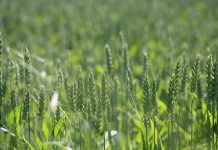
Some herds have successfully eliminated alfalfa from their crop rotation and adopted a winter cereal forage as a double crop with corn silage. Winter cereal forage (wheat, triticale, delayed rye) harvested in the spring at flag leaf stage will have high digestible fiber (NDFd30 over 65%) compared to alfalfa (NDFd30 -55%). Crude protein content of winter triticale with spring nitrogen and sulfur can reach 17 to 20% crude protein. These high-quality winter cereals, when harvested and stored properly and fed to lactating cows during the summer, have shown less milk decline in summer heat.
Dairy farms with limited acreage have mostly grown corn silage since it produces higher forage tonnage per acre. The incorporation of winter cereal forages can offer even higher yields of forage per acre. Tom Kilcer’s research, available at advancedagsys.com, finds that winter cereal forage after corn silage provides an additional two to four tons of forage dry matter per acre. Winter cereal forages will provide improved soil health and reduced potential for soil erosion, but success with winter cereal forages for lactating cows requires more intensive management.
If past experience with harvesting wheat, triticale or rye did not produce good quality forage, then rethink your management. Start with a small acreage of winter cereal forage and focus on proper soil fertility, triticale seed, early fall seeding, proper spring fertility, spring flag leaf harvest and inoculation at harvest.
Alfalfa seed economics 101
A dairy farmer inquired recently, “Is the $600 per bag cost of low lignin alfalfa really worth it?”
Alfalfa seed cost must be evaluated like any investment on the farm. Whether purchasing alfalfa seed, a tractor or renovating the old parlor, the investment must provide a return on investment (ROI).
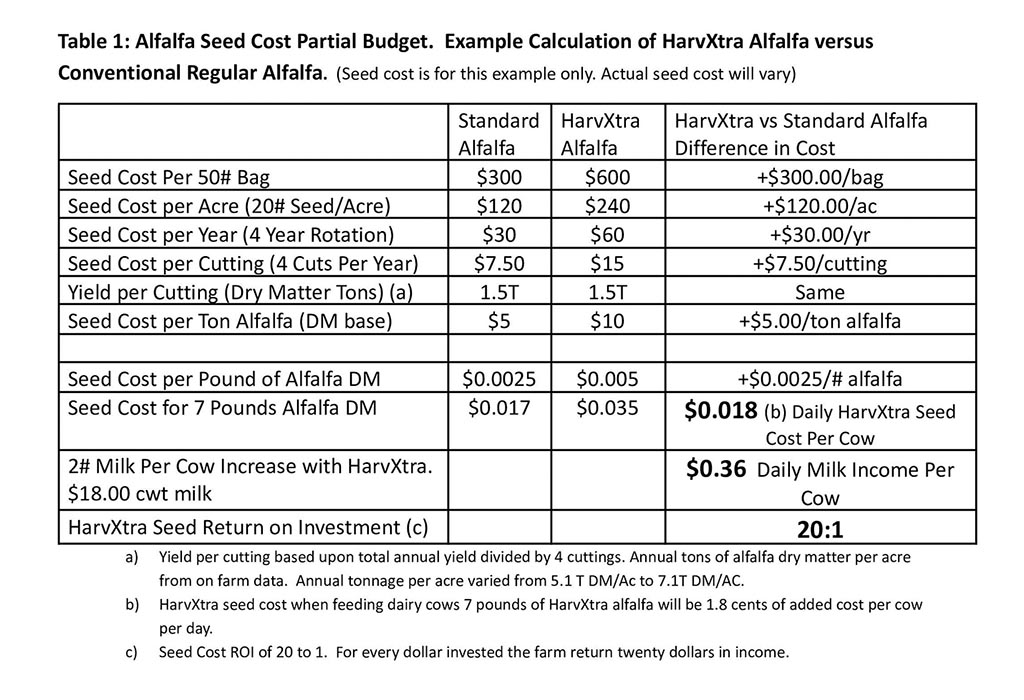
A partial budget is a great tool to evaluate ROI. Alfalfa seed is a long-term investment as it is planted only every four years or more. An example of a HarvXtra seed cost partial budget is in table 1. HarVxtra alfalfa, at $600 per bag, compared to $300 per bag of traditional alfalfa, appears very costly. However, the ROI is 20 to 1! The $300 additional cost per bag (line A/table 1) for HarvXtra converts to $120 per acre (line B/table 1) at a seeding rate of 20 pounds per acre.
An alfalfa seeding persists for four years, which calculates to an added seed cost per year of $30 (line C/table 1) or $7.50 per cutting (line D/table 1). A 1.5-ton dry matter yield per cutting the additional seed cost is $5 per ton of forage. Assuming a fed rate of seven pounds of dry matter from HarvXtra forage is fed per cow per day, the added HarvXtra seed cost is 1.8 cents per cow per day (line H). Round it up to two cents per cow per day.
From research, dairy cows fed HarvXtra increased milk production anywhere from two to four pounds per cow per day. A two-pound milk response at $18/cwt milk generates $0.36 of income (line J/table 1). A 36-cent return for a two-cent investment in seed is a 20 to 1 ROI (line J). Each farm should determine its actual costs for seed and harvest yields. A 20:1 is a good return for the investment.
Queen alfalfa: A summary
High-quality forage, whether alfalfa, corn silage or winter cereals, is a foundation for high-performance and profitable dairy farms. HarvXtra low-lignin alfalfa gives dairy farmers a proven technology to increase forage quality, manage harvest timing and increase tonnage of alfalfa.
Alfalfa is a high-quality protein source that offers an excellent forage in a systematic crop rotation. An alternative to homegrown alfalfa is winter cereal forage, which requires improved management to produce dairy-quality forage.
The seed cost partial budget evaluation for HarvXtra alfalfa compared to conventional alfalfa shows an excellent ROI of 20 to 1 if the farm is growing alfalfa. Each farm should evaluate its land base and soil types for consideration of HarvXtra alfalfa. Thanks to Queen Alfalfa and King Corn Silage for supporting high-producing dairy cows.