




HANOVERTON, Ohio — The key to rotational grazing is to keep it simple, according to Pete Conkle. Getting the infrastructure in is the most challenging part, but farmers shouldn’t overcomplicate it, he said.
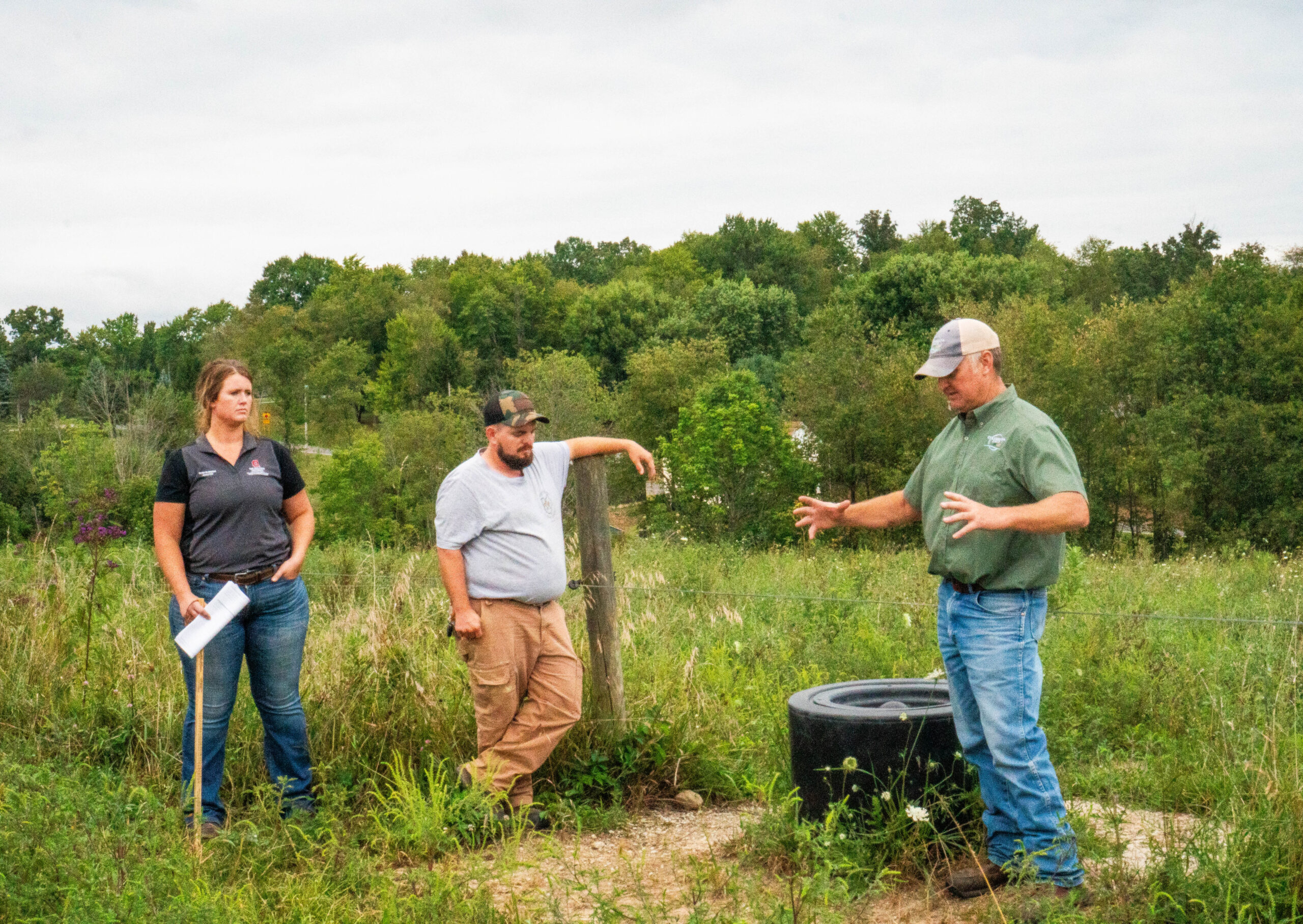
This was the main point of conversation at a grazing workshop at Conkle Family Farms on Aug. 20, where Conkle gave attendees a tour of his beef cattle farm, discussing forage quality, water systems and how these elements work together in his rotational grazing operation.
“A lot of people are too rigid with stuff when they start. It’s a challenge to get their head wrapped around how simple it can be,” Conkle said.
Conkle Family Farms
The farm dates back to 1938, when Conkle’s grandfather bought 90 acres to raise beef cattle, hogs and chickens. His dad, Larry Conkle, took over the farm in the mid-1980s, raising hogs and growing row crops like corn, soybeans, wheat, oats and hay.
Pete Conkle, third-generation owner, moved back home in 1998 after graduating from Ohio State University with a degree in wildlife biology management. He initially wasn’t interested in operating the farm, planning to attend graduate school instead.
But these plans changed when he bought cattle. A few years later, he took a position with Columbiana Soil and Water Conservation District, cementing his role in Ohio’s agriculture industry. Around the same time, the Conkle family bought an additional 80 acres to farm in 2002.
Today, Conkle is the program director for the Columbiana SWCD and raises 125 grass-fed beef cattle — Red Angus, Black Angus and Herefords — and grows hay.
Rotational grazing
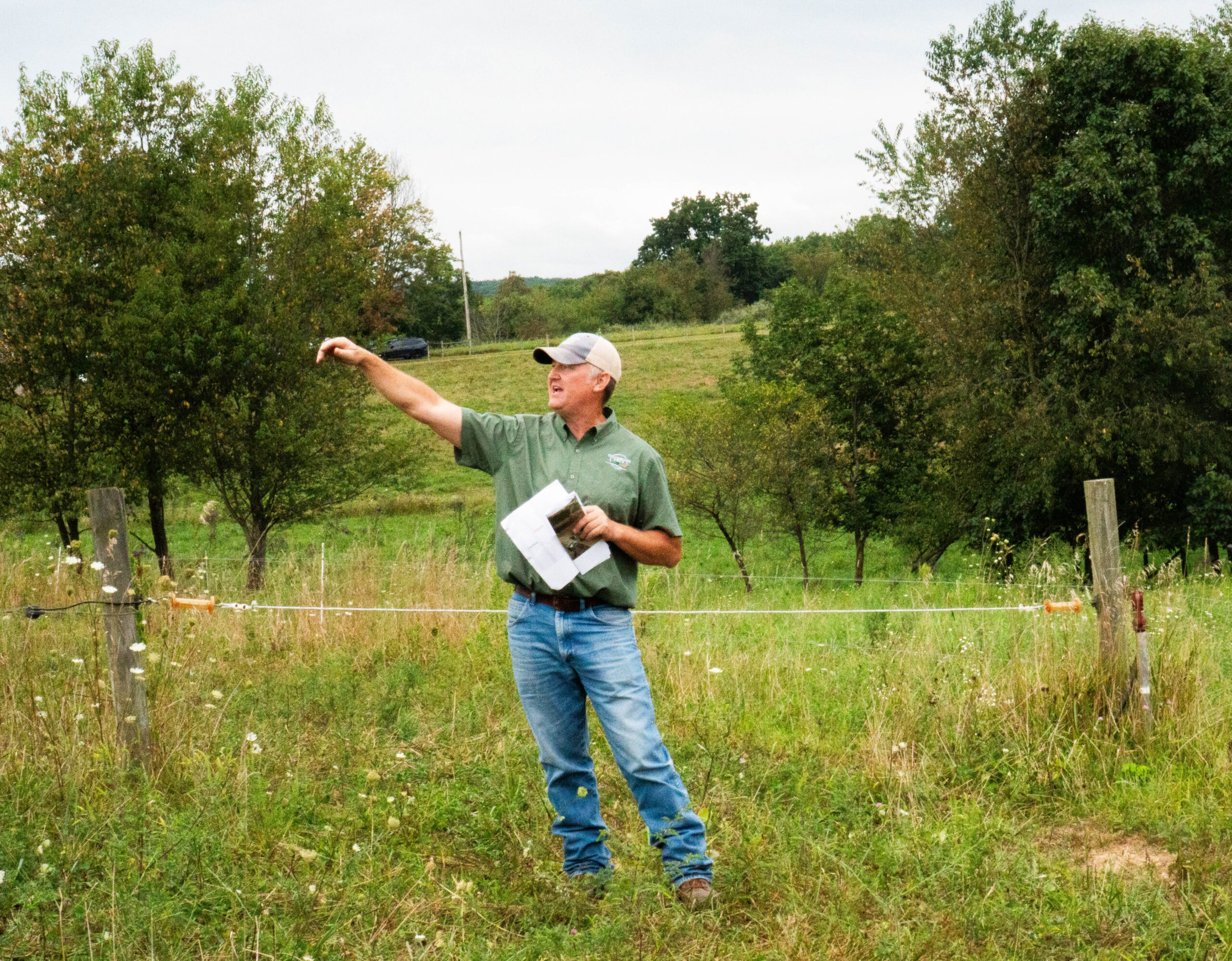
The Conkle Family Farms grazes cattle on 65 acres of paddocks. Conkle transitioned from growing row crops to rotational grazing in 2010, something which he says has led to improved soil health, increased forage production and more diverse species of wildlife, insects and plants.
Conkle’s rotational grazing starts with an Excel spreadsheet, which allows him to keep track of which paddocks have been recently grazed, when bulls should go in or out, etc. The cattle are moved every day, with each paddock getting a rest period of 40-45 days.
These rest periods are important to maintain a healthy forage quality, Conkle says. He gives this spring’s wet weather as an example: “If you leave (the cattle) in one spot too long and it’s wet and muddy, you’re going to compact that soil and it’s going to take all summer to heal (that pasture).”
But healthy-looking pastures are a constant roller-coaster ride.
“I don’t even know that we’re there yet,” Conkle said about his pastures, noting they are still suffering from last year’s summer drought. “It’s an ongoing process.”
Getting water to these paddocks was another source of conversation.
“Water is the most limiting factor to rotational grazing,” said Jimmy Giannone, fourth-generation owner of Dangelo Family Farm, at the workshop. “I see that a lot of landowners wanting to break up a bigger field, but they only have one concentrated area for the water well.”
To get around these challenges, Conkle made portable water tanks out of 55-gallon barrels. Once in the pasture, the tank is attached to an above-ground water line with a plasson fitting, an adapter, at the end of the hose that controls the flow of the water. A Jobe float sits in the tank, opening and closing the water valve, ensuring the cattle have a constant supply of water.
One attendee asked whether the water overheats in the above-ground water line to the point that the cows won’t drink it. Another farmer answered, saying that if enough residual graze was left over, the grass should cover the line, protecting it from the sun.
During the winter, Conkle uses Cobett Company’s automatic cattle and livestock waterers, something which he says is well worth the investment. The watering system uses geothermal heat from the ground to keep the water from freezing.
Native plants and invasive species control
The forages in Conkle’s pasture consist of red and white clover, orchard grass, tall fescue and Kentucky bluegrass. His pasture also contains a host of native plant species, including milkweed, goldenrod and aster, something the cows also like to munch on.
“I figure it’s a forage there. If they can consume it, they’re getting by on it,” he said.
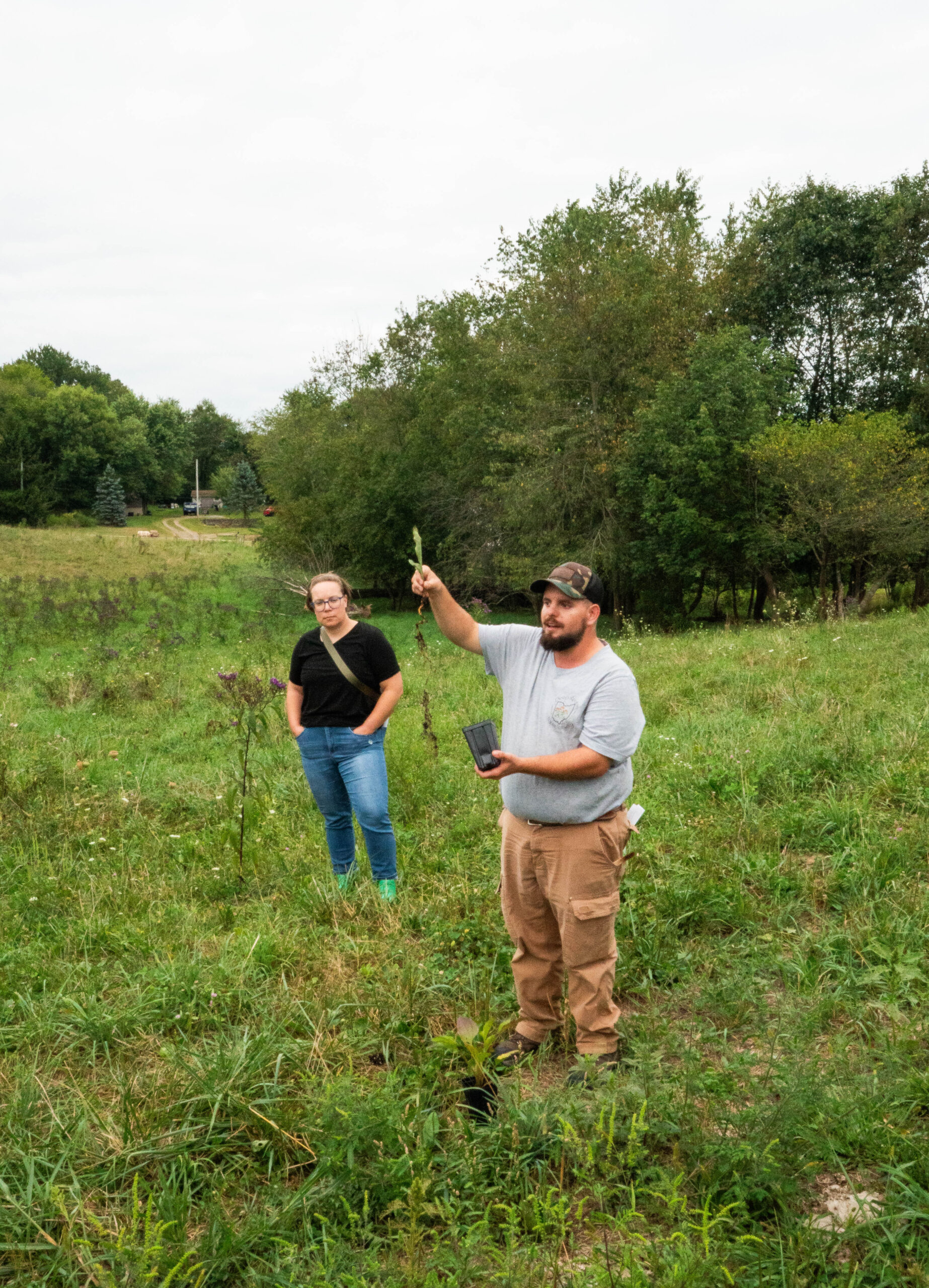
“compass plant” while discussing its deep root system on Aug. 20, 2025. Compass plants are native to western Ohio.
At the workshop, Giannone, who owns Deep Roots Native Nursery in Summitville, Ohio, talked about the other benefits of having native plant species in the pasture, including supporting pollinators and attracting predatory insects and birds.
One of these predatory insects is dragonflies; they are attracted to ironweed, which Conkle has in his pastures. Dragonflies eat mosquitoes and flies. Birds like barn swallows, tree swallows and purple martins also eat flies — making native plants a great way to manage flies on the farm.
This strategy is known as Integrated Pest Management, Giannone notes, which is a sustainable and environmentally-friendly approach to pest control.
John Beilhart, wildlife and forestry specialist for Columbiana SWCD, also gave attendees a rundown on how to kill invasive species on the farm. Conkle has multiflora rose, white mulberry and autumn olive in his pastures, something that’s been a constant challenge to get rid of.
To fight these invasives, Conkle will sometimes clip the pasture, but doing this too often can cause other problems. If woody stems are left scattered across the field, cattle can scrape their eyes on them, leading to pink eye.
Beilhart says herbicides are the best way to get rid of invasive species.
“Unfortunately, it’s one of those necessary evils we have to use to manage it, because dealing with multiflora rose by cutting it takes forever, if ever, to get rid of it,” he said.
Conkle uses a combination of Crossroads or Crossbow herbicide and water to treat his invasives. Beilhart says using a woody plant herbicide treatment like Crossroads helps avoid killing surrounding plants.
He also recommends adding blue dye to the herbicide to prevent spraying the same invasive twice and treating the invasives in the fall and winter when herbicides are most effective.
(Liz Partsch can be reached at epartsch@farmanddairy.com or 330-337-3419.)




