
SALEM, Ohio — Access to weather data has greatly expanded farmers’ ability to forecast conditions, track crop progress and identify critical windows for some of the most important tasks on the field.
“We have a ton of weather information coming at us all the time,” said Aaron Wilson, assistant professor of ag weather and the climate specialist with Ohio State University Extension.
But there are still gaps in the technology and data collection that could put farmers behind the eight ball when making high-stakes, weather-dependent decisions.
To help, OSU Extension is installing more local weather-monitoring stations to improve public meteorological forecasting. Some Ohio farmers have also opted to use private weather forecasting subscription services that claim to give hyper-local farm-specific information.
“I like when I can get my crops in the ground in six or seven days. I can do that with this service,” said Duane Stateler, a crop and hog farmer in northwestern Ohio.
Private weather
Stateler and his son, Anthony, grow corn, soybeans and wheat in northern Hancock County, where temperatures can vary greatly from those of neighbors across the county line.
”We’re north of (Route) 30, so we’ve got the lake effect. Our soils warm up (slower), so our wheat breaks dormancy 10 to 15 days later than what it does in Upper Sandusky… 40 miles away,” Duane Stateler said.
They’re also in a Doppler radar coverage gap between Cleveland, Wilmington and northwestern Indiana, where degraded signals create small but meaningful discrepancies in publicly available weather data.
The Statelers have long relied on another solution. Their grain and hog operation subscribed to a private forecasting service 14 years ago and hasn’t looked back.
Many subscription-based weather products adopted in the last decade use multiple forecast models and teams of professional meteorologists to provide personalized alerts, forecasts and outlooks. Stateler Farms uses BAMwx.com, a company started by meteorologist Michael Clark in his garage.
“He was doing forecasting for the Cincinnati Reds and some other places, and then he spun off into agriculture,” Stateler said.
Their app platform, called Clarity Pro, tracks their farm’s specific location, even pinpointing where they are working in the field. A chat function allows them to ask questions when storm cells begin forming and receive near-instant responses to guide daily decisions. And each morning, they receive a forecast video from the Indianapolis-based team of nearly 12 full-time meteorologists.
“It’s the first thing I listen to when I’m over at the (hog) nursery, a little before 6,” Stateler said.
The service proves especially valuable during planting and chemical applications. In the Statelers’ experience, they can receive a forecast seven to 10 days out from what our local meteorologists are able to develop two to three days out.
“When you’re looking to put seed in the ground, you’re looking for a seven-day window — put corn in where we can get 100 to 120 growing degree units (GDU) and be able to get that corn to pop,” Anthony Stateler said. “Planning is a big thing for us.”
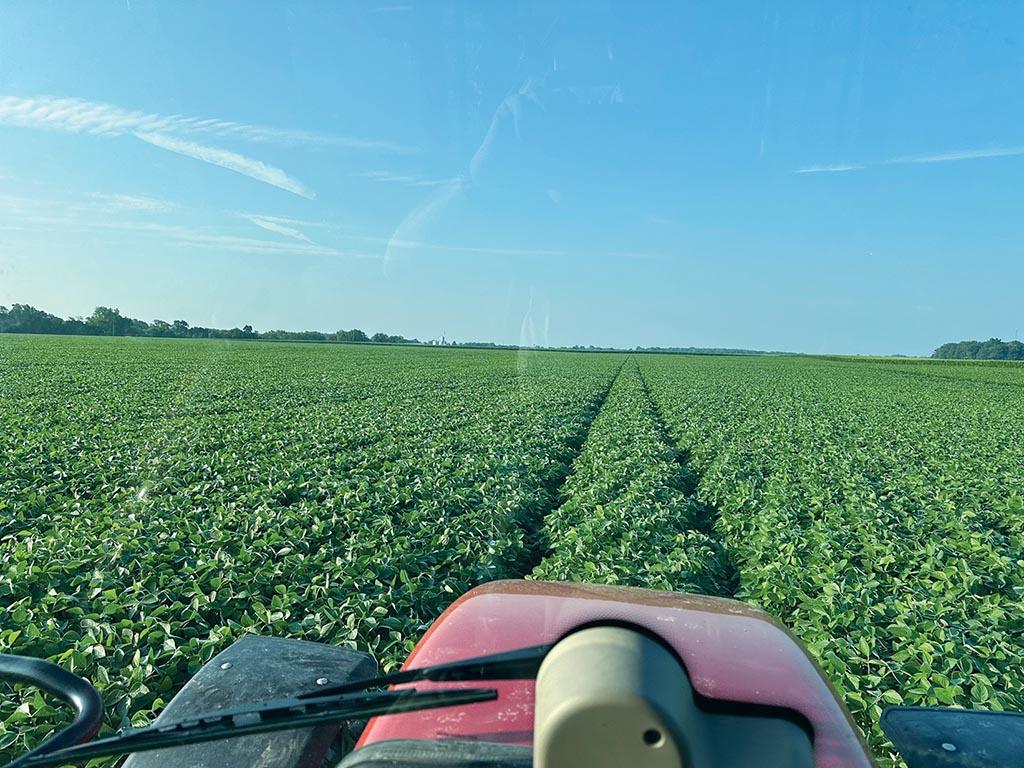
Duane recalls 2019, when relentless rain disrupted fieldwork. He received a message alerting him to a narrow opportunity to plant beans between June 10 and 11 — a window that proved accurate.
In the company’s early years, when the team was smaller, Duane Stateler once received a direct phone call from Clark warning him about a storm headed straight for his location, bringing more than 2 inches of rain and high winds.
“If there’s a storm like severe weather, thunderstorms in the summer, tornado warnings — they’re updating things every couple of hours,” he said.
The forecasting system offers personalized service and additional manpower analysis. Their subscription costs around $600 per year, a price Stateler says has “more than saved us… putting crops in the ground and getting everything done in a timely manner.”
Duane, who has served on the National Pork Producers Council since 2017, says he hears from other farmers in Iowa, South Dakota and Minnesota who use similar services. His subscription is a part of a forecasting block that covers Indiana, Ohio and Michigan.
The growing list of agricultural forecasting tools extends beyond private meteorology firms. Ranchbot measures rainfall for pasture management and cattle troughs. Companies like Tempest and Ambient use existing public data combined with machine learning to deliver forecasts down to one square kilometer. DTN operates more than 5,000 proprietary weather stations from Ohio to the Canadian Valley, collecting its own localized data points.
More weather stations
Whether farmers rely on free phone apps, television meteorologists or paid subscription services, Wilson believes the future of agricultural forecasting lies in denser data collection networks.
Right now, Wilson says short-term forecasting is most reliable three to five days out. Beyond that, “it’s all about pattern recognition and whether we’re likely to see above or below-normal conditions.”
More localized data can increase forecast accuracy in agricultural areas, where planting windows and drought monitoring are critical.
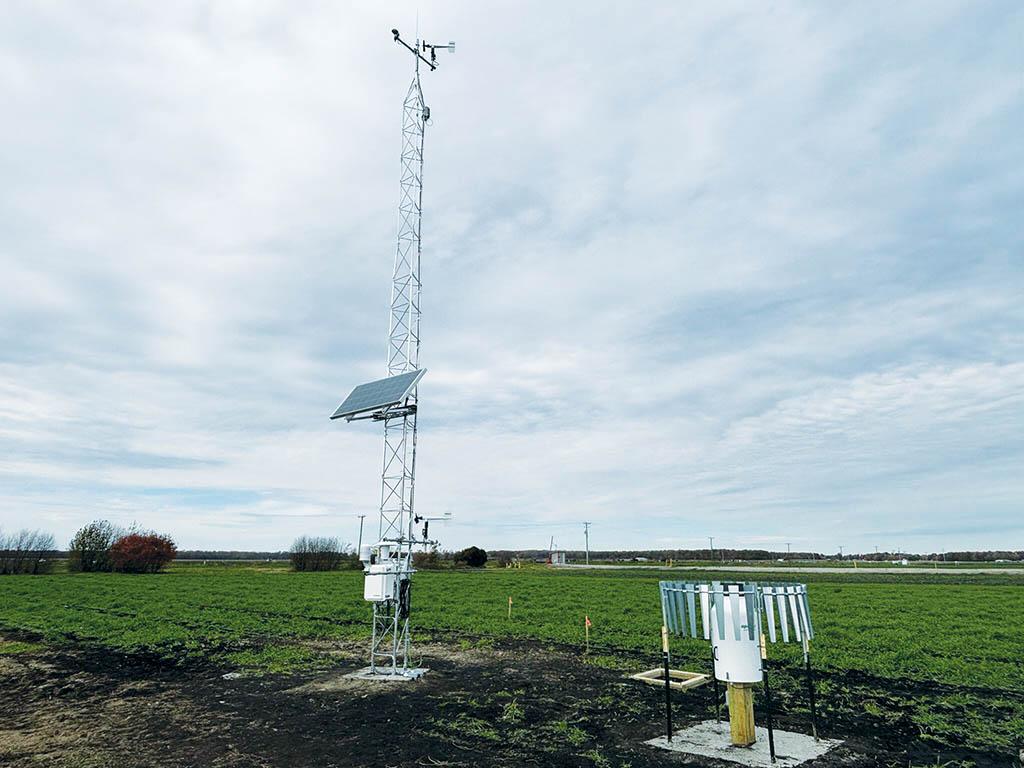
New to Ohio in 2025 are research-grade automated weather and environmental monitoring stations known as mesonet systems. Installed by Ohio State Extension, the stations collect data on temperature, humidity, wind speed, precipitation, soil moisture, soil temperature, solar radiation and wind direction.
“You can start to approach hyper-local forecasting if you have these really dense networks of mesonet stations,” Wilson said. The data is public and feeds into forecasting models, improving accuracy as the network expands.
The first nine stations were installed in key agricultural regions last year, with the ultimate goal of putting one in each of Ohio’s 88 counties. With more shared data, Ohio State Extension hopes to develop scouting alerts for diseases and pests. Crop modeling, growing degree-day forecasting and temperature inversion monitoring are also on the horizon for Ohio farmers, Wilson said.