


Corn silage harvest time always beings about special memories of growing up on the dairy farm in Kentucky. The family worked together during long days to get the crop harvested in a timely manner. Dad ran the chopper, and oftentimes, I was pulling the silage wagons from the field to the blower. We had two upright silos for silage that would provide enough silage for a year.
Hauling the silage was a little tricky in navigating the hill between where the corn was grown and the location of the silos. To be honest, the tractor was a little undersized for the weight of the silage behind you in coming over the hill. At the top of the hill, you would shift in low gear and don’t dare push in the clutch during the decent to the bottom where a large oak tree would have stopped you but it would not have been a soft landing.
The other special memory was the dislike of climbing the silos, especially after harvest in the one silo that had no mechanical unloader; there were two boys, my brother and I, with pitch forks.
From traveling around the state in recent weeks, I noticed that most all crops are harvested except for a few fields of corn for grain. Therefore, now that corn silage has been in storage for a few weeks, it’s time to evaluate the nutritional value of the forage that often consists of about 80% of the forage fed on dairy farms because of its yield and nutritional value.
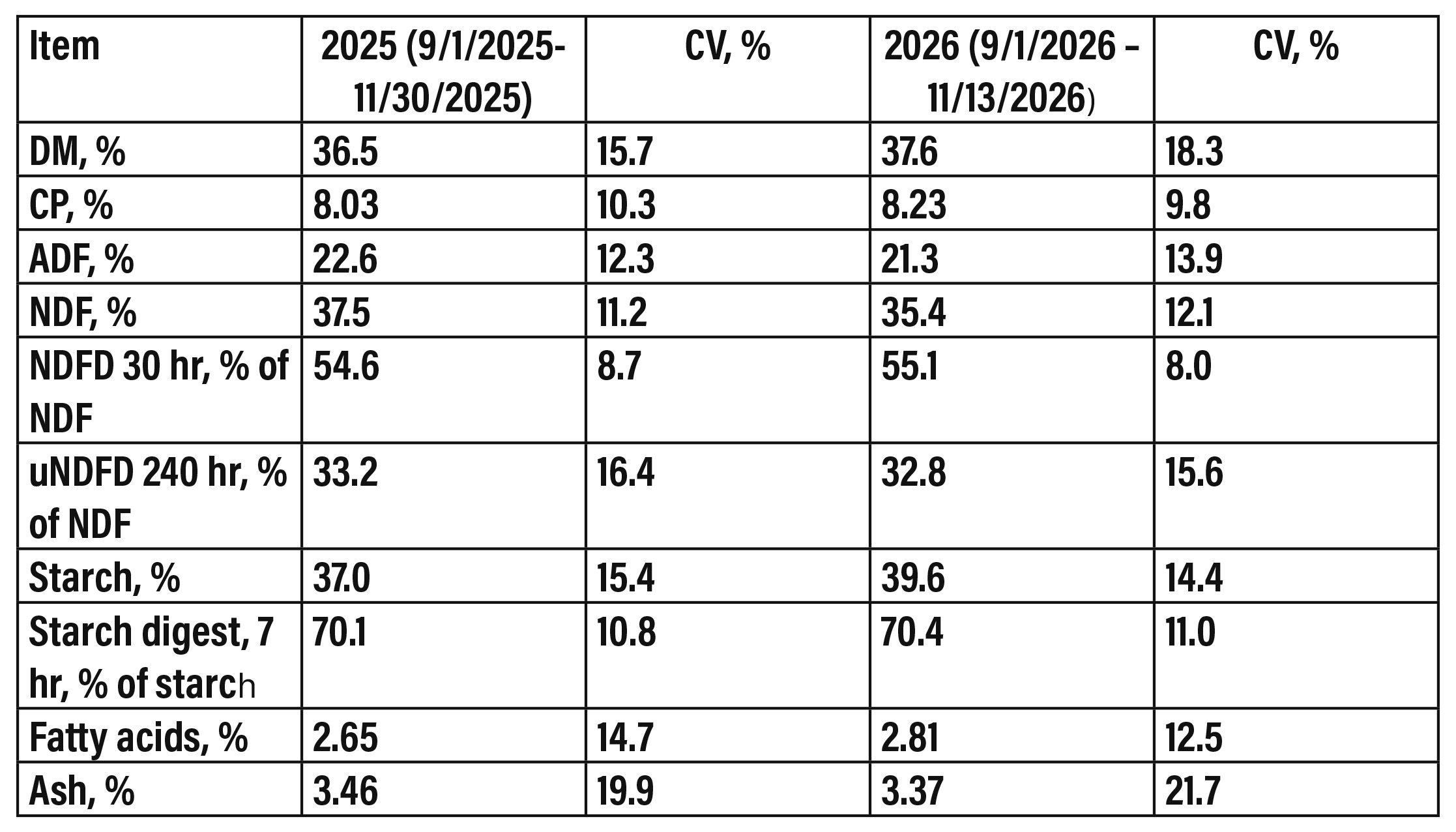
Also of critical planning is the amount in storage so that it will last for the next year on the farm. Thus, data on the composition of corn silage during autumn 2025 was compared to the data to date from the autumn 2026 harvest (Table 1).
The dry matter percentage is similar between the two years, but the variability is slightly higher this year. This could be attributed to the extremes in temperature and rainfall and the timing of harvest relative to topography of the fields for drying conditions. The protein content is similar between the two years. Fiber is slightly lower in 2026, somewhat attributed to the greater ear development for an increase in starch content.
The NDF digestibility is similar between the two years, as well as undigested NDF which is indicative of the extent of rumen fill. Even though starch content increased, starch digestibility was similar as well as its variability. Fatty acid content was about 6% higher in 2026 and with lower variability.
Overall, the nutritional quality of the 2026 corn silage looks good; however, variation can exist from farm to farm, field to field, and with different storage conditions. Therefore, the quality of the corn silage should be monitored throughout the feedout period and always keep an eye on the amount in storage relative to when the next harvest will occur in 2027.