



One of the rewarding parts of working for a soil and water conservation district is the opportunity to connect with the public through education and outreach. Public speaking is a regular part of the job, and lately I have had the chance to visit several elementary schools and 4-H clubs to talk aboutr one of my favorite topics: soil health.
Every time I walk into a classroom or youth meeting, I leave impressed by how much these young people already know about soil, conservation and the environment around them.
Starting with soil. When I speak to students, I usually begin with the basics of what makes up soil. We talk about the different soil particles such as sand, silt and clay, along with the importance of air and water within the soil profile. From there, the discussion often shifts into different land management practices that farmers and landowners use to conserve soil and protect water quality.
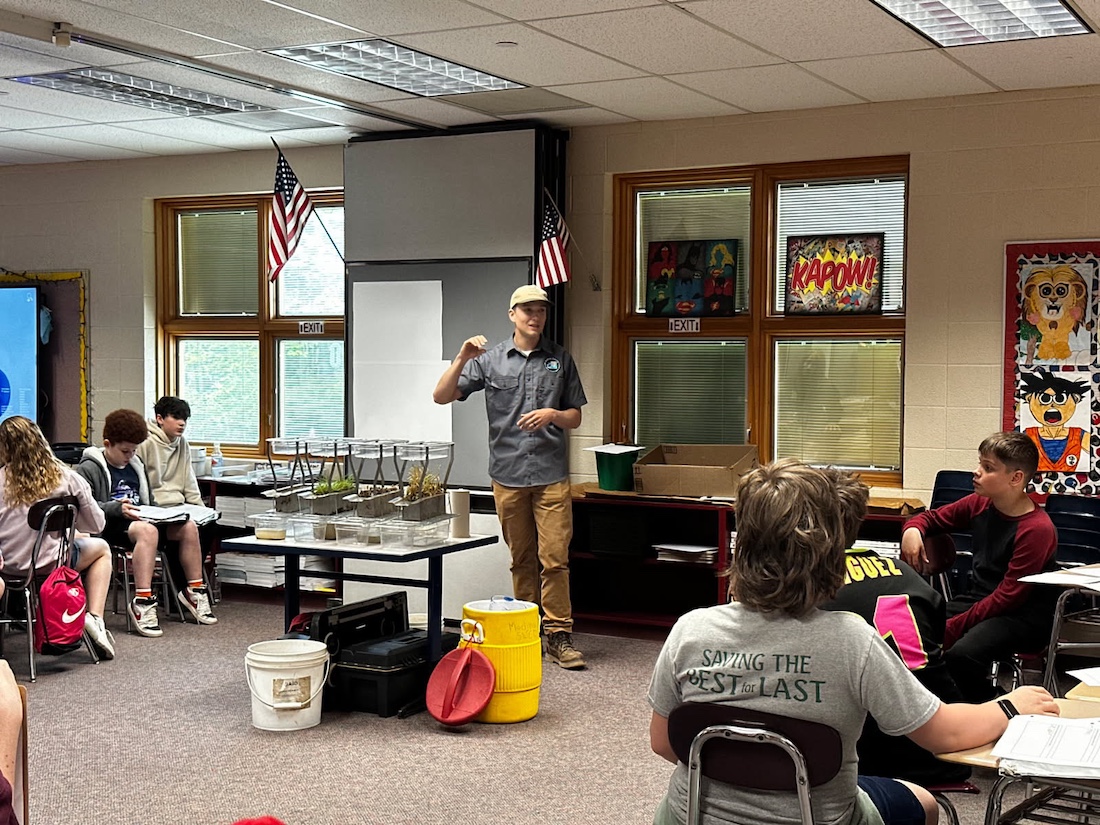
One of the most popular tools I bring along is our office’s rainfall simulator. It is a simple but very effective demonstration that helps students visually understand water infiltration, runoff and erosion. The simulator uses soil cores roughly the size of a standard brick that are placed beneath a slotted tray to simulate rain. Water is applied evenly over the different soil samples to mimic a rainstorm. Because each sample represents a different land management practice, students can quickly see how the soil responds under the same rainfall conditions.
I usually start with a bare soil sample. This sample often produces very little water infiltration, a large amount of runoff and noticeable erosion. Muddy water quickly runs off the surface, carrying soil particles with it. Next, I demonstrate a soil core with lawn grass growing on it. Students can see that the grass roots help stabilize the soil, reducing erosion and producing cleaner runoff even though majority of the water still runs off the surface.
The final demonstrations are usually the most impressive. These samples represent established prairie plants and cover crop practices. With these conservation methods, students often observe significantly improved infiltration rates and much cleaner runoff water.
In some cases, almost all of the rainfall soaks into the soil rather than running off the surface. It creates a powerful visual lesson that shows how conservation practices can help reduce erosion, improve soil health and protect nearby streams and waterways.
While the rainfall simulator always gets attention, the best part of these events is often the questions from the students themselves. Some questions are fun and lighthearted, while others reveal an incredible level of curiosity and understanding.
Recently, a sixth-grade student asked me about how microorganisms in soil differ depending on the area where the soil is located. It was an outstanding question, one I had never been asked before during a presentation. We discussed how soil microorganisms can vary based on climate, landscape, soil type and regional conditions. It was exciting to see that level of interest and critical thinking from such a young student.
Importance of outreach. Experiences like these remind me why youth outreach is such an important part of conservation work. Our office works hard to plant the seed of conservation early within our community. Judging by the students and youth groups I have met, those seeds are already taking root. There are many bright, conservation-minded young people in our area who truly care about protecting natural resources and understanding how the world around them works.
The future of conservation depends heavily on education and awareness, and these youth programs help build both. Whether it is through hands-on demonstrations, classroom discussions, or simply answering questions, these interactions help students better understand the importance of healthy soil and why erosion is an issue farmers work hard to manage every day.
If your school, classroom, or youth organization is looking for conservation education opportunities, consider reaching out to your local soil and water conservation district. You may be surprised by how much there is to learn from the ground beneath our feet.
(Eric Hange is the district manager of Medina Soil and Water Conservation District.)