


We’ve reached the part of the year that is as close to a vacation as we ever get on the ranch. The garden is in, and the plants are established enough not to require the intensive care of newborn seedlings.
The same is true of our calves and lambs. They are gamboling around the pasture with their mothers, still enjoying sips of milk now and again, but grazing frequently as well.
We are months away from needing to feed hay, as wild forage is plentiful. The weather does not require us to gather or move the flock and herd hastily.
We only need to gather them to move them to fresh grass, aka ‘greener pastures,’ a considerably more delightful activity than rounding them up in anticipation of a blizzard.
The one thing flock, herd and garden do require this time of year is daily water rations. We have automatic wells and water tanks in the big pastures where the cattle roam, but my little flock of sheep needs their water tank filled manually.
The same is true for our home garden and the community garden I am tending, where I have a system of hoses, sprinklers and a lone watering can (for the hills of winter squash I planted off to the side) that keep the plants hydrated and thriving.
Both morning and evening, I head out into the pastures and gardens to distribute water to whomever needs it at that point in the day.
This past weekend, I was slinging wool and books at the Wyoming Sheep and Wool Festival. It also happened to be the maiden voyage of my birthday camper, an old, vintage beauty that, while both solidly constructed and quaintly charming, lacks what most think of as modern necessities, namely running water and air conditioning.
We were staying at the Johnson County Fairgrounds, where hydrants were plentiful, but were not located at individual campsites. Consequently, we were hauling the water we needed for drinking, washing dishes, toothbrushing and general hygiene from a few hundred feet away.
In the grand scheme of things, this barely registered as an inconvenience. I told my husband I think it’s good for our kids — who like so many modern children, are awash in convenience — to have the experience of washing a few dishes with water they packed themselves from one location to another. Surprisingly, I think they’d agree. Since it was only one weekend, the extra labor felt more like an adventure than a hardship.
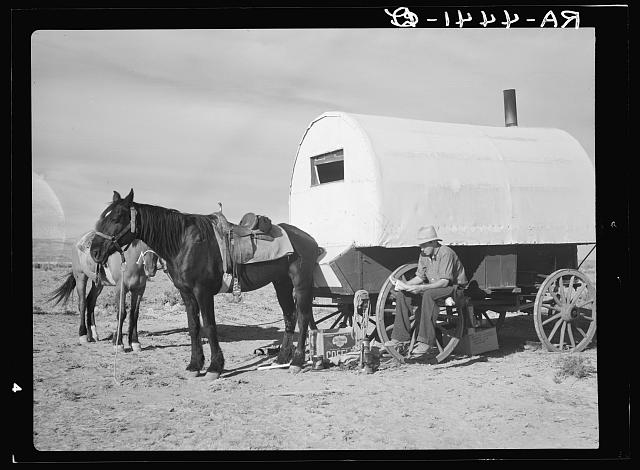
As part of the Sheep and Wool Festival, there was a self-guided tour of the sheep wagons that were commonplace here on the western plains a century or so ago.
My kids marveled at the craftsmanship and tidiness of these small, sturdy, canvas-covered wagons — everything a person would need to cook a simple meal tucked into drawers or hanging from leather straps, and a large enamel bowl used for the washing up strapped onto the door of every single one.
“We need one of these,” my daughter said, gazing admiringly around the cozy but bright space, then patting the quilt-covered bed of one of the larger sheep wagons.
“We have one!” I replied, laughing and pointing toward our camper, parked only a short distance away. Both kids began to laugh with me.
Our vintage camper, probably only 40 years newer than some of the sheep wagons on display, travels at speeds the wagons’ original owners never dreamed of, but essentially has all the same components — the true necessities of life haven’t changed all that much.
Now, we are home again. As soon as I finish writing this, I will walk down the road to the sheep. I will climb over the fence and lift the switch for the hydrant.
I will stand beside the water tank as it slowly fills, holding the hose so the sheep don’t knock it out. And I will marvel at the things we find commonplace now — like water, fresh, sparkling clear, and flowing freely on demand right where we want it to appear.
The conveniences of modern life may obscure the ties that bind our past, present and future, but they are there just the same.