


It’s the prime time of year for football — professional, college, flag and so forth. One cannot listen to game commentators for more than a few minutes without them referencing the action taking place on — wait for it — the gridiron. Why the gridiron? Well, it sort of sounds cool and is a departure from having to say “the field” ad infinitum.
Those commentators likely have no idea where the term gridiron actually comes from or what its relationship to a football field actually is. They would likely be surprised to learn that gridiron is a word that was first recorded in the English language in the late 13th century. It derives from the Middle English word gridirne, which evolved into gridiron because of a false association with the unrelated word “iron,” perhaps because of the metal rods used in griddles.
Regardless, the gridiron was a mainstay cooking tool known to every pioneer in the early settling of the Ohio country, as common then as the backyard barbecue is today. As a matter of fact, most of today’s barbecues incorporate elements of the early gridirons.
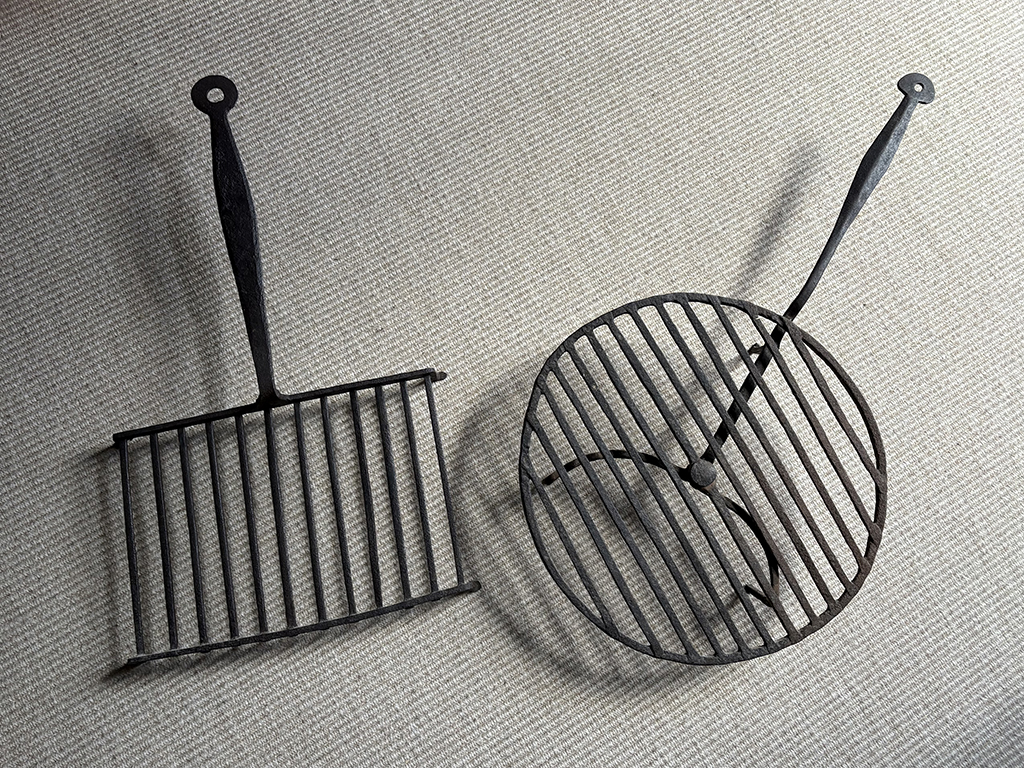
The product of local blacksmiths, the gridiron was crafted of wrought iron. Typically square, rectangular or round, with an integral handle, the basic frame was connected from one side to the other with thin crosspieces spaced a half inch to an inch apart. It is this arrangement of bars, similar to the lines on a football field, that inspired the relationship of a piece of pioneer cookware to the vernacular of present-day sportscasting.
Gridirons were used in cooking fireplaces primarily to boil meats over hot embers. They had short feet which enabled them to closely straddle beds of coals, cutting down on cooking time.
Another type of gridiron had a circular cooking surface, constructed so that it revolved on a triangular base. The circular outline was connected with parallel lines of iron bars. Known generally as “whirling broilers,” because the foods being cooked thereon could be revolved over various piles of coals on the hearth with the aid of a poker, they often incorporated fancy work by the blacksmiths who crafted them. Many examples are known in which the iron bars are executed in wavy patterns, and the handles are beveled and terminate in some kind of fancy hanging hook.
Today’s modern barbecue units typically incorporate a gridiron cooking surface — a true throwback to when our pioneer forebears cooked their meats over an open fire.
Another early cooking utensil which lives on today, though with modern adaptations, is the griddle. In the 17th, 18th and early 19th centuries, the hand-forged iron griddle was the creation of the blacksmith.
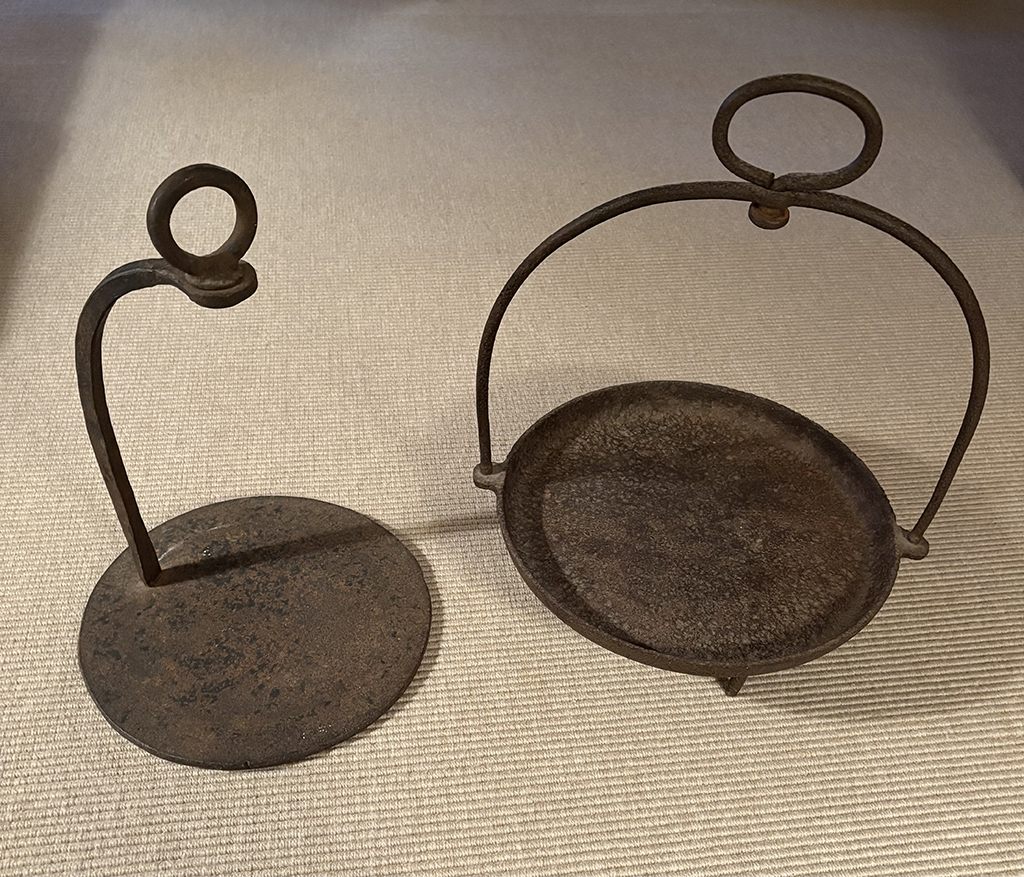
In its earliest incarnation used in pioneer homesteads, the griddle was formed by the blacksmith from a heavy bar of iron which was heated and then about half of it was pounded out and flattened into a circular cooking surface. The remaining integral portion of the bar was shaped into a single handle with a loop at the end which allowed it to be suspended from the fireplace crane. In some examples, the blacksmith simply drew out a chunk of iron, flattening it out into a circle. Then, the handle portion was crafted as a separate piece and mortised into the iron disk that was the cooking surface.
Later on, as cast iron fireplace implements became available from foundries in the east, circular griddles having lipped edges and usually three short feet to sit on above the coals came into popular use. These cast iron griddles had holes formed into the edges so that a blacksmith could craft a semicircular handle and hanging hook for it.
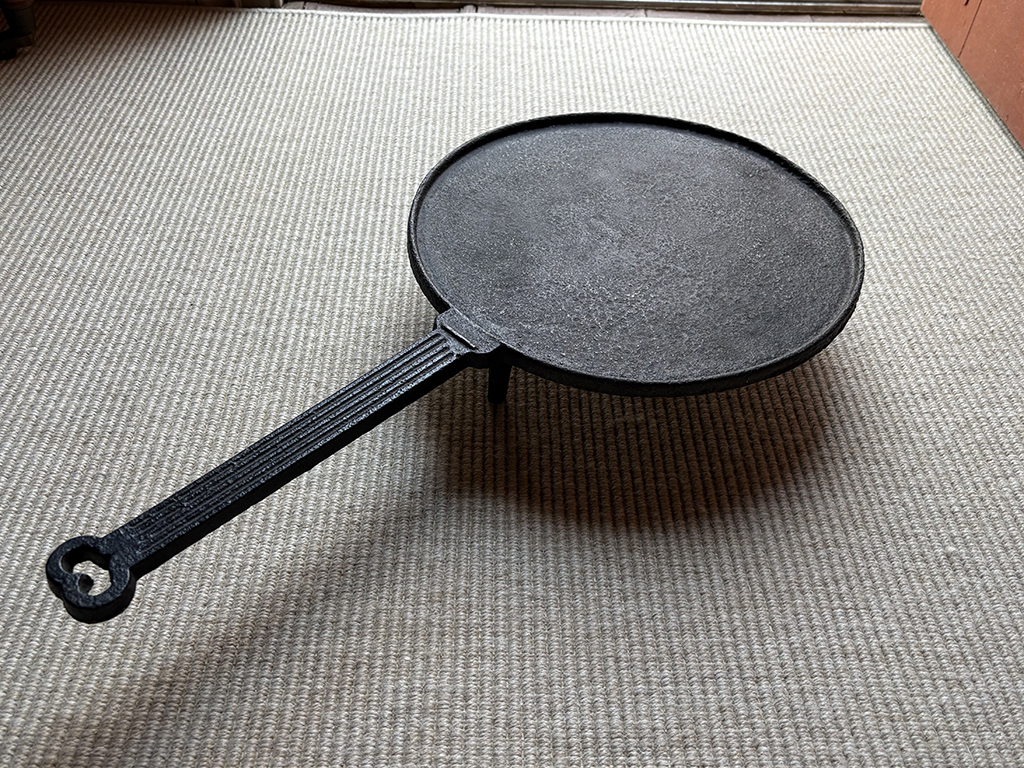
Beyond these hanging-type griddles there were cast iron griddles that sat on short feet just above the coals. Some of these heavy griddles date back to the 1600s, and a surprising number of them have survived the centuries. Often these have various designs cast into the handles, which terminate in a hole or heart motif, enabling it to be hung on a hook by the fireplace.
With the advent of wood-burning cookstoves in the 1830s, cast iron griddles were reincarnated as narrow, oval-shaped vessels with flat bottoms. Although they were still sand cast by the same foundries that made their earlier counterparts — and often still exhibited gate marks on the bottom — they were lighter in weight, typically had a higher lip around the edges and often had integral pouring spouts and handles. In terms of design, these griddles exhibited a sameness and seldom had any decoration. Today, they are readily available on the antiques market. Early griddles saw soaring prices a couple decades ago, but they have dropped dramatically in recent years.