



Nitrogen (N) prices have seen a rapid rise since the beginning of March, primarily due to the conflict in Iran. The price increases are reminiscent of the 2022 growing season when Russia invaded Ukraine, resulting in record-high N prices.
If you have not yet re‑evaluated your N management strategy for 2026 to maximize profits, you might want to consider doing so in the wake of these recent price increases. Arbitrarily cutting back on your N rate can result in lower yields and reduced profits, but there are tools available to help you select a profitable nitrogen rate.
The Corn Nitrogen Rate Calculator (www.cornratecalc.org) is an excellent tool developed by land‑grant universities across the Midwest to calculate the most profitable N rate based on current fertilizer and corn prices. You may have heard it referred to as the Maximum Return to Nitrogen (MRTN) tool.
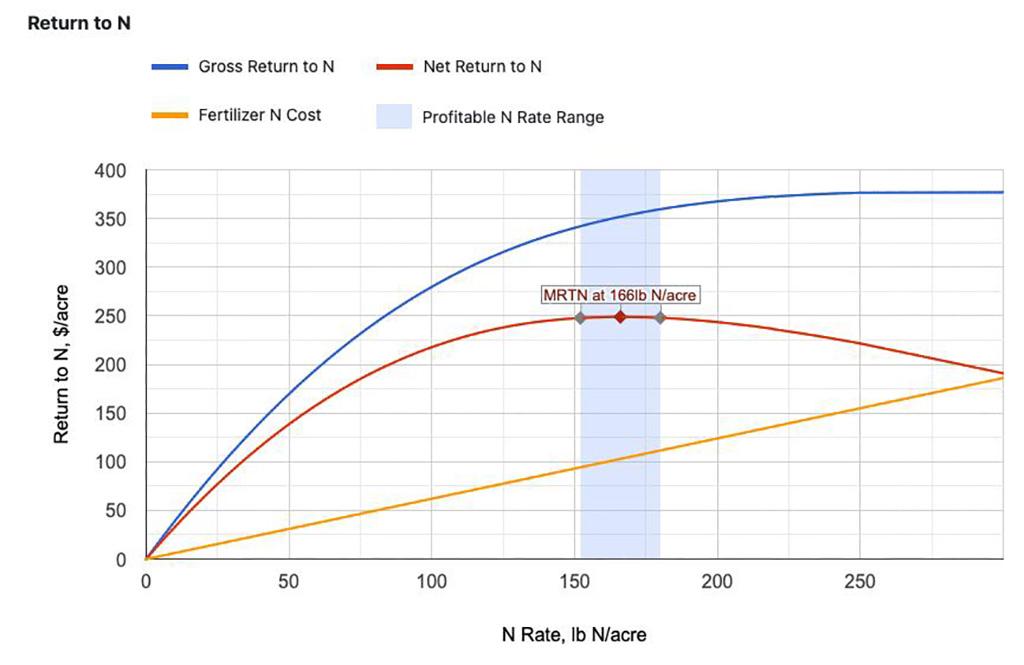
We know that the more N you apply to corn, the more return in yield you will see. However, there are diminishing returns as more fertilizer is applied, and at some point, you will add one more pound of N that costs more than the value of the corn produced from that pound of fertilizer.
The Corn Nitrogen Rate Calculator determines these values for you and provides an MRTN fertilizer rate that makes the most of your fertilizer dollars. The MRTN rate will vary depending on fertilizer and corn prices, but it provides a range of N values that will keep you from spending more than necessary.
At the time of writing this article, local anhydrous prices are around $1,050/ton ($0.64/lb of N), and urea is nearing $825/ton ($0.92/lb of N). Suppliers anticipate further price increases in the short term.
Using anhydrous as an example for corn following soybeans, the MRTN rate is 151 to 178 pounds of N per acre with a current corn price of $4.40. The lower MRTN rate for urea — 130 to 153 pounds of N per acre — reflects the higher cost of urea on an N basis. If corn prices rally, or fertilizer prices drop, the MRTN rate will increase accordingly.
The MRTN rates are quite low compared to the amount of N traditionally applied in our area. Many farmers apply over 200 pounds of N to their corn each year. Using the current values for anhydrous, that higher rate of N will provide similar profit returns as applying a lower rate of 130 pounds of N per acre. On either side of the MRTN rate, you run the risk of leaving money in the field.
In addition to using the Corn Nitrogen Rate Calculator, there are additional tools you can use to stretch your N budget this spring. A manure analysis prior to application will tell you how much N you have on a per‑ton basis. Knowing the nutrient composition of your manure can help you apply more intentionally and reduce your synthetic fertilizer bill.
Additionally, OSU Extension’s crop enterprise budgets have been updated for 2026. Enterprise budgets examine all input costs for growing crops and can provide a projected profit or loss for each crop. If you’re considering switching crops due to the volatile fertilizer market, these budgets are a great way to visualize the differences in profitability between corn and soybeans.
Margins were tight even before these price increases, and now there is even less room for error to remain profitable in 2026.
If you need assistance developing an N plan for your farm, contact your local Extension office. We can help you create a plan that works for your operation.