



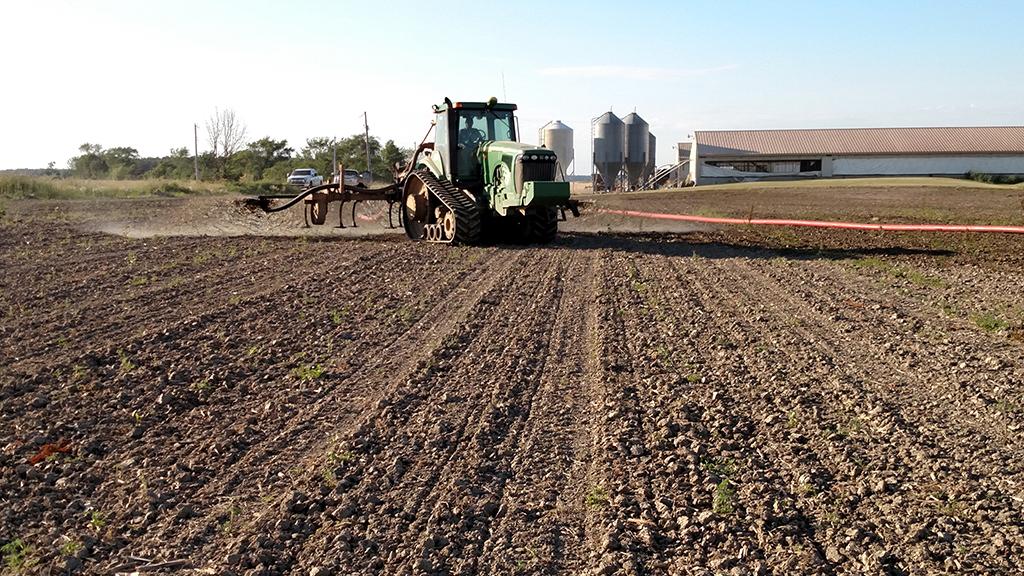
In recent years, dairy farmers and commercial manure applicators have been moving towards applying dairy manure to newly planted corn and soybeans in the spring. This has been in response to delayed planting due to cooler and wetter spring planting conditions.
Applying dairy manure to fields after crops are planted in the spring offers some advantages over applying manure before crops are planted. One advantage is corn or soybean planting not being delayed by the added moisture to the field from the liquid manure. This delay can be costly if wet weather further delays spring planting. The second advantage is the liquid manure adding moisture to the soil that can enhance crop germination and emergence, especially if the weather turns off dry once a field is planted. A third advantage is not placing newly planted corn and soybeans into soil that has just received manure. The nitrogen, phosphorus and potash in manure are all salts and can interfere with seed germination and emergence if the manure and the seed are placed side by side.
As soon as a field is planted, the manure can be applied. This is true for both corn and soybeans. The seed is protected by an inch or more of soil. In university research, the application of 10,000 gallons per acre of dairy manure has not negatively impacted crop germination and emergence on corn or soybeans. If the crops are emerging, manure can still be applied to corn but not soybeans.
Newly emerging soybeans can easily be killed by the application of liquid manure. Corn can tolerate the drag hose from the spiking stage up to the V-4 stage (four true leaves) of growth without an issue.
The nitrogen in the dairy manure will be a boost to the emerging crop. It is difficult to know how much of the ammonium nitrogen in the dairy manure will be available to the crop. The organic nitrogen portion will be a released slowly over several years.
The ammonium nitrogen in the dairy manure can be lost to volatilization and possibly leaching. In university trials of surface-applied dairy manure, only about half the ammonium nitrogen applied seemed to be available for crop growth.
When a drag hose is utilized, the drag hose applicator commonly applies the manure at an angle across the field. The field needs to be firm enough to support the drag hose to avoid scouring the soil surface and burying small corn plants or further burying seeds.
Fields that are spring tilled are not good candidates for a drag hose. No-till fields, stale seed beds, fields with dead or alive cover crops and tilled fields that have been packed with heavy spring rain are usually good fields for a drag hose.
Additional on-farm manure side-dress plot results can be obtained by clicking on the On-farm Research link on the OSU Extension Agronomics Crops team website at agcrops.osu.edu or E-fields at digitalag.osu.edu/efields or follow OSU Extension’s manure research on Facebook at www.facebook.com/OSUnutrients/.
(Glen Arnold is an Ohio State University Extension Field Specialist in manure nutrient management.)