



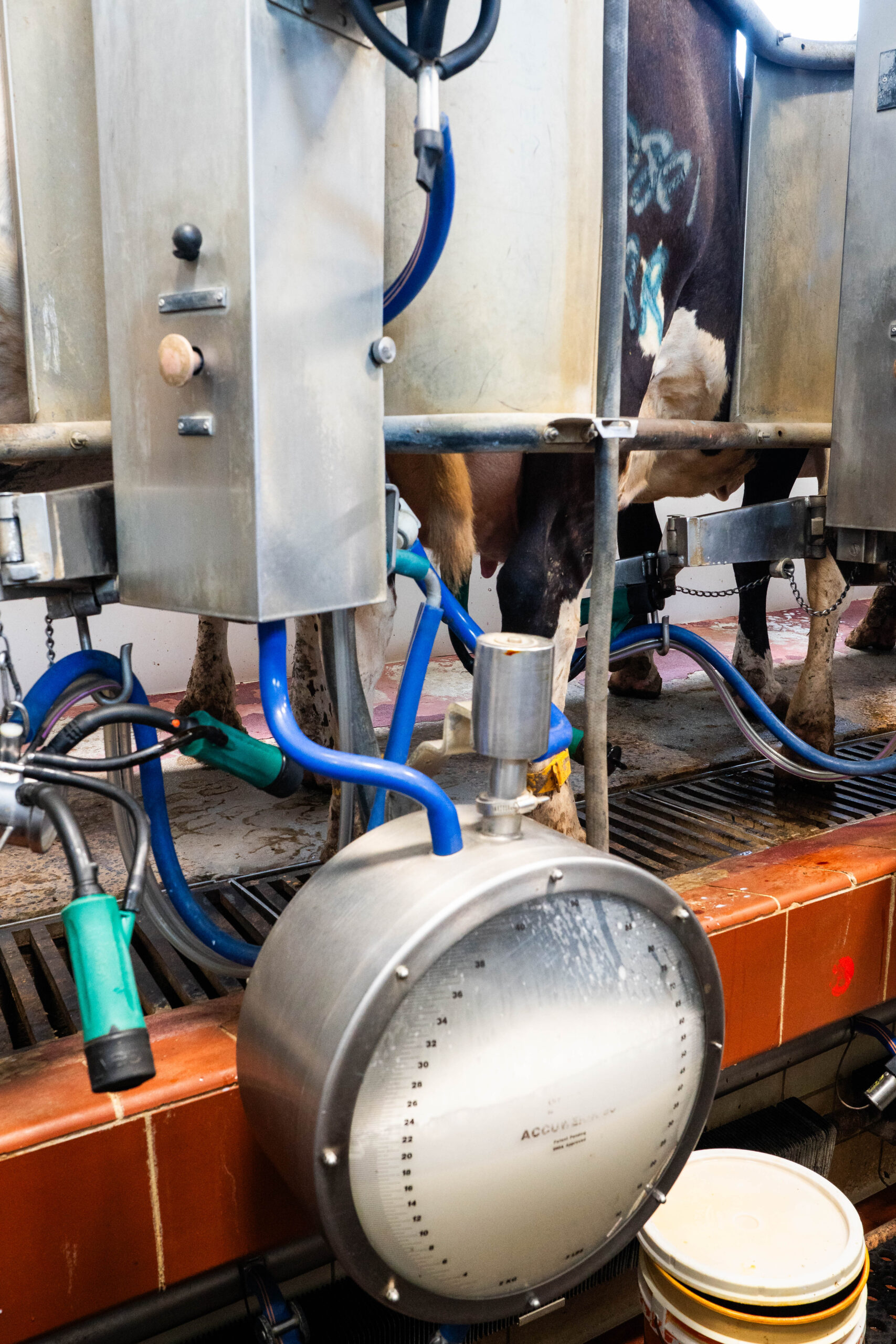
Raw milk typically has little bacterial contamination when it leaves the udder, unless the cow has mastitis. However, it can become contaminated with bacteria from environmental sources such as the outside of the teats or milking equipment.
Different processors test milk for different quality factors, but all milk must be tested monthly for Somatic Cell Count (SCC) and Standard Plate Count (SPC) for Grade A requirements. Many processors will also test for at least Preliminary Incubation (PI) counts and may test for Laboratory Pasteurization Count (LPC) and Coliform count (CC). Each of these tests tells you a little more about your milk quality and how it will last as a final processed dairy food product.
SPC determines the total number of bacteria in the milk sample that can grow and form countable colony-forming units when the milk is incubated aerobically at 90 degrees Fahrenheit for 48 hours. Raw milk should contain SPC counts of less than 5,000 bacteria/mL.
When reviewing your reports, be sure to note whether your numbers are listed as x 1,000, which would mean your goal should be a 5. For most farms, if teats are properly sanitized, milking equipment is well-maintained and sanitized correctly, and cooling is adequate, SPC should be in the range of 5,000-10,000 bacteria/mL. While the regulator limit for SPC is 100,000 bacteria/mL, levels well below this limit are an indicator of issues on the farm.
There is a highly significant relationship between SCC and SPC levels when SCC exceeds 200,000; SPC levels are also higher, as active mammary infections often contribute to bacterial levels. Mastitis infections caused by Streptococcus agalactiae can lead to a large number of these bacteria being shed into milk. When several cows are infected with Strep. Ag. an elevated bulk tank SPC often occurs. The lowest SPC levels are on farms that practice excellent cow milking hygiene, including complete coverage pre- and post-dipping, along with removing all dirt on teats before milking. Dirty equipment, including liners and rubber gaskets that are cracked and worn, will cause elevated levels. Poor milk cooling shows the strongest association with high SPC levels.
Good cooling can actually mask equipment sanitation issues on the farm. PI counts, though, can be used as an early warning sign of sanitation issues. The PI test involves incubating raw milk for 18 hours at 55 degrees F to enrich psychrophilic bacteria (cool temperature-loving bacteria that can spoil refrigerated milk), followed by an incubation and counting procedure used for SPC.
PI levels should be no more than three times your SPC levels. If they are, this would be an indicator of potential sanitation problems. PI counts above 50,000 should be investigated for sanitation problems. Farms should aim for 25,000 or less, with many having PI counts within 1,000 of their SPC count. When PI counts and SPC counts are similar, it means that the levels of bacteria that grow well in cool conditions are low, but if both are similarly high, there is still a bacteria problem. Mastitis rarely causes PI counts to be elevated higher than SPC.
To determine the source of bacterial problems on the farm, in-line milk testing can be used by pulling samples from various points before the milk enters the bulk tank, in addition to the traditional bulk tank samples. Be sure that samples pulled before the bulk tank are cooled properly, or results will be inaccurate. High coliform counts can be caused by poor equipment cleaning but are most often due to fecal contamination from poor udder hygiene or milking units that fall off during milking into the manure. An LPC test of over 200 cfu/mL is associated with poor equipment cleaning and sanitation.
When bacteria levels begin to rise, it is time to investigate what changed. Wash water temperatures should start between 155 and 170 degrees F and be drained before levels drop below 120 degrees F. Closely inspect milk receiver jars, sanitary traps, plate coolers and bulk tanks for debris buildup.
Rubber and silicone parts can develop cracks over time and need replacement, as deposits can form in these cracks that can’t be cleaned. This would include gaskets, teat cup liners, rubber seals in valves and hoses. The other major cause of high bacteria counts is issues with the bulk tank cooling system. The bulk tank milk temperature should be less than 40 degrees F within two hours of initial milk entering the tank and kept below 45 degrees F during milking. Finding the cause of high bacterial counts can be challenging, but systematically checking each possibility will help you identify the root of the problem.