

Regarding agriculture, unpredictability is not usually a welcoming environment. Most farms that we see on our daily drives through the country have probably been around and have been passed down from generation to generation. Farm losses and farm preservation are discussed more often than farm establishments. The farms do not move and keys to success are established and usually followed as guidelines. Soil maps that were created over half a century ago and, in some cases much longer, still hold current and applicable information.
Such is the case with grass hay, eastern Ohio’s largest agricultural commodity crop. Ideally, fresh grass and stockpiled grasses are forages at their peak nutrient value.
Dry matter loss is inevitable
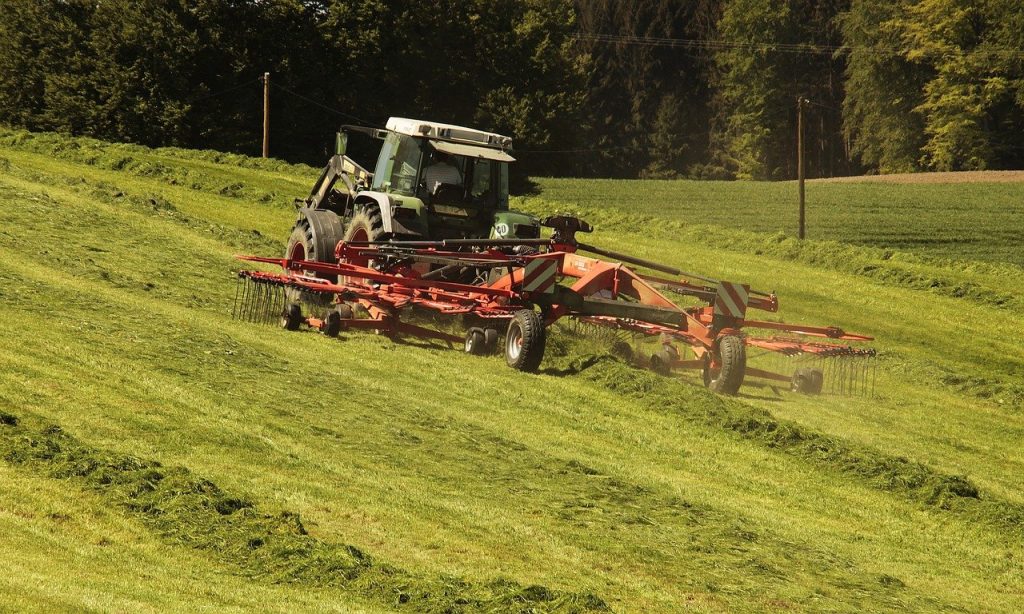
The key point to understand is that there will be a loss of dry matter and quality when making hay through the preservation/curing process.
Even if the most ideal conditions are met during the cutting, curing and baling processes, the quality of the hay will be diminished compared to the starting grass/legume material. The forage harvest loss can be up to 25% of dry matter through mechanical harvesting alone. What this means is that hay will never be as abundant and nutrient-rich as the forage was at the time of cutting.
When the grass is cut at 80% moisture, the grass is still chemically active and will utilize some of its stored sugars for metabolic activity as it dries. Not to mention that the microbes present will also assist in the breakdown of the cut material until the preservation conditions are met.
On average, you want to have hay preserved at less than 20% moisture. To be more specific: small squares need to be 20% or less; large round, 18% or less and large squares, 16%.
A forage test analysis will give you the percentage of moisture present in a bale.
The approximate two to three days of curing the hay to bring that moisture level down — as the plant is metabolizing energy and the microbes are breaking down the sugars and proteins — contribute to the quality degradation and dry matter losses in creating the hay bale.
Most of the nutrients will be preserved when the forages in the hay dry down to below 20% moisture, but there is still a slight loss even at storage.
A good rule of thumb is that you should expect a 1% DM loss per 1% decrease in moisture even after baling.
To maximize the nutritional concentration of the forages used to make hay, we need to maximize the grass quality at the start and make the transition to the preserved state with the minimum amount of nutrient degradation.
Rain doesn’t help
Unpredictable and isolated storms complicate the situation. Typical quality losses from an inch rain event can average 1.5-2% crude protein, 4-8% increase in neutral detergent fiber and a drop of 5-10% in total digestible nutrients.
Dry matter losses are closely tied to the initial moisture level of the forage that was cut during that one inch of rain.
If it starts raining right after you mowed a field, that is less damaging than if it rains right before baling. If it rains early in the forage curing process, when the grass is around 70% moisture, one should expect about a 10% loss in DM; at 50% grass moisture, that rain event will lead to an approximate 20% loss, and at 30% moisture, expect about a 30% loss in DM as well. These losses in both quantity and quality can make a major impact on the nutritional needs of your livestock.
With so much uncertainty, a forage analysis can shed light on what you have stored for winter feeding.
Most county extension offices have a hay probe that can be used, and extension educators who can help you interpret the results.
This process can remove at least part of the uncertainty in your production and give you a better calculation of your harvest and potential profits. Forage analysis can also be utilized in hay that was made outside the farm.
Every year, farm owners deal with uncertainty in a variety of different ways. But if we use the tools that are available to us, we can mitigate issues before they become problems.