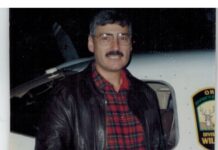

Wildlife Officer Darin Abbott serves Ohio as a wildlife officer in the southern portion of the state, but his time isn’t all chasing poachers and promoting wildlife conservation. Sometimes he’s able to spend a little time having some fun while freezing his fingers and toes numb.
Now, I’ve never been much of a duck hunter. Something about driving to the local — or not so local — hot spot and setting decoys before the sun even thinks about peaking over the horizon just never seemed to excite me like a wade in a trout stream.
Toss in that ducks, and therefore duck hunters, like cold, overcast, wind-driven rainy or snow squalling predawn mornings, and you soon understand that there’s an amount of peculiar dedication required. Abbott happens to be one of those dedicated people.
One January, Abbott and a black Labrador named Gunner were huddled in hiding near the Ohio River, hoping to decoy some southbound ducks. A few ventured in their direction, and he was able to take a fat mallard drake. Not really an atypical situation, at least until the bird was in his hands. That’s when he noticed the leg band.
Miner history
This mallard was something special, a Miner bird. The big drake was carrying a chronicle of conservation on its leg. It had been banded at the Jack Miner Bird Sanctuary in 2007, making the duck at least 12 years old when it crossed paths with Abbott and Gunner. Miner tagged birds are very special, and to understand why, we have to do a little time-traveling.
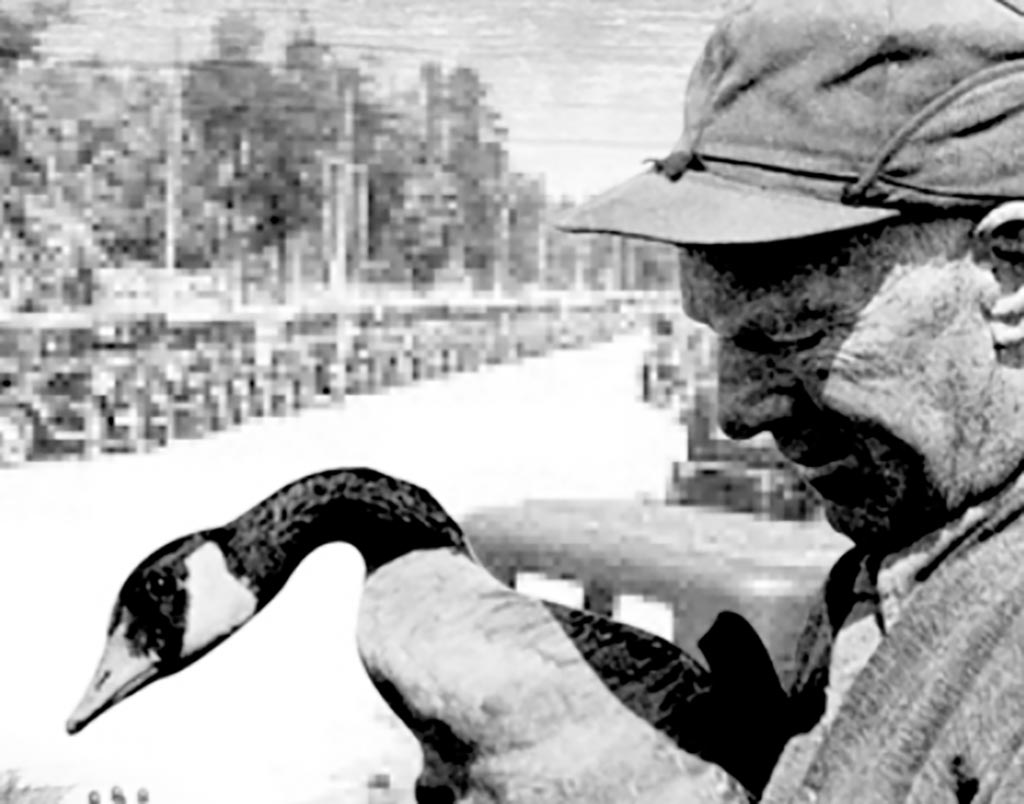
Born in Dover Center (Westlake), Ohio, Jack Miner’s family moved to Kingsville, Ontario, Canada, in 1878. Making a living was tough, so he helped to supplement his family’s income through trapping and hunting. He didn’t receive a formal education and was illiterate until he was 33 years old.
As is true of many sportsmen, he developed an interest, some might say a love affair, with the wildlife that helped him through those early years. Miner’s Christian upbringing was instrumental in how he viewed wildlife, deeming that humans were charged with playing an active and protective role in conservation and ecological preservation. He believed in a practicing stewardship born of belief, understanding and love.
Experimenting
He began experimenting with brush shelters for upland species, furnishing spare grain to quail and raising pheasants. The Canada geese he saw during their migration soon caught his interest, enough so that he built a pond in the hope that some might call it home. It took nearly four years, but a few settled in and reared their young. Some folks labeled Miner “Wild Goose Jack” for what many then deemed as seemingly eccentric ideas.
It was 1904, and Miner wasn’t discouraged by those who questioned his actions. He was a man with an idea — an idea that would impact the future of all waterfowl conservation. By 1911, both geese and ducks were arriving in large numbers, and he continued to experiment by adding more ponds of various sizes, depths and a variety of accompanying vegetation.
He began to see what helped waterfowl flourish and how the birds fit into these habitats that he was creating. It wasn’t just the ponds or his work; it was his ability to view the land as a duck or a goose would, to see it as a home, to understand.
Government funding
Ontario’s governmental representatives saw the significant improvements Miner’s efforts were producing and began to help fund his work. This allowed him to add evergreen, nut-bearing trees and shrubs; to dig more ponds, and to surround them with wind-sheltering groves, shelterbelts and food sources.
Miner designed the first reliable methods of harmlessly trapping waterfowl for examination, allowing him to begin his studies of the routes ducks and geese use to journey across the hemisphere. He made his own hand-stamped aluminum bands that could be attached to his catch’s leg before release. Each had its own identifying number and instructions about how to contact him with the information.
Feeling blessed to be able to help conserve what he saw as the future of waterfowl, he found a way to express his beliefs. Miner added a simple Biblical quote to each of the bands that were attached to the legs of these avian travelers. Ducks and geese wore a different verse, and he changed the scriptural passages annually.
In 1909, he got his first band return. Recovered in Anderson, South Carolina, it marked the first complete record of banding a migratory bird. His first inscription, “With God all things are possible – Mark 10-27,” now seemed to witness that his conservation work was in some ways prophesied.
Wild Goose Jack was nobody’s joke. His banding helped decipher the pathways used during waterfowl’s migratory travels, and his work was instrumental in the development and signing of the U.S. Migratory Bird Treaty Act of 1918, an agreement between six nations that made it illegal to capture, sell or kill certain migratory birds.
Miner spent his life as an outspoken proponent of waterfowl conservation and for the establishment of sanctuaries and wildlife refuges. He lectured about his banding, research and habitat preservation methods while promoting birding, building bird boxes and expressing his concerns of the declining ecological condition of the Great Lakes.
He wasn’t without controversy. Some of his views relating to predation often took on a moral dimension of “good versus evil,” causing a bit of an uproar in the conservation community. Even so, his work was invaluable, and many took a stand that those views were “just Jack’s.”
Legacy
While not the first person to band waterfowl (that distinction goes to American Leon J. Cole), Miner must be considered the earliest success story in documenting waterfowl travel patterns and flyways.
Wild Goose Jack died in 1944, but his legacy lives at The Jack Miner Bird Sanctuary located near Kingsville in Essex County, Ontario. Resting on a peninsula between Lake Erie to the south and Lake Saint Clair to the north, the sanctuary is 10 miles away from Point Pelee National Park, which Miner helped to get designated in 1918.
During his life, Miner banded over 50,000 ducks and 40,000 Canada geese — and banding continues today within the sanctuary. His tradition of including a Bible verse on the bands has also been followed. Hunters, birders and biologists continue to share a special place in their heart for the birds, the bands and for the love that Jack Miner so fervently shared for waterfowl.
Today, the Jack Miner Migratory Bird Sanctuary is still operating in Kingsville, Ontario, Canada. During the spring and the fall, the grounds will be filled with birds passing through the area, using the wetland habitat as a safe resting place for food, water and shelter. The sanctuary was once rated the second greatest tourist attraction in Canada, with Niagara Falls being the first.
This historic conservation area gives birders the perfect opportunities to spy on a variety of species, especially during the spring and fall migrations. You can also walk the trails, picnic, feed the birds, visit Miner’s historic home, museum and other buildings, or join one of the many available programs. You can even bring your mitts and toss a ball around on Ty Cobb Baseball Field — yes, that Ty Cobb. He and Wild Goose Jack were good friends and hunting partners. He built the field to encourage outdoor sports and for some impromptu games starring the Georgia Peach. Cobb would often gift Miner tickets to watch him play in Detroit during his 22 years as a Tiger.
Now you can understand how special that fat mallard drake was to wildlife officer, hunter and lifelong conservationist Darin Abbot. You can learn about Jack Miner and his beloved birds by visiting www.jackminer.ca — it can also help you plan a visit to his original home, museum and historic conservation grounds.
“As long as there is such a thing as a wild goose, I leave them the meaning of freedom.”
— Gene Hill