

The transition from mild autumn temperatures to winter’s chill has signaled the start of the forage dormancy period and hay feeding season is upon us.
A few weeks ago, my colleague Ted Wiseman authored an “All About Grazing” article detailing the findings of a statewide hay testing program conducted by The Ohio State University Extension. He reported that the average quality of the samples submitted will not be able to meet the nutritional needs of most ruminant livestock in late gestation or lactation. Producers that were forced to make low quality hay will need to provide targeted supplementation throughout the winter-feeding period.
While we will always recommend you consult a nutritionist, small producers may not have access to this resource. A Pearson Square is a simple method to calculate a livestock ration when using a few ingredients.
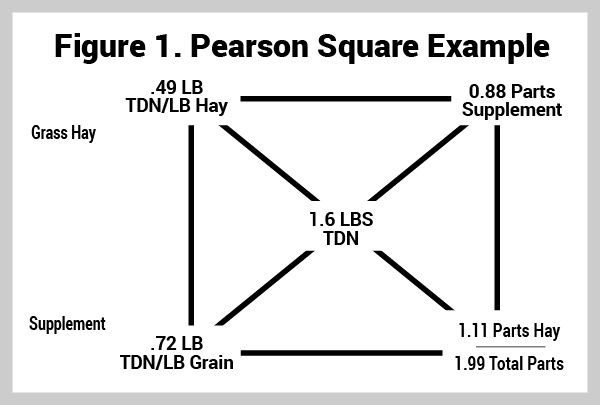
Example Pearson Square. Figure 1 is an example use of a Pearson Square to balance a ration, based on Total Digestible Nutrients for a 176-pound open ewe.
Using the Oregon State University Extension publication “Nutrient Requirements of Sheep,” we see that a 176-pound ewe will eat approximately 2.9 lbs of dry matter every day and that diet needs to provide 1.6 pounds of TDN. You will be feeding grass hay that is 84% DM with a TDN of 49.28%, and a commercial grain supplement that is 89% DM with a TDN of 72%.
How to use a Pearson Square
1. Determine the pounds of TDN in one pound of hay and supplement. The grass hay is 49% TDN, and the pelleted grain supplement is 72% TDN.
100 lbs of your grass hay contains 49 lbs of TDN. One pound of grass hay contains 0.49 lbs of TDN (49 ÷ 100 = 0.49 lbs/lbs hay).
100 lbs of pelleted grain supplement contains 72 lbs TDN. One pound of grain supplement contains 0.72 lbs TDN (72 ÷ 100 = 0.72 lbs TDN/lb grain).
2. The value in the middle must be between the values provided on the left side of the figure. In this example 1.6 lbs is the requirement, 0.4928 lbs is the TDN of the grass hay, and 0.72 lbs is the TDN of the pelleted grain supplement.
3. Ignore any negative numbers when subtracting
4. Subtract the nutritional value from the nutritional requirement along the diagonal
1.6 – 0.49 = 1.11 parts grass hay
1.6 – 0.72 = 0.88 parts grain supplement
5. Add the parts of each ingredient and divide by total to determine percent of each ingredient to comprise the diet.
1.11 + 0.88 = 1.99 total parts
1.11 ÷ 1.99 X (100) = 56% hay
0.88 ÷ 1.99 X (100) = 44% grain
6. Determine the amount to feed your ewe, on a DM basis, if she is going to eat 2.9 lbs of DM each day.
2.9 lbs X .56 = 1.6 lbs hay
2.9 lbs X .44 = 1.2 lbs grain
7. Check your math.
1.6 lbs hay X (49% TDN ÷ 100) = 0.78 lbs TDN
1.2 lbs grain X (72% TDN ÷ 100) = 0.86 lbs TDN
A 176 lbs ewe requires 1.6 lbs TDN each day
0.78 + 0.86 = 1.64 lbs TDN
8. Although rations are calculated on a dry matter basis, you need to convert from pounds of DM to pounds “as fed” to know how much of each ingredient to offer.
1.6 ÷ (84 ÷ 100) = 1.9 lbs hay “as fed”
1.2 ÷ (89 ÷ 100) = 1.34 lbs supplement “as fed”
The limitation of this method is that it only considers one requirement of your animal. I chose to calculate based on TDN because the determination of TDN incorporates several factors. Using TDN will not ensure that all your animal’s requirements will be completely met.
We can check if this ration satisfies other nutrient requirements. A 176-pound ewe needs to consume 0.27 lbs of protein each day when at maintenance. If the grass hay is 9.75% crude protein, and the grain supplement is 12% crude protein, we can determine the total pounds of protein provided at the recommended feeding levels.
• 1.6 lbs hay fed X (9.75% CP ÷ 100) = 0.156 lbs CP from hay
• 1.2 lbs supplement X (12% CP ÷ 100) = 0.14 lbs CP from supplement
• 0.156 + 0.14 = 0.296 lbs CP, which slightly exceeds her requirements
Again, this ration balancing method cannot ensure all requirements have been satisfied. If possible, consult with a nutritionist to develop a diet that meets all of your livestock’s nutritional needs. The University of Maryland provides a great resource for management of small ruminants (sheepandgoat.com). They provide several useful spreadsheets for balancing sheep and goat rations under the resources tab. Oklahoma State University Extension publication E-974 provides the nutrient requirements for beef cattle. They also have several useful ration calculation spreadsheets at extension.okstate.edu/programs/beef-extension/calculators/.