




One of the biggest problems faced by fireplace cooks in the early Ohio country was something that today’s chefs largely take for granted, that being the ability to control cooking temperatures. Modern cooks just dial the desired heat setting on their cooktops and ovens and forget about it. But for the pioneer trying to cook over flames and beds of hot embers using heavy cast iron pots, cauldrons and griddles, the process was anything but simple. Because the temperature fluctuated minute to minute, constant adjustments with the cooking apparatus were required.
Since early 19th-century cooks could not control the amount of heat coming off the flames or embers, they had to rely solely on being able to control the proximity to the heat source of the cooking vessel itself. Thus, the closer to the heat, the hotter the temperature and the quicker the food in the vessel would heat.
Controlling heat
One type of control that the pioneer cook had at his or her disposal was trivets, the creation of which was largely the domain of the village blacksmith, who wrought them out of iron.
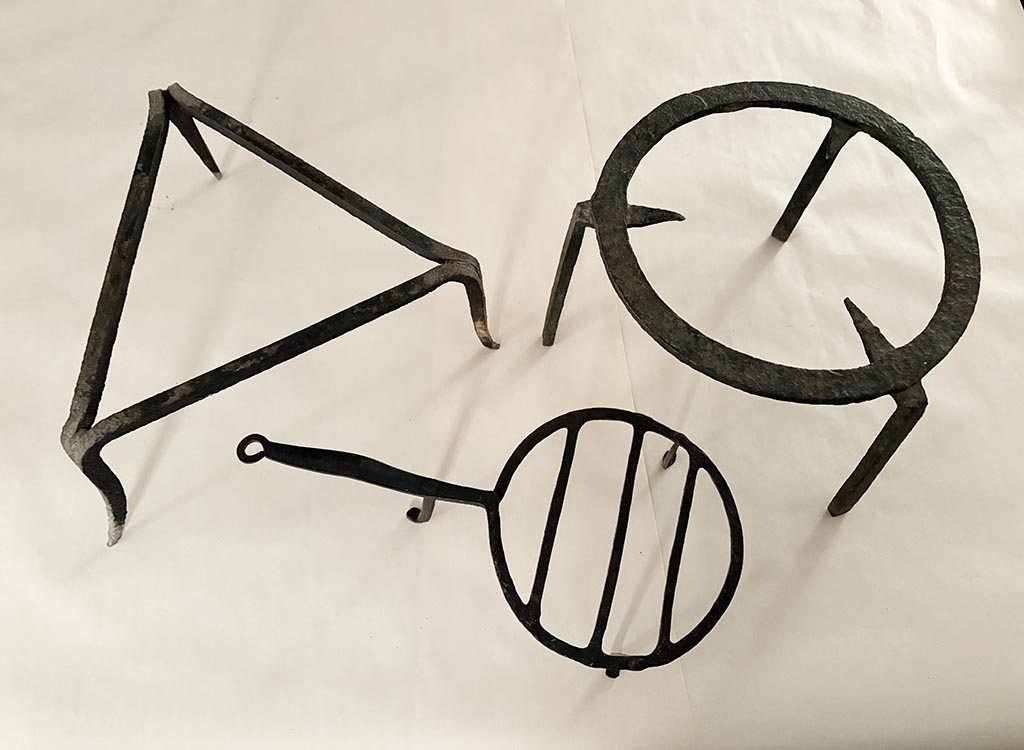
Trivets, introduced into the colonies from England in the 17th century, were simply platforms having, as the name implies, three legs. Trivets were crafted in a wide range of sizes and configurations, with the heights ranging from a few inches to the better part of a foot in height. They can be divided into two distinct classifications: wrought first and later cast iron. Those categories can, in turn, be broken down into trivets that were used in the fireplace for cooking purposes, and those that were used on the table to hold hot dishes or hot clothes irons.
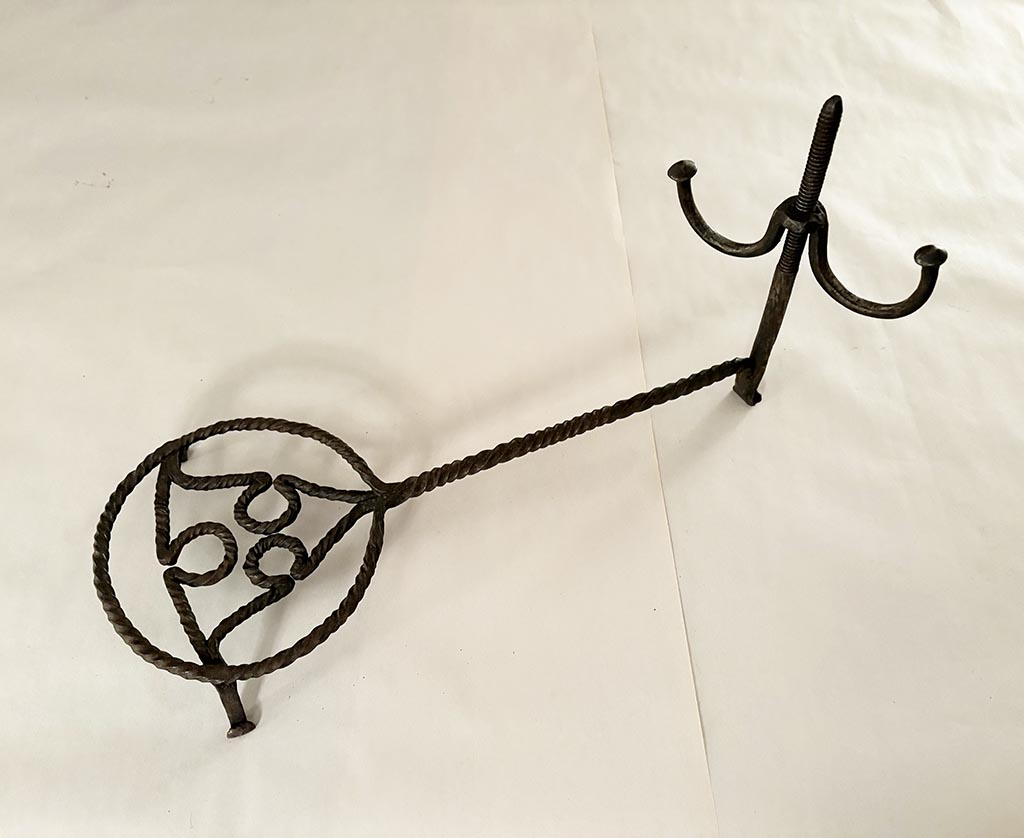
The vast majority of trivets utilized in the fireplace had a round or triangular flat surface as the top, which could accommodate an array of cooking utensils set upon it. Legs were generally made of thin, rectangular bars of iron, often splaying outward to provide greater stability. Occasionally, examples in which the feet curl upward at the ends or were hammered into so-called “penny” feet are found. Sometimes the trivets integrate an adjustable device to support the handle of a cooking vessel.
Such fireplace trivets rarely incorporate any decorative elements per se beyond occasional twists in the metal. Thus, they are seldom elevated into the ranks of folk art accorded to other handcrafted pieces of fireplace cooking equipment.
Dangers
Trivets were placed on the hearth over mounds of hot coals, lower or higher depending on the food being cooked. It was not unusual for there to be multiple dishes cooking over piles of coals on the hearth at the same time. While this might have increased cooking efficiency, it also made the hearth a far more dangerous environment for the lady of the house doing the cooking. Floor-length dresses worn by the women often dragged through these embers as they worked back and forth among the various vessels cooking over trivets. History is fraught with stories of women whose dresses went up in flames, causing tragic — and all too often fatal — burns.
On the table
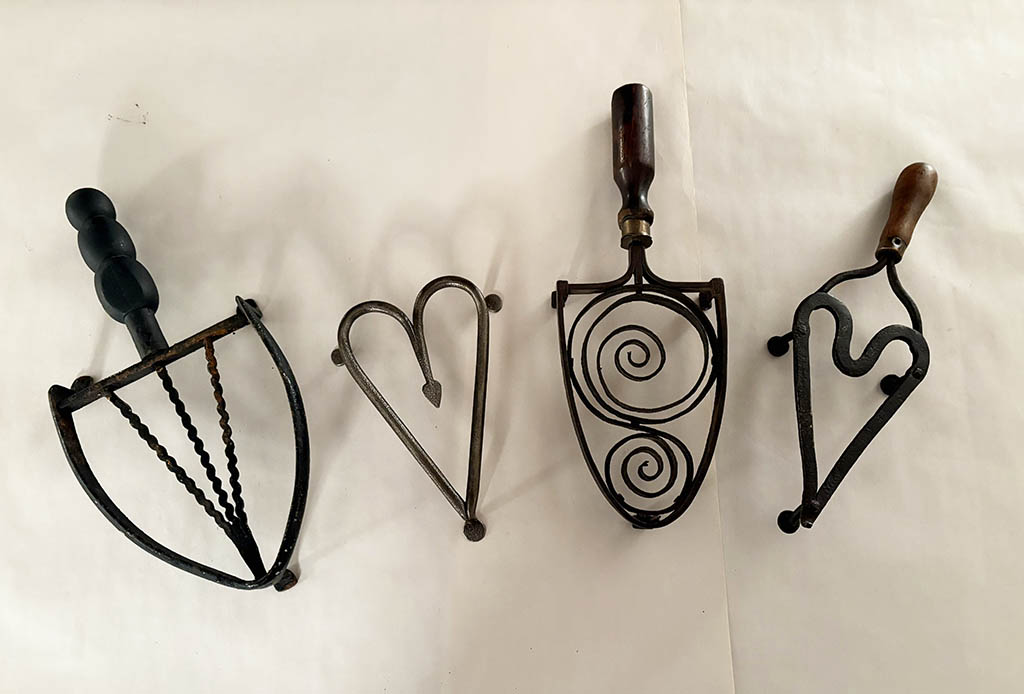
Tabletop trivets, however, were something different, since they were made to be seen, unlike their hearth counterparts. The earlier tabletop trivets were invariably made of wrought iron and crafted by the blacksmith to show off an array of his artistic and metalworking acumen. Often being round or boat- or heart-shaped, these trivets were imaginatively designed. Within the frame of the tabletop trivet could be found a wide range of curls, twists, zig-zags and curved bars of endless variation. Many of these trivets had decorative handles as well, either being wrought as an integral part of the body of the trivet, or having lathe-turned wooden handles which were fastened onto the iron frame.
By 1830, as the use of the cooking fireplace was giving way to stoves, decorative cast iron trivets became the rage, and by the 1850s had almost completely replaced their hand-wrought counterparts.
These trivets flooded into the Ohio country, largely from foundries in Philadelphia, Lancaster and Pittsburgh, as well as from many other locales. At each foundry, designers had their own unique ideas; thus we see these tabletop trivets incorporate vast variations using such motifs as hearts, stars, hex signs, scrolls, laurel wreaths, sunbursts, lyres, eagles, diamonds, foliage and flowers, classical feminine motifs, fylfots, tulips, serpents, birds, political figures, horseshoes, initials and names, advertising missives, dates and much, much more.
For the next century, the popularity of these trivets waned remarkably little as housewives continued to use them to rest their electric irons and hot casserole dishes on.
Even today, you can still find reproductions of these cast-iron trivets for sale in souvenir shops across the country, often continuing to be cast from the original molds developed so long ago.