





SALEM, Ohio — Ohio’s hemp industry is struggling to chart a path forward after restrictions on hemp-derived products took effect in March.
A state law barring any container with more than .4 milligrams of THC sold outside of a licensed marijuana dispensary amounts to a de facto ban on hemp-based products, according to experts and industry insiders.
“It’s really going to hurt,” said Chris Schluttenhofer, a Central State University researcher who has studied the crop.
Hemp never truly lived up to its billing as a cash crop for Ohio farmers. Cultivators abandoned the plant by the hundreds in the six years since hemp licenses were first issued by the Ohio Department of Agriculture. And the new law, in concert with looming federal restrictions, could destroy Ohio’s hemp industry entirely, researchers and farmers said.
Regulatory changes
Ohio and federal law once classified hemp as any variety of cannabis containing less than .3% THC Delta 9, which is the psychoactive ingredient in marijuana. However, products containing other hemp-derived compounds, such as THC A and THC Delta 8 started popping up in Ohio convenience stores and gas stations in the early 2020s.
In an effort to restrict these so-called “intoxicating hemp” products, which are not well-studied, the Ohio General Assembly passed Senate Bill 56 in late February reclassifying hemp as any variety of cannabis with less than .3% total THC. The law included a ban on any container with more than .4 milligrams of THC.
CBD sellers say the law unfairly categorizes them with less reputable products.
“Products that do not get you high are lumped in with gas station weed,” said Joey Ellwood, who owns the Uhrichsville hemp company Modern Remedies.
His company grows hemp and sells hemp-derived cannabidiol (CBD), which is often marketed as a wellness supplement.
Hemp-derived CBD and cannabis-infused beverages — which were also made illegal outside of marijuana dispensaries by the Ohio law — have already been removed from store shelves across the state.
The Ohio law mirrors language included in a U.S. Senate budget bill that takes effect in November. Hemp industry lobbyists are trying to soften national restrictions before that time, but Ohio’s rules became effective on March 20. A Sandusky judge, however, blocked enforcement of the law on April 4.
Several of the bill’s sponsors in the Ohio General Assembly did not respond to requests for comment.
Groups such as the Ohio Poison Control Centers and the Preventing Tobacco Addiction Foundation supported the bill as a way to protect children.
“The number of accidental poisonings reported to Ohio Poison Centers increased 317% since these products became widespread and poison centers developed the capability to track exposures in 2021,” The Ohio Poison Control Centers said in written testimony, referring to compounds such as THC Delta 8 and THC A. “In children under 6 years, exposures have increased over 350%.”
Growing hemp in Ohio now
Growing cannabis without THC is an arduous task, Schluttenhofer said. And classifying products like CBD as marijuana means they will be subject to tracking restrictions and other expensive and time-consuming regulations, he noted.
“Processors aren’t going to be able to make a product they can sell,” Schluttenhofer said.
The number of hemp growers in the Buckeye State is already a fraction of what it used to be. The Ohio Department of Agriculture issued more than 500 hemp licenses in 2020, the first year those licenses were available. Last year the agency issued less than 50. The Ohio Department of Agriculture turned over hemp licensure to the USDA this year.
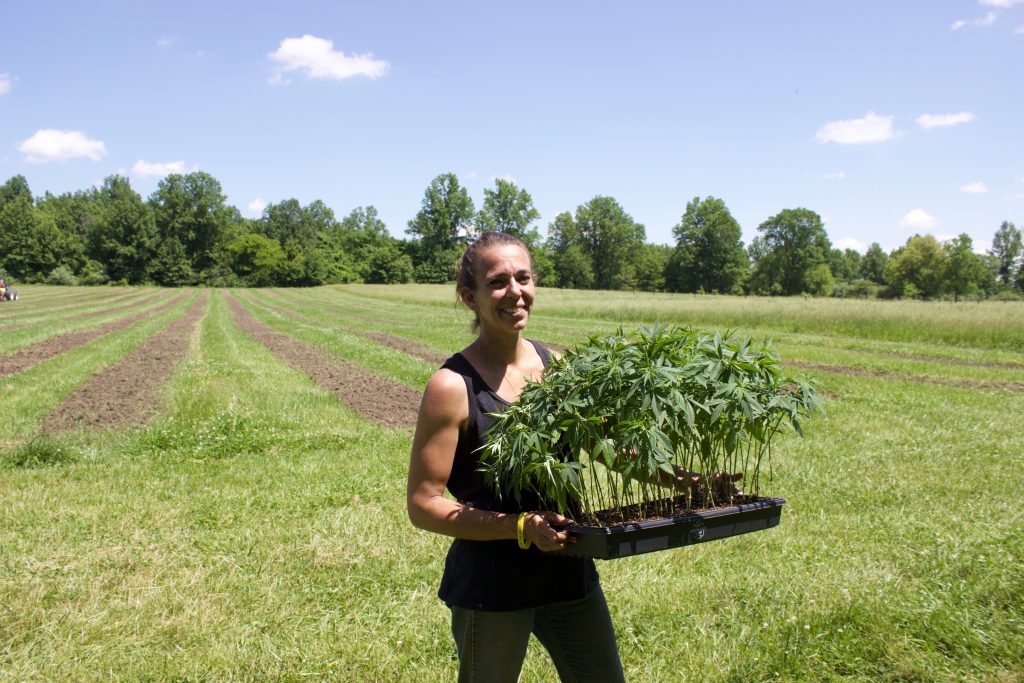
Julie Doran, who owns Meigs Fertilizer in Portage Lakes, stopped growing hemp after she was unable to find many buyers for her crops.
She also headed a hemp advocacy group, which dwindled in membership through the years and was eventually dissolved in 2022.
“We really overplanted,” Doran said. “We didn’t know what we were getting into.”
Farmers struggled with the crop’s complex nature, she said.
Hemp “has to be dried before it’s packaged or processed or stored and a lot of farmers didn’t have drying facilities,” Doran said. “They would mow their plants over and wrap them all together in a big round bail, and it got moldy.”
Doran still sells CBD she processed from her hemp, estimating she has enough supply for several years.
Ellwood is one of the few farmers still growing hemp in Ohio.
“The industry takes time and encouragement,” he said. “And with Ohio being an agricultural state, you would think we would have some support.”
Ellwood sees some hypocrisy in the federal restrictions that Ohio’s hemp law is based on. Medicare recently started covering some hemp-derived CBD products, he noted.
“They’re allowing seniors that benefit, but keeping farmers from taking part in it,” Ellwood said.