


I want to discuss a couple of pasture management items to think about this winter. At a recent pasture walk, Ted Wiseman, educator in Perry County, reminded those in attendance that we must be forage managers first, as opposed to livestock producers.
I know personally this can be a difficult shift in thinking to make; however, when we commit to taking care of our pastures, they will take care of the livestock. When was the last time you did a soil test on any of your pastures to check the pH and fertility of the soil? Most of our forage legumes and grasses prefer a pH of 6.0-6.8. The soil test will also let you know if the fertility of your soil is adequate for your forages.
Perhaps you practice continuous grazing. It requires the least amount of capital investment, the least amount of labor and the least planning. You simply build a perimeter fence, provide water and add livestock. They can go wherever they desire and eat their favorite forages. In this scenario, you have X number of acres and Y number of livestock. Eventually, the desired forages will be overtaken by less desirable forages or weeds, especially when conditions turn dry.
Remember that desirable grass species can only take so much abuse. For example, the growing point for orchard grass is 2 inches above the ground, so if we continually graze below 2 inches residual, we use up the reserves until there is no energy left.
By continually removing the leaves, we limit the plants’ ability to perform photosynthesis to produce the energy needed to survive. Also, as we defoliate the plant, we limit its ability to produce a deep root system. Therefore, in a continuous grazing scenario, we will eventually end up with a less desirable forage stand that produces fewer grazing days.
When the dry weather comes, it is less resistant to those conditions because the plant has a shallower root system and has had no time to rest, regrow and store energy. Consequently, when pastures reach this point, and rain finally does come, it takes much longer to recover. Often, as we have seen this year, weeds or less desirable species have taken over.
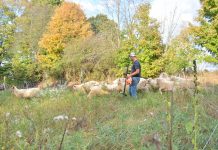
Conversely, if we have a rotational grazing plan, which admittedly requires more infrastructure (cheapest is temporary electric fence), we can manage our desirable forages to better compete with weeds and less desirable species. We control the number of livestock and how long they stay there. By controlling when they move, we can control the height of the forage when the livestock enter and the height of the residual when they leave.
For typical cool-season pasture mixes of tall fescue, orchard grass and clovers, grazing height of at least 8 inches and a stop grazing height of 4 inches would help tremendously. Just by making this residual height adjustment, when rain returns, you will see a noticeable response and improvement to your pastures. Remember, if we remove up to 40% of the leaf, no root growth has stopped.
At 50%, 2-4% of root growth has stopped. At 70% removal, 78% of root growth has stopped. If grazed down 80%, 100% of root growth has stopped (Crider, 1954). This OSU Fact Sheet is also an excellent resource with visuals and data: ohioline.osu.edu/factsheet/anr-0166.
Using a sacrifice area when conditions turn hot and dry is an excellent way to prevent further damage to your pastures. It is cheaper to fix a small portion of a pasture than to fix the whole farm. Incorporating this flexibility into your grazing plan will save most of your grazing acres in the long run. Plan to use this strategy; feeding hay for a few weeks in the summer could save your pasture stand long term.
To give pastures the best chance to thrive, focus on the management. Check fertility with a soil test if you haven’t done one in the past three years. Manage the pasture forages to favor a healthy root system using planned rotational grazing by maintaining a residual height of at least 3 inches and a rest period to allow those pastures to regrow and replenish reserves.
Using these principles, you can produce healthier, more productive grasslands. Your local NRCS office can work with you to produce grazing plans that can be extremely helpful and/or contact your local extension office.
(T.J. Wells is the Washington County Agriculture and Natural Resources Extension Educator. He can be reached at 740-376-7431 or wells.314@osu.edu.)