
This is the final part of a four-part series. Get caught up: Part 1, Part 2, Part 3.
The Division of Fish and Game, operating under the Department of Agriculture, did have its critics. Many felt that wildlife and fisheries’ interests weren’t best represented by an agricultural base.
The growing influence of the League of Ohio Sportsmen championed change, and another competing, impactful sportsmen’s group, the Izaak Walton League, joined them in that belief. It was thought that the importance of the work deserved a cabinet-level position.
The political purse-string holders were forced to listen — though many continued to hold onto the idea that the agency should remain under control of the Department of Agriculture.
The sportsmen didn’t win that battle, but seeing another administrative name change to the Division of Conservation — still beholden to the Department of Agriculture. But “conservation” was now the central theme of the division’s authority. It began to reflect a need to reevaluate how wildlife and fisheries could, should and would be handled in the future, a future still looking for clearer definition.
There was a growing link between the Division of Conservation and Ohio’s hunters and anglers. Sportsmen and the division understood the relationship as symbiotic and began working closely on a variety of projects. Both learned to value the other’s opinions, which led to a rapport that had seldom been seen between a government agency and the public.
Prompted by the popular conservation work being accomplished and the division’s successful collaboration with voters, in 1935 Ohio’s General Assembly moved to assist with funding. It began to reserve fees from the sale of hunting and fishing licenses, which would then be earmarked for the discretion of the Conservation Council. Division-owned and stocked lakes were constructed to improve fishing and other recreational opportunities. These included Madison (Madison County), Kiser (Champaign County), Harrison (Fulton County) and Van Buren (Hancock County). All four are now found within Ohio State Parks.
While many wildlife populations remained low and there still were no seasons for deer or turkey, the ring-necked pheasant was in its glory. The long-tailed, cackling rooster kept hunters excited for the return of the fall season, bolstered hunting license sales and kept bird dog breeders, restaurants and hotels busy.
Demand for information
The Division of Conservation was recognizing the need to become more responsive to hunters, anglers and the public. They were becoming known as the experts in the wildlife sciences, and the demand for information was growing. Responding to growing public enthusiasm, publication of a new monthly magazine, “The Ohio Outdoorsman,” began in 1936. In 1937, a name change was made to reflect the division it championed: “The Conservation Bulletin.” Besides how-to columns, the magazine highlighted the division’s accomplishments, projects, employees, regulations, and the artwork of Alvin “Al” Staffan, and caricatures by Bob Hines and Ed Dodd.
Al Staffin was the artist/photographer and art editor of the Conservation Bulletin and a professional nature photographer. Bob Hines began as a staff artist for the Ohio Division of Conservation during the Great Depression, leaving to become an artist with the U.S. Fish and Wildlife Service. Hines was designated “National Wildlife Artist,” the only person ever granted that distinction. Ed Dodd became a professional cartoonist in 1930. An advocate of conservation, he would create the popular “Mark Trail” comic strip.
The landmark Pittman-Robertson Act became law in 1937, authorizing that excise tax revenue from the sale of firearms and ammunition be apportioned to state wildlife agencies and be earmarked for projects related to conservation and shooting programs. This would assist state agencies by furnishing them a dedicated financial boost. Since inception, over $15 billion has been collected and awarded to states.
Once called wardens, then conservation officers, the term for the division’s law enforcement professionals was also in an evolutionary state, and they were now referred to as game protectors. Placed one per county, their 1939 paycheck averaged from $115 to $125 per month. For the first time, officers were instructed to expand their duties and teach safe gun handling, a move that would be supported by the National Rifle Association, a precursor to hunter education courses.
In 1940, the Division of Conservation required all officers to complete a specialized training program — Ohio becoming the first state to do so. This first organized academy focused upon the knowledge and skills needed for the unique enforcement position and was held at the Ohio State Fairgrounds.
World War II slowed many state agencies down. Manpower was diminished by enlistments and the draft while money and interest were diverted to wartime efforts. Although the division suffered from major manpower and material shortages, it promoted policies to encourage public interest in wildlife and fisheries management.
Deer hunting returns
In 1943, an abbreviated deer season took place in the state; the first in 50 years. Lasting from Dec. 6 to 18, the hunt was held in three counties: Adams, Pike and Scioto. Hunters were required to have a hunting license and one of the 8,500 free deer permits issued for the event.
The harvest is recorded as 168 bucks, but that number is not likely accurate. While check stations were set up to record the harvest, landowners who chose to hunt on their own property were not required to report their kill.
Mr. and Mrs. Paul Ralston of Dayton were the first to check a harvested deer which was taken at the Roosevelt Game Preserve in Scioto County.
After the war ended in 1945, things settled back into a more normal routine. Game protectors were at full strength, fisheries and wildlife managers were at work on improving wildlife areas and lakes, pheasants were still king of the uplands, fish were being stocked, grouse were becoming more common in the southeast, and deer season possibilities continued to be explored. Then something big happened.
Creation of ODNR
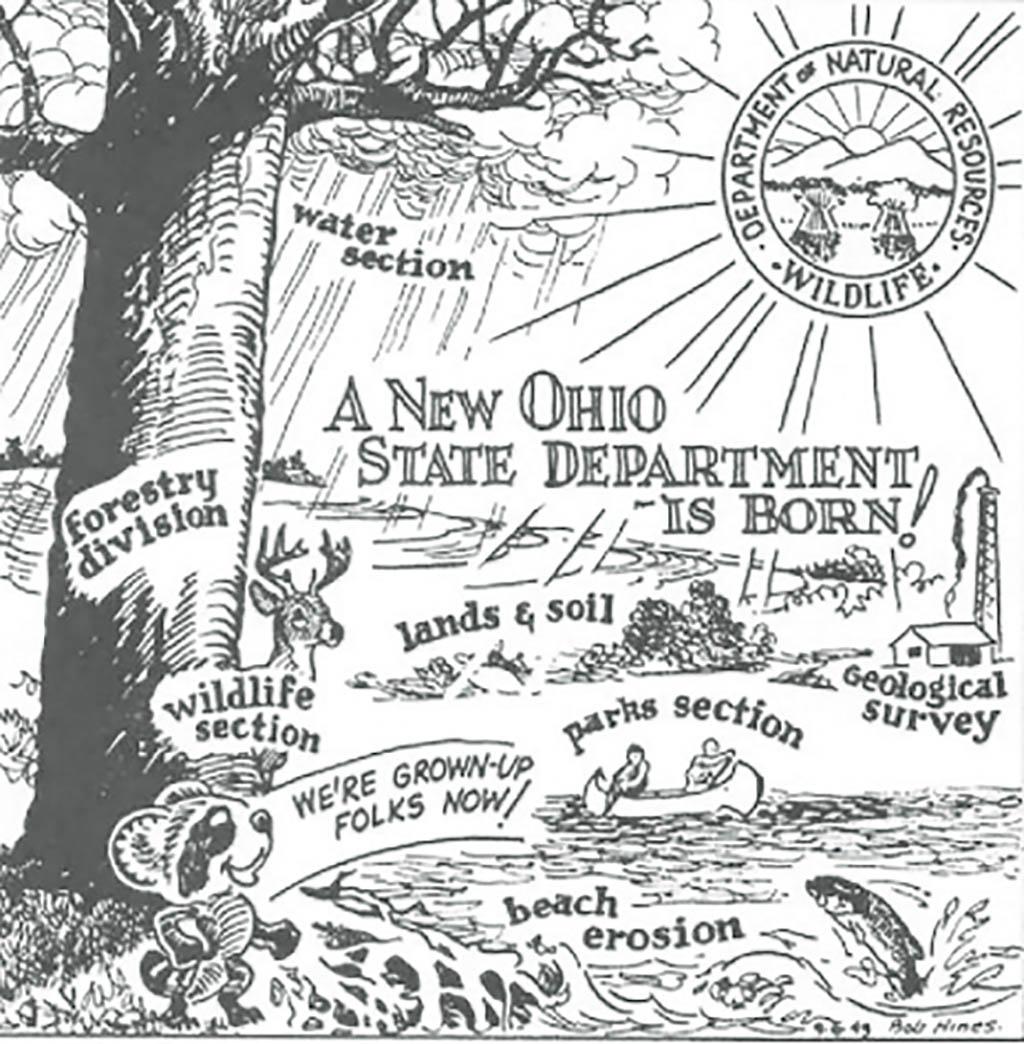
Gov. Frank J. Lausche and Ohio’s General Assembly were considering the creation of a Department of Natural Resources. Senate Bill 13 was introduced and outlined a new department that was to “formulate and put into execution a long-term comprehensive plan and program for the development and wise use of the natural resources of the state…may be assisted and encouraged.”
Lausche signed the bill into law on May 9, 1949, and appointed Alonzo Marion as the Department’s first director (In 1962, A.W. Marion State Park was later named in his honor). The bipartisan support of the bill indicates the high degree of faith that the General Assembly had in updating and supporting conservation of all of Ohio’s natural resources, a faith that has since been well rewarded. The Division of Wildlife and the Division of Parks and Recreation became the most visible of those creations.
“The nation behaves well if it treats the natural resources as assets which it must turn over to the next generation increased and not impaired in value. Conservation means development as much as it does protection.”
— Theodore Roosevelt